9 September 2017, Landschlacht, Switzerland
I am determined to not write myself into too predictable a rut.
There have been a number of themes running through the posts of this blog since I started it back on 18 May 2015.
I have written of many things: my travels in Switzerland and abroad, topics currently relevant at the time of writing, and occasional glimpses into the comedy that is everyday life.
I have started themes that have yet to be completed, like the Brontes and Brussels, my own solo travels prior to this blog, the crucial importance of Turkish politics and history, and, of course, the current political malaise that is the US Trump Administration.
After a long break from blog writing over the summer I have found two themes that interest me greatly: travelling in Italy, and the Russian Revolution and how it was shaped from Switzerland.
To keep both the reader´s attention and my creative juices flowing I have decided to alternate between these themes.
This is not to say that current events are not worthy of my attention….
They have it.
The monsoons in Bangladesh, the destructiveness of hurricanes in America, the reversal of DACA resulting in over 800,000 people forced to leave their homes in America and return to birthplaces they have never really known, the tragedy of Standing Rock and international indigenous peoples, the ongoing farce that is Brexit, the abyss of race relations in the US, world poverty, immigration and refugees, the relevance of the media in modern times, terrorism….
The list and the complexity of world events seems endless and daunting for a simple blogger such as myself to tackle.
But be patient, gentle readers, over time I shall try to weave these events and more into the ongoing saga that is the Chronicles of Canada Slim.
At present, I want to talk about a place that at first glance seems easy to ignore.
The Splügen Pass (Italian: Passo dello Spluga) is a 2,115-metre high mountain pass which marks the boundary between the Lepontine and Rhaetian Alps, respectively dividing the Western Alps from the Eastern.

The pass road connects the Swiss Hinterrhein valley and the hamlet of Splügen in Graubünden Canton with the Valle Spluga and the town of Chiavenna in the Italian province of Sondrio, the road continuing on to Lago Como.
The Pass is the water divide between the drainage basins of the Rhine, which flows into the North Sea, and the Po, which flows into the Adriatic.
On the Italian side of the Pass is the small three-street village of Montespluga, which is cut off from both Italy and Switzerland during the winter.

Above: Montespluga in summer
So the best time of year to travel this quiet pass is June to October.
The Pass was already in use in the Roman era.
The route follows historic mule trails and was recorded in the Roman Empire´s list of arterial roads as it followed an almost dead-straight link between southern Germany and Lombardy.
Path and road construction, transport services and trading traffic, spiritual exchange and creative artistic power have influenced the landscape and settlements as well as improving living standards and broadening horizons for local farmers.
The name Splügen/Spluga is possibly derived from the Latin specula (lookout).
From 1818 to 1823 the modern road was built at the request of Austrian authorities then ruling the Kingdom of Lombardy-Venetia in the south.
In 1840, English author Mary Shelley (best known for her gothic novel Frankenstein) travelled through the Pass on the way to Lake Como with her son Percy Florence.

Above: Mary Shelley (1797 – 1851)
This was not her first trip to Italy and one might wonder why she would return to a country that had seen her suffer great sorrow.
The threat of debtor´s prison, combined with their ill health and fears of losing custody of their two children, her husband Percy Bysshe and Mary left England for Italy in 1818.

Above: Percy Bysshe Shelley (1792 – 1822)
They had no intention of returning to England.
The Shelleys then embarked on a roving existence, never settling in any one place for long.
They devoted their time to writing, reading, learning, sightseeing and socialising.
Their Italian adventure was blighted by the deaths of both their children: Clara, in September 1818 in Venice; and William, in June 1819 in Rome.
These losses left Mary in a deep depression that isolated her from her husband.
For a time, Mary found comfort only in her writing.
The birth of her son Percy Florence, on 12 November 1819, lifted her spirits, though she nursed the memory of her lost children till the end of her life.
On 8 July 1822, her husband and Edward Williams set out on a return sailing journey from Livorno to Lerici with their 18-year-old boatsman Charles Vivian.
They never reached their destination.
Ten days after the storm that arose after they sailed from Livorno, their three bodies washed up on the coast near Viareggio, midway between Livorno and Lerici.
Mary eventually returned to England to raise her son.
In 1840, mother Mary (age 43) and son Percy (21), along with three of his friends, travelled together on the Continent.
This journey and a subsequent journey together in 1842 would result in the travel narrative Rambles in Germany and Italy.

Although her husband and her two children had died there, Italy had become for Mary “a country which memory painted as Paradise”.
From their home in north London, they travelled to Paris and Metz.
From Metz, they went down the Moselle by boat to Koblenz and then up the Rhine to Mainz, Frankfurt, Heidelberg and Baden Baden.
Feeling ill, Mary rested at a spa in Baden Baden.

Above: Baden-Baden
She had wracking pains in her head and convulsive shudders, symptoms of the meningioma that would eventually kill her.
(Meningioma is a tumor that attacks the brain and spinal cord.)
This forced stop dismayed Percy and his friends as it provided no entertainment for them, but because none of them spoke any German they were forced to remain together.
The group eventually travelled on to Freiburg im Breisgau, Schaffhausen, Zürich to arrive at the Splügen Pass.
She describes the Pass in her travel narrative, Rambles in Germany and Italy, published in 1844:
Chiavenna, Italy, Monday 13 July 1840
“At five in the morning we were in the yard of the diligence (stagecoach) office (at Chur).
We were in high spirits – for that night we should sleep in Italy.
The diligence was a very comfortable one.
There were few other passengers and those were of a respectable class.
We still continued along the valley of the Rhine, and at length entered the pass of the Via Mala (the evil road), where we alighted to walk.

It is here that the giant wall of the Alps shuts out the Swiss from Italy.
Before the Alp itself (the Splügen) is reached, another huge mountain rises to divide the countries.
A few years ago, there was no path except across this mountain, which being very exposed , and difficult even to danger, the Splügen was only traversed by shepherds and travellers of the country on mules or on foot.

But now, a new and most marvellous road has been constructed.
The mountain in question is, to the extent of several miles, cleft from the summit to the base, and a sheer precipice of 4,000 feet rises on either side.
The Rhine, swift and strong, but in width a span, flows in the narrow depth below.
The road has been constructed on the face of the precipice, now cut into the side, now perforated through the living rock into galleries.
It passes, at intervals, from one side of the ravine to the other, and bridges of a single arch span the chasm.
The precipices, indeed, approach so near, in parts, that a fallen tree could not reach the river below, but lay wedged in midway.
It may be imagined how singular and sublime this pass is, in its naked simplicity.
After proceeding about a mile, you look back and see the country you had left, through the narrow opening of the gigantic crags, set like a painting in this cloud-reaching frame.
It is giddy work to look down over the parapet that protects the road, and mark the arrowy rushing of the imprisoned river.

Midway in the pass, the precipices approach so near that you might fancy a strong man could leap across.
This was the region visited by storm, flood and desolation in 1834.
The Rhine had risen several hundred feet, and, aided by torrents from the mountains, had torn up the road, swept away a bridge, and laid waste the whole region.
An English traveller, a Mr. Hayward, then on his road to Chiavenna, relates that he traversed the chasm on a rotten uneven plank, and found but a few inches remaining of the road overhanging the river.
It was an awful invasion of one element on another.
The whole road to Chiavenna was broken up, and the face of the mountain so changed that, when reconstructed, the direction of the route was in many places entirely altered.
The region of these changes was pointed out to us, but no discernible traces remained of where the road had been.
All here was devastation – the giant ruins of a primaeval world; and the puny remnants of Man´s handiwork were utterly obiliterated.
Puny, however, as our operations are, when Nature decrees by one effort that they should cease to exist, while She reposes they may be regarded proudly and commodiously traversed by the antlike insects that make it their path.
We dined at the village of Splügen.

Above: Splügen in summer
It was cold and we had a fire.
Here we dropped all our fellow travellers – some were going over the San Bernandino – and proceeded very comfortably alone.
It was a dreary-looking mountain that we had to cross, by zigzags, at first long, and diminishing as we ascended.
The day, too, was drear, and we were immersed in a snowstorm towards the summit.
Naked and sublime the mountain stretched out around, and dim mists, chilling blasts and driving snow added to its grandeur.
We reached the dogana (Italian customs) at the top and here our things were examined.

Above: Spluga Pass, present day
The customs house officer was very civil – complained of his station, where it always rained – at that moment it was raining – and, having caused the lids of one or two trunks to be lifted, they were closed again and the ceremony was over.
More time, however, was consumed in signing passports and papers.
We then set off downhill, swiftly and merrily, with two horses – the leaders being unharnessed and trotting down gravely after us, without anyone to lead or drive them.
All Italian travellers know what it is, after toiling up the bleak, bare, northern, Swiss side of an Alp, to descend into ever vernal Italy.
The rhododendron, in thick bushes, in full bloom, first adorned the mountain sides, then pine forests, then chestnut groves.
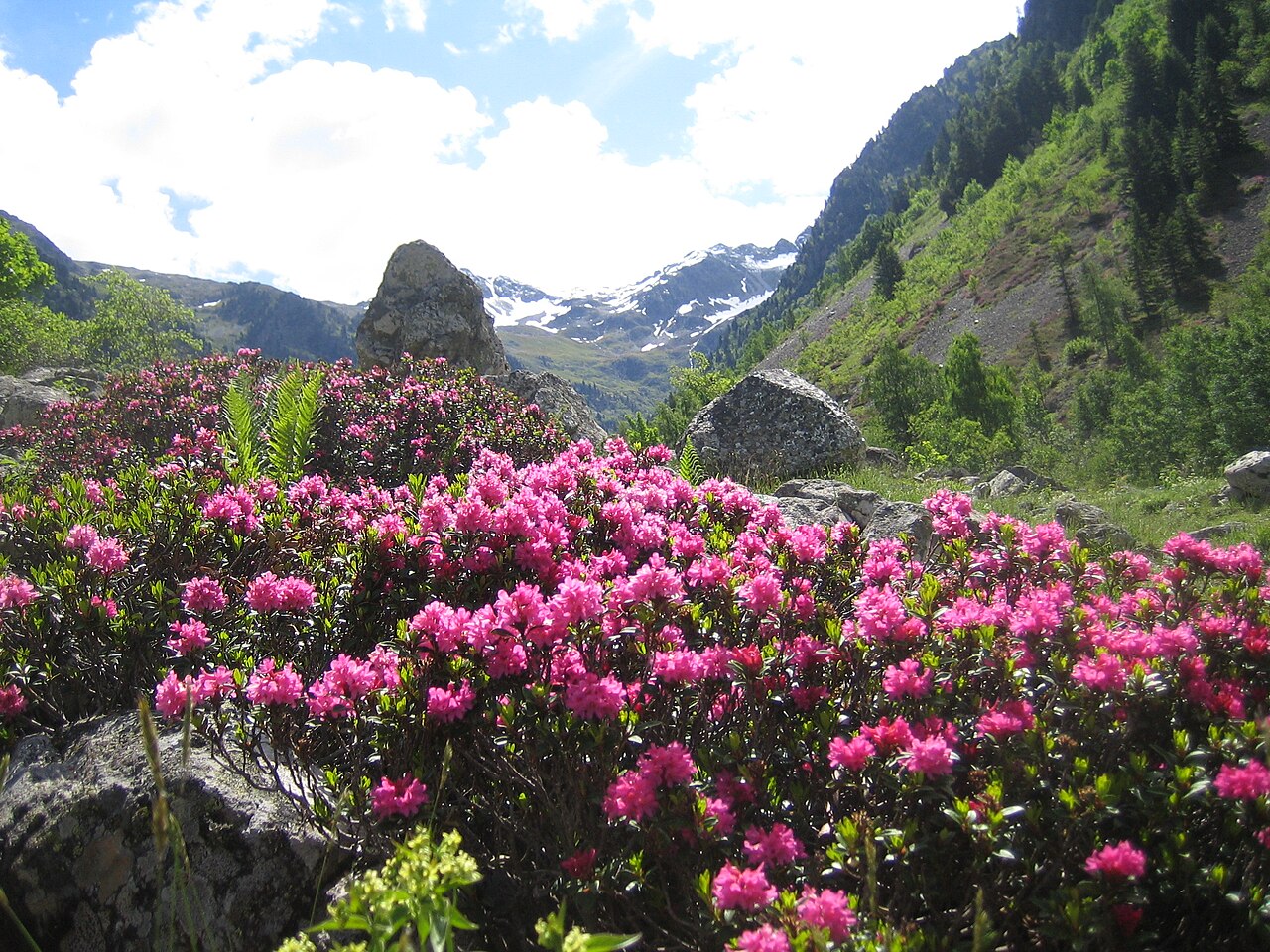
The mountain was cleft into woody ravines.
The waterfalls scattered their spray and their gracious melody.
Flowery and green, and clothed in radiance and gifted with plenty, Italy opened upon us.
Thus – and be not shocked by the illustration, for it is all God´s creation – after dreary old age and the sickening pass of death, does the saint open his eyes on Paradise.” (Mary Wollstonecroft Shelley, Rambles in Germany and Italy)
After Chiavenna, Mary and her travelling companions would spend two months at Lake Como and then go on to Milan.
In Milan, the young men left Mary to go back to their studies in England, while Mary slwoly made her way back home via Geneva and Paris.
Upon her return, she became depressed.
“In Italy I might live as once I lived: hoping, loving, aspiring, enjoying.
I am placid now and the days go by….and darkness creeps over my intellect.”
9 September 2017, Landschlacht, Switzerland
In 1843 the road was further expanded with a 312-metre/1,024-foot long avalanche gallery designed by Swiss engineer Richard La Nicca which today is out of use but largely preserved.

Above: Richard La Nicca (1794 – 1883)
Plans to build a railroad line across Splügen Pass were abandoned in favour of the Gotthard Railway opened in 1882.
The author Sir Dr. Arthur Conan Doyle as well as his beloved creation Sherlock Holmes, a creation that Doyle himself was not particularly fond of, are inextricably linked to Switzerland.

Above: Sir Arthur Ignatius Conan Doyle, M.D. (1859 – 1930)
Doyle, who spent most of his childhood and youth in boarding schools, spent some time at Stella Matutina in Feldkirch, Austria.
On his journey back home to Edinburgh in 1876, Doyle had his first contact with Switzerland.
Many years later, 34-year-old Dr. Doyle came to Switzerland in August 1893 to give a series of talks in Lucerne.
Doyle was a sporty doctor.
He had seen skiing in Norway and imported one of the first pair of Norwegian skis to Davos.
Along with the Branger brothers, Doyle scaled the saddle of the Jacobshorn in the Albula range, now served by cable car and renowned for snowboarding.
They then tackled the 2,253-metre pass between Davos and Arosa, rising at 4 am, heading to Frauenkirch, crossing the Maienfelder Furka Pass and sliding down to Arosa.
Since 2008 this area has been added to the list of UNESCO World Heritage sites, traversed by the Rhaetian Railway and by “lads leaping about on planks tied to their feet”. (Thomas Mann, The Magic Mountain)
Doyle predicted that “the time will come when hundreds of Englishmen will come to Switzerland for a skiing season”. (Conan Doyle, “An Alpine Pass on Ski”, The Strand, August 1894)
Time has proved him right.
Doyle would then travel on to Maloja and Caux with his wife.
On 6 November 1895, the Doyles left Caux for Italy.
Did he enter Italy through the Splügen Pass?
I have no information so far about his exact route.
After a few days in Rome, the family left Brindisi by ship to Egypt, where they would spend the winter in Cairo.
It remains a question of debate whether Doyle ever came back to Switzerland after his journey to Egypt and his subsequent return to his home in England.
Besides skiing, Doyle left his mark on Switzerland by setting the Holmes Story “The Final Problem” at Reichenbach Falls.

(See Canada Slim and the Final Problem of this blog.)
Splügen Pass is mentioned in Doyle`s “The Adventure of the Illustrious Client”, a Holmes story published in 1924.
“Both Holmes and I (Dr. Watson, the narrator) had a weakness for the Turkish bath….
On the upper floor of the Northumberland Avenue establishment, there is an isolated corner where two couches lie side by side, and it was on these that we lay upon 3 September 1902, the day when the narrative begins.
I had asked him whether anything was stirring, and for answer he had shot his long, thin, nervous arm out of the sheets which enveloped him and had drawn an envelope from the inside pocket of the coat which hung beside him….
…This is what I read:
“Sir James Damery presents his compliments to Mr. Sherlock Holmes, and will call upon him at 4:30 tomorrow….”
Sir James comes to see Holmes and Watson about his illustrious client´s problem.
(The client´s identity is never revealed to the reader, although Watson finds out at the end of the story, it is heavily implied to be King Edward VII.)
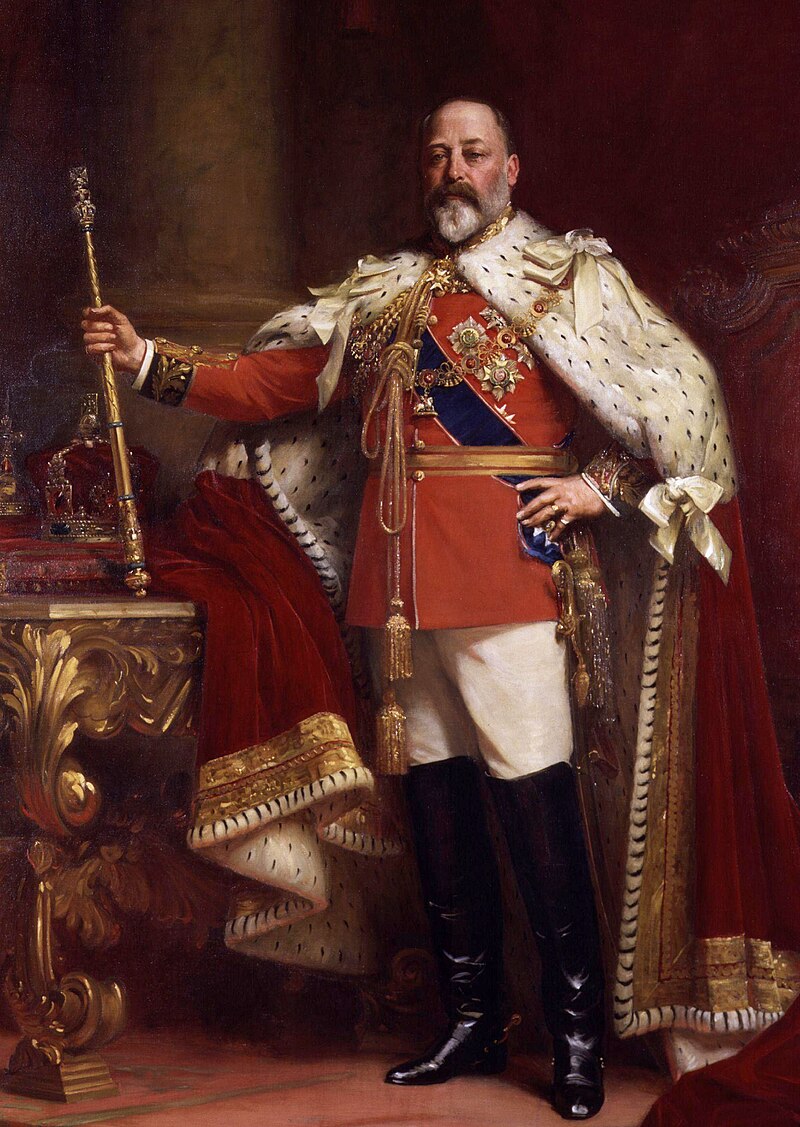
Above: Edward VII, King of Great Britain (1901 – 1910), (1841 – 1910)
General de Merville`s young daughter Violet has fallen in love with the roguish and sadistic Austrian Baron Adelbert Gruner….
Damery: “…for we are dealing on this occasion, Mr. Holmes, with a man to whom violence is familiar and who will, literally, stick at nothing.”
I should say that there is no more dangerous man in Europe.”
Holmes: “….May I ask his name?”
Damery: “Have you ever heard of Baron Gruner?”
Holmes: “You mean the Austrian murderer?”
Damery: “There is no getting past you, Mr. Holmes! Wonderful! So you have already sized him up as a murderer?”
Holmes: “It is my business to follow the details of Continental crime. Who could possibly have read what happened at Prague and have any doubts as to the man´s guilt? It was a purely technical legal point and the suspicious death of a witness that saved him! I am as sure that he killed his wife when the so-called “accident” happened in the Splügen Pass as if I had seen him do it….”
The Granada TV series (1984 – 1994), with Jeremy Brett as Sherlock Holmes, is faithful to the original story as penned by Doyle, though it takes some artistic licence regarding the Bruner wife murder.

“The Illustrious Client” shows the fallen Baroness, to whom Gruner rushes to her side, accusing him with her dying breath of pushing her off the mountainside.
The viewer sees the scene is witnessed by a young boy, whom we are told by Holmes in his interview with Sir James that he suspected that Gruner had seduced his mother to poison the shepherd boy.
In “The View from Olympus”, the 18th episode of the 3rd season of the US modernised adaptation Elementary, with Holmes as a recovering drug addict who aids the New York City police accompanied by a female Dr. Joan Watson, Holmes mentions a previous case about a man who killed his wife on the Splügen Pass and tried to make her murder look like an accident.

In this blog`s Canada Slim and the Lure of Italian Journeys, I wrote of how my wife (aka She Who Must Be Obeyed) and I travelled from our home by the Lake of Constance in Landschlacht to Chur.
“We leave the Autobahn and enter a wild land – a land of deep, narrow valleys, ancient forests, mountain torrents and villages that have seen little excitement or change since Roman times.
Past Rhäzüns and its isolated chapel of Sogn Gieri/St. George to the town of Thusis loomed over by threatening mountains and mysterious forests, the road, the Evil Road / Via Mala plunges into a narrow ravine, with sheer rock walls rising over 500 metres from the bed of the foaming Hinterrhein River.”

Above: The Chapel of Sogn Gieri, Rhäzüns
Via Mala, that ancient and notorious section of an abomination of a path along the Hinterrhein River between Zillis and Thusis in Graubünden Canton….
Via Mala, that narrow gorge that blocks the approach to two mountain sorties that defiantly declares that the traveller shall not pass….
Via Mala, so beautifully maleviolent and enchanting that the German director Werner Herzog filmed his 1976 psychological drama Heart of Glass there….

(Heart of Glass is the story of an 18th-century Bavarian town with a glassblowing factory that produces a brilliant red ruby glass.
When the master glass blower dies, the secret to producing the ruby glass is lost.
The local Baron and factory owner is obsessed with the ruby glass and believes it to have magical properties.
With the loss of the secret, he soon descends into madness along with the rest of the townspeople.
The main character is Hias, a seer from the hills, who predicts the destruction of the factory in a fire.
During shooting, almost all of the actors performed while under hypnosis.
Every actor in every scene was hypnotized, with the exception of the character Hias and the professional glassblowers who appear in the film.
The hypnotized actors give very strange performances, which Herzog intended to suggest the trance-like state of the townspeople in the story.
Herzog provided the actors with most of their dialogue, memorised during hypnosis.
However, many of the hypnotised actors’ gestures and movements occurred spontaneously during filming.)
As I look into the gorge of the Via Mala, my heart grips tightly in fear….
As we navigate the climbing hairpin curves leading to the Paradise of Italy, my heart grips tightly in fear….
For my wife is driving.
She is mostly a fine driver but give her a challenging, cliff-hanging, narrow road and suddenly she becomes a Grand Prix Formula race car driver, a Maria Andretti or a Michaela Schumacher.

Of all the duties that are split between man and spouse, my wife has assumed the role of driver.
This has never bothered me, for I had never the urge to learn to drive and as a result I believe I am a great passenger.
Perhaps because ignorance is bliss, she could drive down a one-way pedestrian street knocking over a half dozen old ladies in the process and I would not react because I foolishly assume she knows what she is doing.
Now I have read statistics that say when partners are in a car together, the man is four times likely more to drive.
And perhaps I should feel more emasculated when she is driving, but she loves to drive and I make an excellent navigator (despite what the wife says).
But cliff hanging races and breakneck curves make me reassess my masculinity and I once again, especially on this trip, wonder if I will somehow survive my marriage (unlike Baron Gruner`s wife) or make it through the Evil Road of the shadow of Death to Italian Paradise (like Mary Shelley).
Sharing a car ride with my wife is a lot like being an unwilling participant in a hostage situation – you don´t know what´s going to happen and you hope you will survive the experience.
I am reminded once again of Canadian comedian Lorne Elliott´s comments on driving through the mountains:

“Not only can you fall down these mountain things, these mountain things can fall down on you!”
The climb up to Splügen reminds me of the lacing of a corset thrusting the hills into prominence.

Corsets?
How fear emasculates!
After 20 years together there are very few off-putting things we don´t know about one another, but I have learned, the hard way, that a little paranoia is a good thing in marriage.
Normally she does not want to kill her husband….
But my wife is driving.
I am not certain whether we will arrive in an Italy that resembles Paradise or in a Paradise that resembles Italy.
I will keep you posted….

Sources: Wikipedia / Sir Arthur Conan Doyle, “The Adventure of the Illustrious Client”, The Casebook of Sherlock Holmes / Nicole Glücklich (Editor), The Adventures of Two British Gentlemen in Switzerland: In the Footsteps of Sir Arthur Conan Doyle and Sherlock Holmes / Padraig Rooney, The Gilded Chalet: Off-piste in Literary Switzerland / Mary Wollstonecraft Shelley, Rambles in Germany and Italy