Christian Friedrich Hebbel (1813 – 1863) was a German dramatist, lyric poet and novelist.
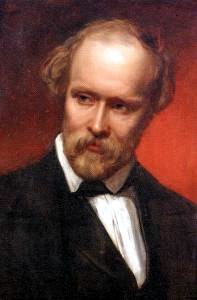
Above: Friedrich Hebbel
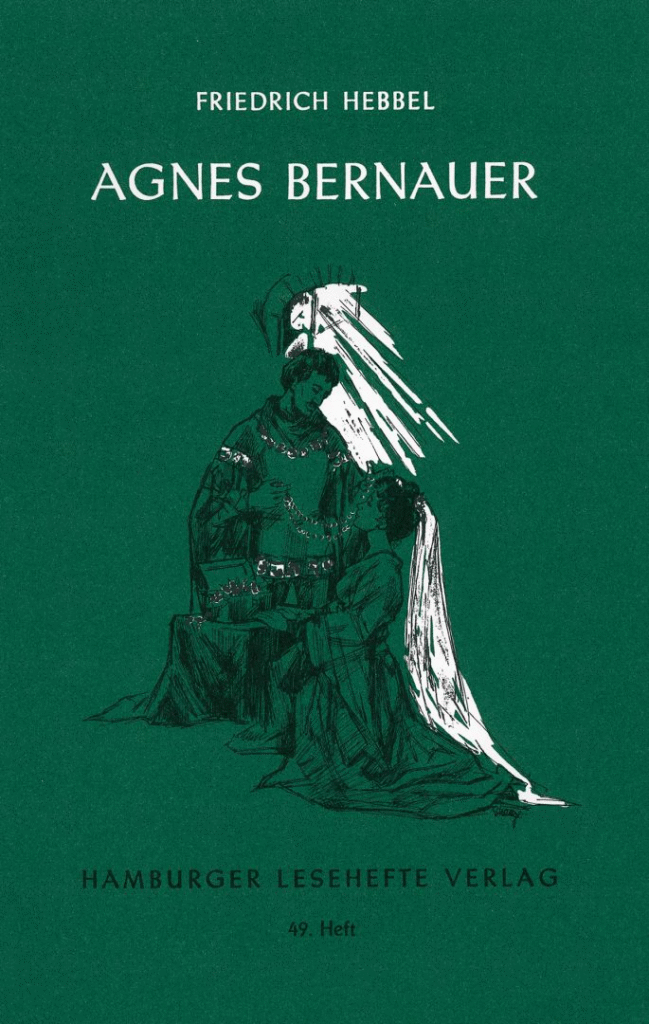
Besides his major works, the two tragedies Agnes Bernauer and
Maria Magdalena, his love poems such as Sie seh’n sich nicht wieder (They Will Not See Each Other Again) and Wenn die Rosen ewig blühten (When the Roses Bloom Forever), nature poems such as Sommerbild (Summer Picture) and Herbstbild (Autumn Picture) , as well as several ballads, including Der Heideknabe (The Heath Boy) and Liebeszauber (Love Spell) and his diaries are among the highlights of his work and of Realist literature.

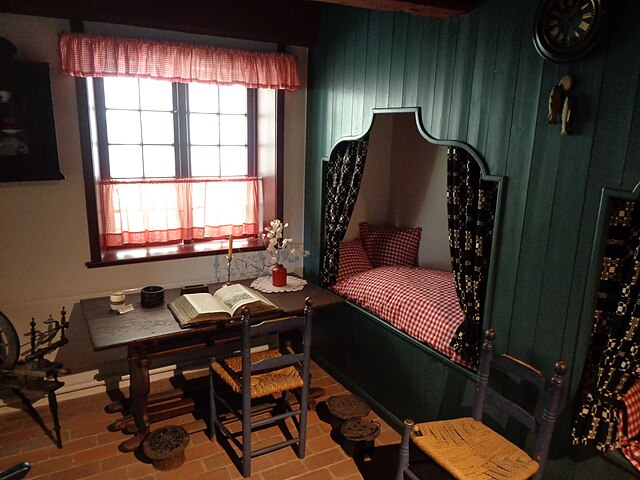
Above: Hebbel’s recreated birth room in the Hebbel Museum in Wesselburen, Germany




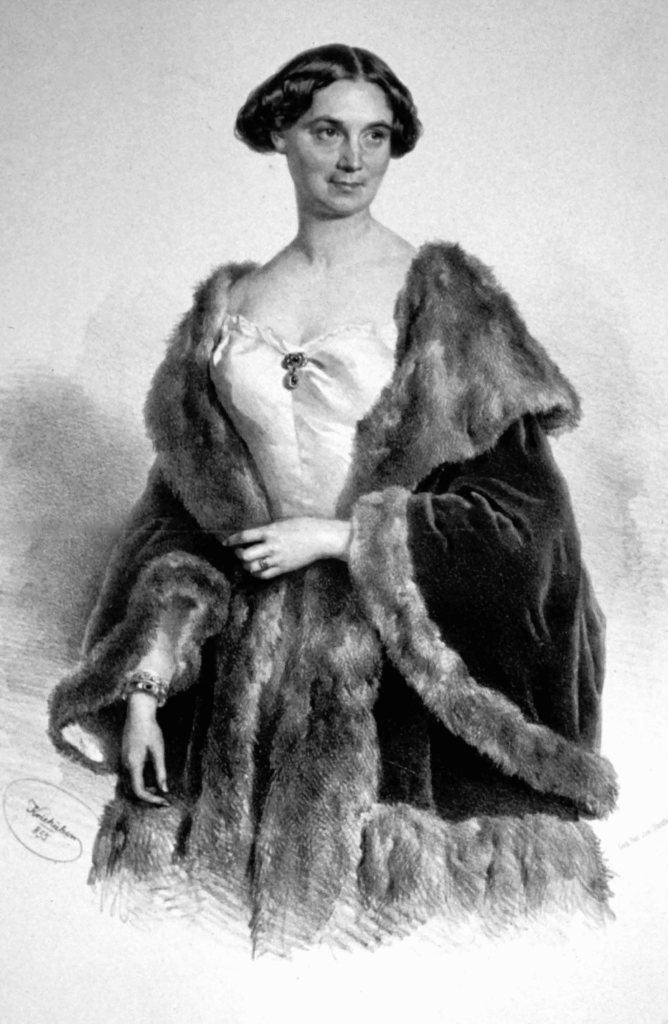
Above: Christine Hebbel
In his diary he wrote on 30 December 1846:
“I became engaged to Miss Enghaus.
I certainly did so out of love, but I would have sought to master this love and continued my journey had the pressures of life not become so heavy upon me that I had to see my only salvation in the affection this noble girl showed me.
I do not hesitate to make this confession unequivocally, however much I might lose if I had a German youth as my judge.“
Friedrich Hebbel : His Life in Texts and Pictures

Above: Hebbel’s former workplace, the writing room of the parish bailiff
His drama Die Nibelungen (The Nibelungs) represents the most important adaptation of the epic poem for the stage.

“Hebbel’s nature is harshly revolutionary, full of bitter criticism. There is little trace of the scheme that if the hero has fought for a legitimate idea, the hero may indeed be defeated, but the idea must triumph, or at least the poet must promise it victory. In murder, he is a true Shakespeare. He is most at ease when someone destroys themselves through the consequences of passion. All his heroes are stubborn fools who smash each other’s skulls in. He always portrays the passions so intensely that it is worthwhile for the poet to illuminate them and perhaps, if one understands Hebbel correctly, to excuse them.“
Sigmund Freud

Above: Austrian psychoanalyst Sigmund Freud (1856 – 1939)
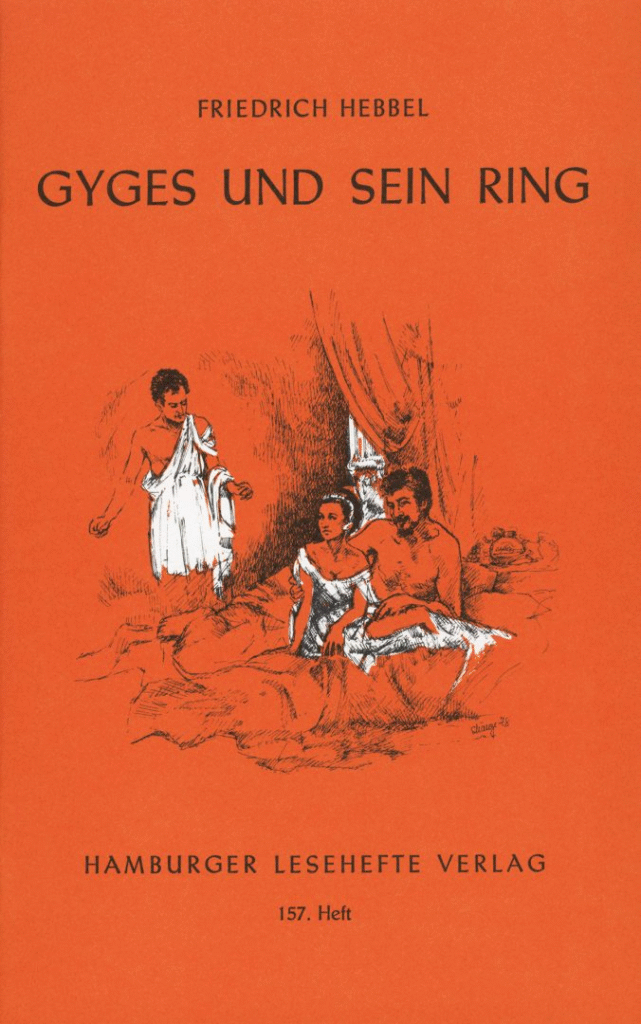
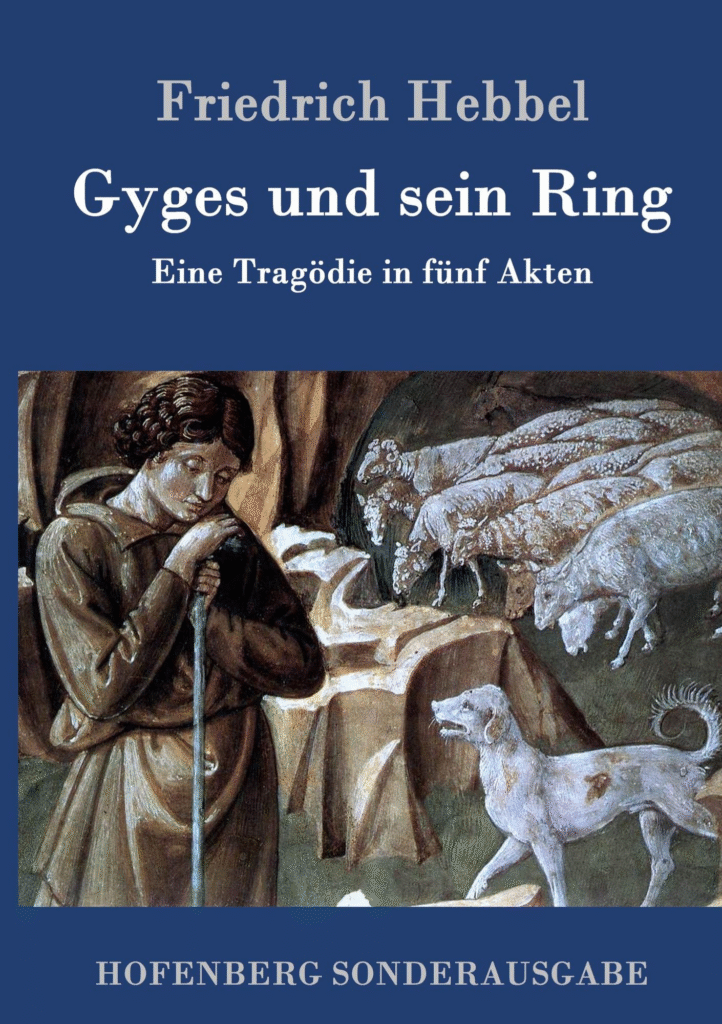
What has caught my attention recently is Hebbel’s Gyges und sein Ring (Gyges and his Ring).
It is a tragedy in five acts based on the ancient myth of Gyges (r. 680 – 644 BC) who rises to become King of Lydia – Lydia is generally located in the modern western Turkish provinces of Uşak, Manisa and inland İzmir – through a magic ring and wins the wife of his friend and predecessor, Candaulus.

Above: Map showing the Kingdom of Lydia at its greatest extent during the late reign of Croesus
Hebbel draws on the accounts of the myth as told by Plato (428 – 347 BC), Herodotus (490 – 420 BC) and Cicero (106 – 43 BC).
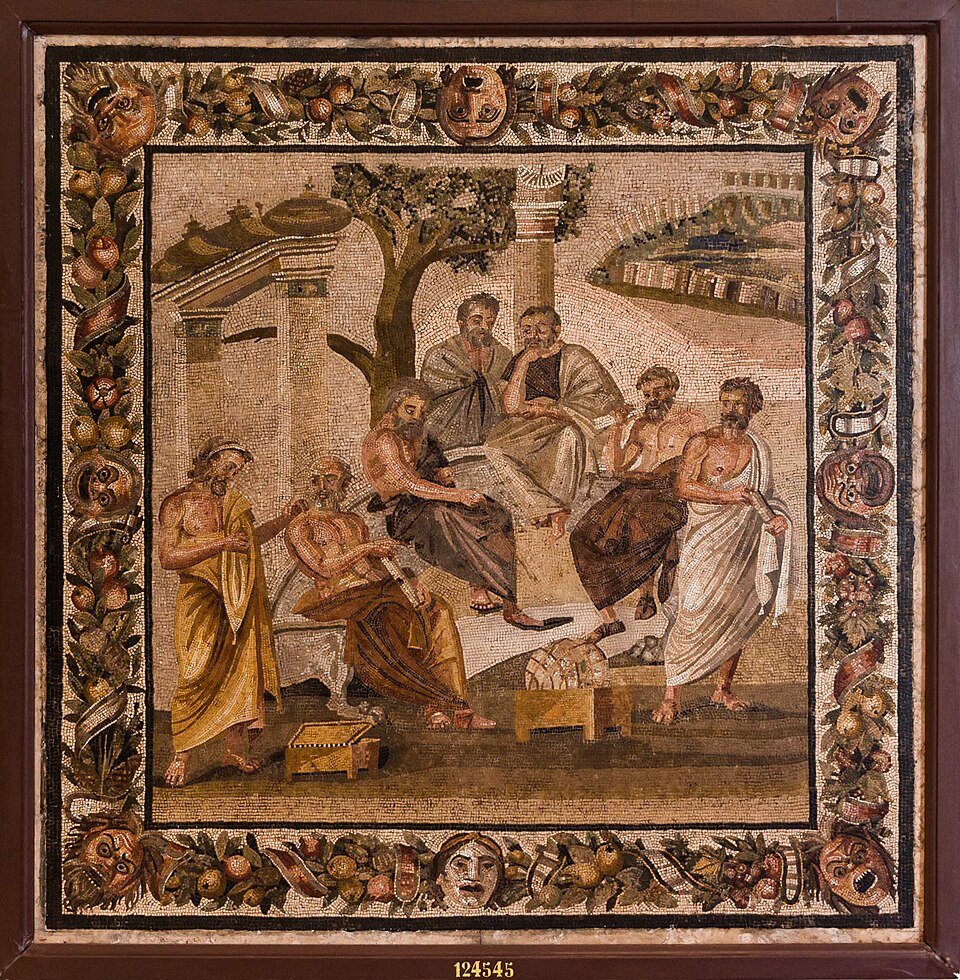
Above: Plato’s Academy mosaic in the villa of T. Siminius Stephanus in Pompeii, around 100 BCE to 100 CE, now at the Museo Nazionale Archeologico, Napoli, Italia
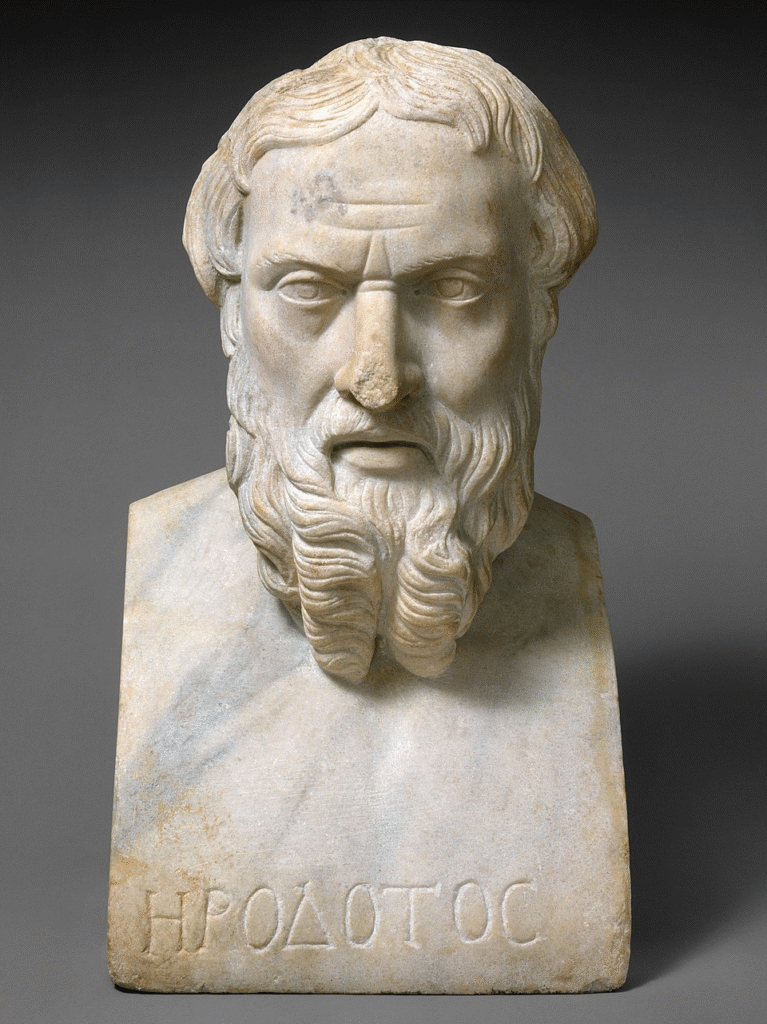
Above: Bust of Herodotus of Halicarnassus (Bodrum, Türkiye)

Above: Bust of Marcus Tullius Cicero, Château de Vaux-le-Vicomte, France
The setting is the palace of Candaules.
The action takes place over two days.
Gyges lives at the court of the Lydian King Candaules as his friend and favorite.
He gives Candaules a magic ring he once found in a tomb:
If you wear the ring and turn the stone forward, you become invisible.
Candaules is very proud of his wife Rhodope’s beauty, but she never reveals herself to anyone.
He persuades Gyges to use the ring to sneak unnoticed into her bedchamber so he can see her beauty for himself.

Above: Kandaule’s wife discovers the hidden Gyges, Eglon Hendrik van der Neer (1662)
However, Rhodope hears noises.
Candaules manages to prevent her from noticing the intruder just in time.
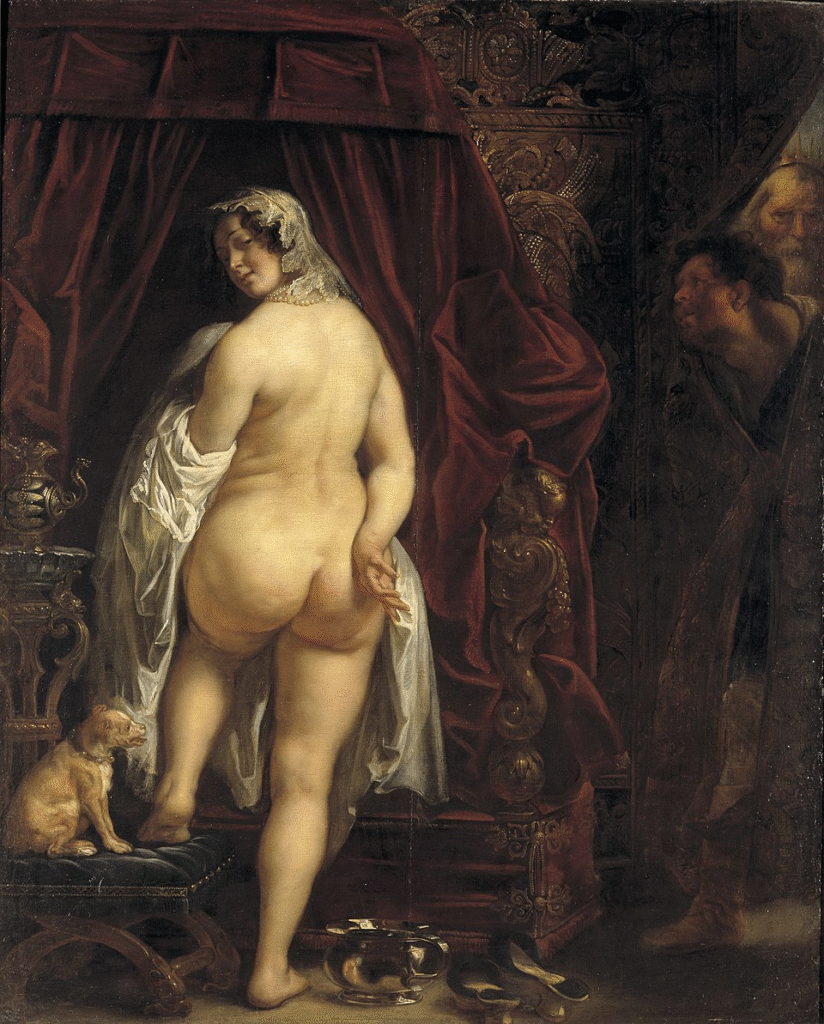
Above: Candaules Showing His Wife to Gyges, Jacob Jordaens, (1646)
Gyges immediately falls in love with Rhodope, who was unattainable for him.
He regrets his actions and leaves the King’s court.
His disappearance confirms his deed for Rhodope.

Above: Candaules, King of Lydia, Shews his Wife by Stealth to Gyges, One of his Ministers, as She Goes to Bed, William Etty (1829)
Feeling humiliated and defiled, she demands Gyges’ death as atonement, but her husband refuses.
She sends a slave to bring Gyges back.
When he reveals that the secret intrusion into the bedroom had occurred with Candaules’ consent (and in his presence), she no longer demands Gyges’ death, but rather that Gyges kill Candaules, after which she will marry him — thus washing away her shame with blood, and ensuring that no one would have seen her unclothed who was not entitled to do so (through marriage).
Should Gyges refuse, Rhodope would kill herself.
Gyges agrees.
To save Rhodope’s life, and also because he recognizes the shame of his deed, Candaules also agrees to a duel and is slain by Gyges.
The play ends with the wedding ceremony in the Temple of Hestia.
Rhodope marries Gyges, who thereby inherits Candaules’ crown.
But still in the temple, Rhodope stabs herself.
Candaulus is not evil, but he is fatally vain.
His wife’s beauty becomes a reflection of himself.
He needs someone else – specifically Gyges – to confirm his own good fortune, his own status, his own masculine triumph.
He externalizes his self-worth.
He needs an audience to validate what he has.
Rhodope becomes an object, a trophy, not a person with boundaries.
Candaulus is psychologically blind.
He commits the ultimate violation without perceiving the enormity of it.
His pride becomes a kind of self-deception, a tragic flaw reminiscent of classical Greek heroes.
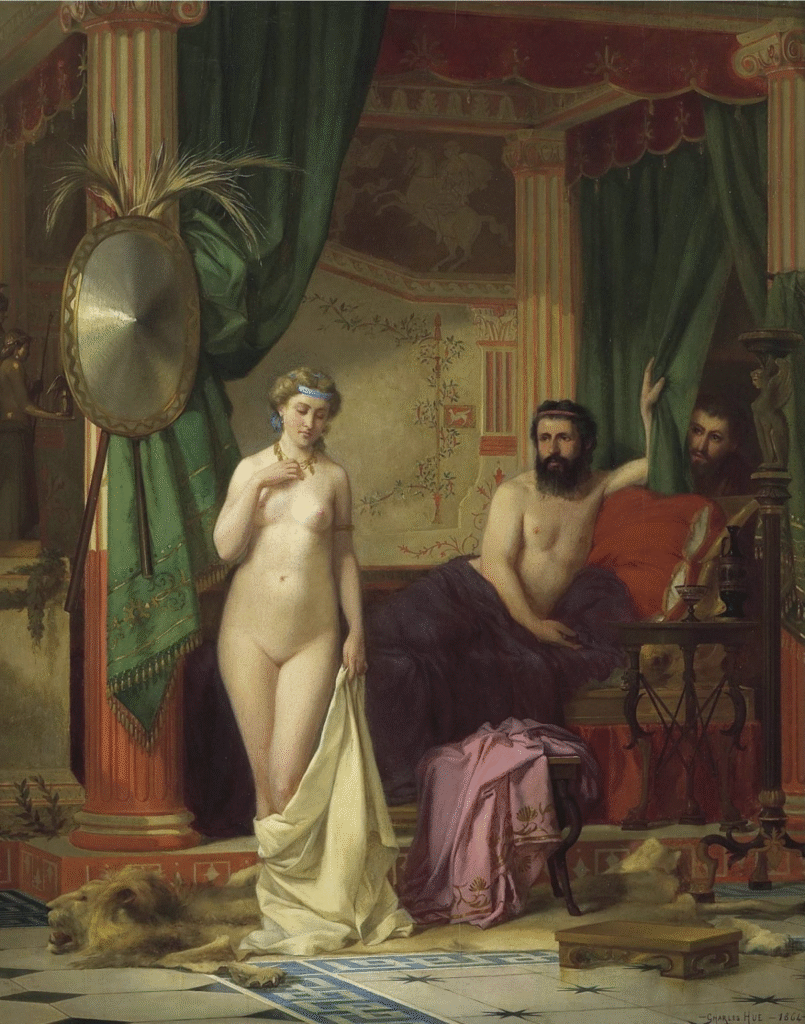
Above: The Myth of King Candaules, Charles Désiré Hue (1864)
I wonder if whether Candaulus was driven not by vanity alone, but by suppressed martial rage born of sexual rejection.
Sexual refusal within a marriage can generate a mixture of shame, resentment and self-doubt intense enough to poison the relationship.
His pride as King is wounded.
His masculinity is unsettled.
His joy in her beauty becomes tinged with bitterness.
He seeks witnesses to validate that she is his – even if he cannot enjoy her himself.

Showing her off to Gyges becomes an act of self-punishment – “If I cannot have her, someone else must see what I suffer by being denied.” – an act of revenge – “Let her feel exposed if she denies me intimacy.” – or a desperate plea for confirmation of his own desirability – “Tell me she is truly beautiful, because perhaps I am the reason she withholds herself.“.
Perhaps Candaules is less the naive braggart and more a tragic man hallowed out by longing.
(I am reminded of a scene in the 1994 film Wyatt Earp where Sheriff Behan (Mark Harmon) proudly shows off a nude photo of his girlfriend actress Josie Marcus (1861 – 1944)(Johanna Going).
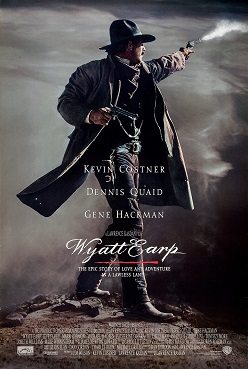
This act ends their relationship and eventually she becomes the lifelong companion of the famed lawman Wyatt Earp (1848 – 1929)(Kevin Costner). )

Above: Josie Marcus-Earp
What causes some wives to reject their husbands’ advances?
For many women, emotional safety is the foundation of desire. If the marriage is marked by unresolved arguments, criticism or contempt, feeling unheard or unappreciated or chronic tension, then physical intimacy can feel impossible.
Sex becomes interconnected with trust and emotional closeness.
Modern life places enormous demands on women – career, housework, caregiving, social expectations.
Chronic stress or exhaustion can suppress libido.
When the body is tired, sex can feel like another duty rather than a pleasure.
A wide range of biological factors can reduce desire:
- hormonal shifts
- medications
- thyroid issues
- chronic pain
- pelvic floor disorders
- low estrogen.
In such cases, the rejection is not personal but physiological.

Some women disconnect sexually when they feel unappreciated, invisible, used only for sex or burdened with unequal responsibilities.

Above: Marvel Comics character The Invisible Woman
Sex becomes symbolic.
Why give touch to someone who does not give emotional presence, support or partnership?
If intimacy had been rushed, repetitive, focused on one person’s pleasure, or emotionally distant, the experience may lose its appeal.
Desire withers when pleasure is absent.

For some women, past trauma can resurface or intensify within a marriage.
Even loving touch can trigger old fear or numbness.
A woman who feels unattractive or insecure may withdraw sexually – not because she rejects her husband, but because she rejects herself in those moments.

Sometimes attraction fades due to significant personality changes, resentment, feeling emotionally abandoned or the relationship has become more like roommates or business partners.
This is not uncommon, but difficult to voice aloud.

Couples often have different libido levels.
If one partner consistently initiates more than the other, the lower-desire partner may feel pressure or guilt, which paradoxically reduces desire even further.
In some marriages, refusal becomes a way of reclaiming autonomy if a husband dominates decisions or if emotional space feels tight or if she feels controlled in other aspects of life.
Withholding intimacy is sometimes a subconscious rebellion.

Rejection of sexual advances is rarely about a simple lack of desire or a lack of love.
It is usually a symptom of something deeper in the body, emotions, the relationship or her personal history.
Understanding the underlying cause often opens a path toward healing and connection.
Perhaps Rhodope had been withholding her favours from her husband because she was insecure that she is desired only for her beauty.

Perhaps Gyges saw her not only unclothed in body, but also naked emotionally, thus creating love for her rather than merely lust.
Perhaps Rhodope withheld herself from Candaules because of her insecurity – not pride, not cruelty – but fear.
Her beauty is not a gift but a trap.
She fears being loved only as an ornament, not as a person.
Exposure feels dangerous.
“If I reveal myself physically, I reveal the emptiness of our emotional connection.“

Beauty becomes alienation.
The more beautiful she is, the less she trusts the love directed at her.
Canduales’ obsession with her beauty would then confirm her worst fears.
With this in mind, her refusal might be motivated by thoughts like:
“He desires my body, but not me.“
“If I give myself to him physically, I am giving myself to someone who sees me as a prized possession.“
“I am a Queen, yes, but I am also alone.“

She guards her body, because it is the only part of herself she can protect from being objectified.
This is not rejection but self-preservation.

Gyges does not simply “see her naked“.
Gyges hears the sounds of her solitude, feels the vulnerability of her space, perceives the raw humanity behind her guarded exterior and senses her emotional nakedness before he even sees her physical body.
Invisibility gives Gyges access not just to her skin, but to her private reality.
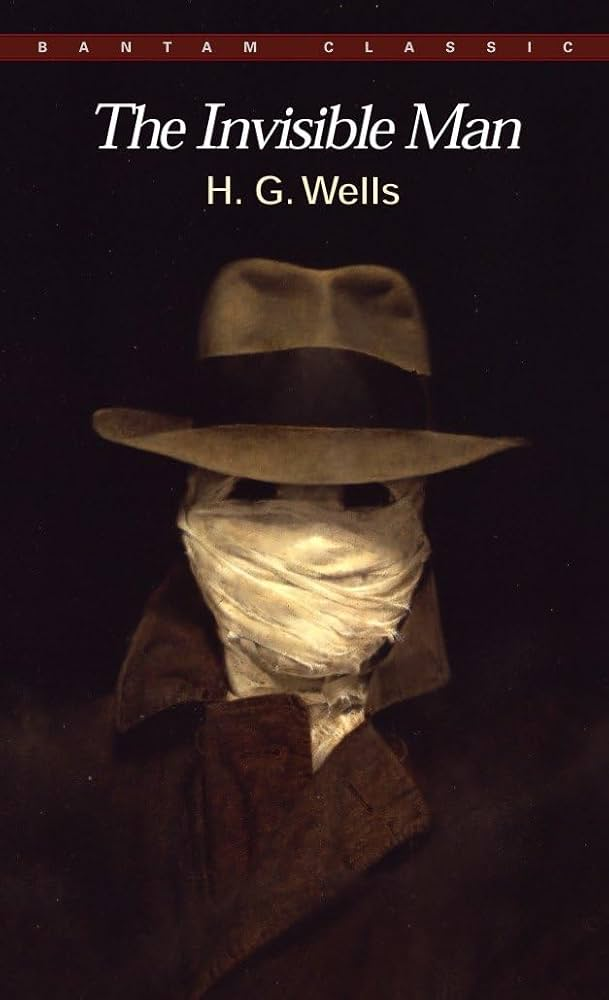
And that is what awakens his love.
It is the difference between lust and love.
Lust: “I want your body.“
Love: “I see your soul trembling beneath your beauty.“
Gyges becomes the only person who sees Rhodope as something more than the most beautiful woman in the Kingdom.

If Rhodope’s deepest fear is being valued only for her beauty, then Candaules’ betrayal is far worse than a voyeuristic prank.
He proves he sees her as a spectacle, not a wife.
He treats her privacy as a public possession.
He is willing to expose her emotionally and physically.
Her humiliation is total, because her husband confirms the very truth she has been protecting herself from:
To him, she is not a person.
She is a prize.
Thus her fury is not merely about nudity.
It is about the collapse of her selfhood.

Gyges becomes the man who unintentionally saw her true loneliness, the one who witnesses her vulnerability, the first person to love her as a human, not an emblem of beauty.
He is a man whose shame mirrors her shame.
She does not choose Gyges because he saw her body.
She chooses him because he saw her humanity.
He was invisible, but through him, for the first time, she was seen.

If Gyges sees her as a person, then marrying him is not just strategic, but emotionally logical, but this creates a terrible irony.
She marries him because he saw her soul, but her marriage depends upon the murder of a man who never saw her true self.
The foundation is cracked from the beginning.

Her greatest fear – being loved for the wrong reasons – haunts her even in the arms of the man who loved her rightly.
This is why the temple scene feels rather less than triumphant.
She cannot live with the knowledge that authentic love was born through false circumstances.
Thus she destroys herself to protect the only pure thing left:
Her final act of self-possession.

Above: Temple of Hestia, Ephesus, Türkiye
Rhodope’s physical nakedness was never the true crime.
What devastated her was that Gyges glimpsed her emotional nakedness, the vulnerable self she had hidden even from her husband.
This makes the tragedy deeply human.
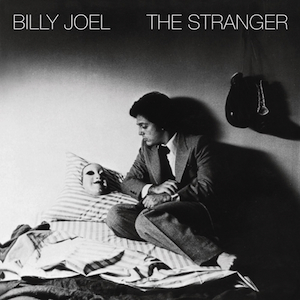
Well, we all have a face
That we hide away forever
And we take them out
And show ourselves
When everyone has gone
Some are satin, some are steel
Some are silk, and some are leather
They’re the faces of the stranger
But we love to try them on
Well, we all fall in love
But we disregard the danger
Though we share so many secrets
There are some we never tell
Why were you so surprised
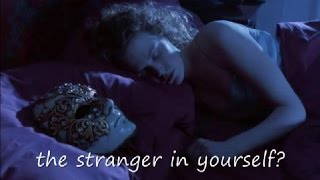
That you never saw the stranger?
Did you ever let your lover see
The stranger in yourself?
Sexual refusal can be painful for husbands, because men often equate sexual acceptance with emotional acceptance.
For many men, sexual intimacy is deeply tied to feeling valued, chosen, respected and loved.
When a wife withdraws sexually, a husband may experience it as:
“She no longer loves me.“
“I am not desirable.“
“I am failing her.“
Even if these thoughts are not verbalized, they create emotional corrosion.
Rejection can feel like a rejection of identity.
A man’s sense of masculinity- rightly or wrongly – is often entangled with potency, desirability and success as a partner.
Thus sexual refusal touches not just desire but ego, self and dignity.
Men often have fewer emotional outlets.
Sex becomes the primary place they feel connected, soothed, accepted and safe.
If intimacy is withdrawn, men lose their emotional refuge.
They often cannot articulate this hurt. Hurt unspoken becomes anger.
One refusal is normal, but repeated refusals form a narrative.
“You are not wanted.“
“You are not enough.“
That narrative becomes heavier with time until it reshapes the entire marriage.

Desire rarely matches perfectly.
Humans have natural variations in libido.
One partner wants intimacy more often.
The other, less.
This is normal and yet profoundly destabilizing.
The high-desire partner (HDP) feels rejected, lonely, starved for touch, embarrassed to ask, resentful and ashamed of their own desire.
The low-desire partner (LDP) feels pressured, inadequate, objectified, guilty, anxious and overwhelmed.
Both suffer.
Each misinterprets the other.
HDP: You don’t love me.
LDP: You only want sex, not me.
This dynamic easily becomes a cycle.
- One partner initiates.
- The other refuses.
- The first withdraws emotionally.
- The second feels even less desire.
- Repeat.
Mismatched desire ruins relationships, not because either person is wrong, but because neither understands the other’s invisible suffering.

Can couples repair intimacy after withdrawal?
The first healing step is to speak the pain aloud, without accusation.
Truth creates space.
Silence creates distance.
Couples reconnect when they build reflection, conversation, trust and emotional safety.
Sex cannot be repaired through sex.
Intimacy is repaired through closeness first.
The low-desire partner must feel respected, understood and unforced.
Pressure kills desire.
Respect rekindles it.
For some couples this means hormonal evaluation, trauma therapy, couples counselling or addressing stress and depression.
Intimacy revives when couples let go of routines and rediscover curiosity through slower intimacy, different expressions of touch, sensual but non-demanding contact and rebuilding playfulness.
Repair means rebuilding safety, not demanding compliance.

If Rhodope had been withholding intimacy, then Candaules suffers deeply.
He feels unwanted by the woman he desires most.
He interprets her distance as judgment of his masculinity.
He becomes obsessed with her beauty because he cannot access her love.
Every refusal reinforces his humiliation.
“Even though she is mine, she is never mine.“
This creates a storm of longing, shame, resentment and desperation.
A King in public, an exile in his own bed.

Rhodope refuses him, because she fears being valued only for her beauty, of being possessed rather than cherished, of being reduced to an object.
Withholding intimacy becomes her shield, her protest, her attempt to preserve her dignity, her attempt to protect her inner self.
She does not reject Candaules.
She rejects the role she feels she has been forced into.
Candaules fears: “You don’t want me.“
Rhodope fears: “You only want my body.”
Both are true.
Neither understands the other.

Gyges enters at the rupture point.
He sees Rhodope’s emotional vulnerability.
He sees the truth Candaules never saw.
Gyges feels compassion.
Candaules feels pride.
Gyges’ compassion becomes love.

She can kill with a smile. She can wound with her eyes.
And she can ruin your faith with her casual lies.
And she only reveals what she wants you to see.
She hides like a child, but she’s always a woman to me.
She can lead you to love. She can take you or leave you.
She can ask for the truth, but she’ll never believe you.
And she’ll take what you give her, as long as it’s free.
Yeah, she steals like a thief, but she’s always a woman to me
Oh, she takes care of herself. She can wait if she wants.
She’s ahead of her time.
Oh, and she never gives out, and she never gives in.
She just changes her mind.
And she’ll promise you more than the Garden of Eden.
Then she’ll carelessly cut you and laugh while you’re bleeding.
But she’ll bring out the best and the worst you can be.
Blame it all on yourself, ’cause she’s always a woman to me.
Oh, she takes care of herself. She can wait if she wants.
She’s ahead of her time.
Oh, and she never gives out, and she never gives in.
She just changes her mind.
She is frequently kind and she’s suddenly cruel.
But she can do as she pleases. She’s nobody’s fool.
And she can’t be convicted. She’s earned her degree.
And the most she will do is throw shadows at you.
But she’s always a woman to me.

Rhodope senses, perhaps subconsciously, that someone finally sees her, not just her beauty.
Someone understands her pain.
Thus Gyges becomes the man who gives what Candaules never could:
Recognition.

Showing Rhodope’s body to Gyges proves that she was right to withhold her favours from Candaules, that she was nothing more than a spectacle to her husband, that her deepest fear was true.
It shatters her inner world.
In couples, breaches can be repaired, but not when trust is shattered, when dignity is destroyed, when the very boundary she protected is violated and the voyeur (though by proxy) is her husband.
This is why she demands blood.
It is symbolic reclamation of her violated self.

In the end, the entire tragedy of Gyges and his Ring becomes a portrait of a husband starving for closeness, a wife protecting the last fragment of her dignity, a friend who sees what neither spouse can, and a marriage destroyed by mismatched needs, unspoken fears and one catastrophic breach of trust.
Hebbel’s tragedy is not just myth or morality.
It is a painfully realistic psychological drama about intimacy, identity and the destruction that follows when partners misread each other’s hearts.
Rhodope kills herself, not out of despair, but out of necessity.
For Rhodope, her body has been violated, her marriage corrupted, her boundaries annihilated, her identity stripped, her dignity compromised.
The act that was supposed to cleanse her honour – Gyges killing Candaules – only deepens the moral contamination.
Her logic becomes:
“If I live, I am living in the world they made of me.“

Marriage to Gyges cannot save her, because it was born of humiliation and blood.
Her suicide is her final act of meaning-making – a gesture that says:
“This story will end on my terms.“

Rhodope chose the Temple of Hestia, because the goddess represents home, sacred fire, purity and the untouched centre of the household.
By dying there, Rhodope restores her violated inner hearth.
Rhodope cannot inhabit a world where her true self was never seen.

Candaules never saw her.
Gyges saw her only by accident.
Though Gyges loved her truly, that love came through an act she could never forget.
This inner contradiction is too great.
She longs to be seen as a person, but the only man who could see her saw her at her most exposed and without her consent.
Her death resolves the contradiction by severing the knot entirely.

Gyges is often read as a passive character swept along by events, but under this interpretation his psychology is far more complex and tragic.
Gyges sees Rhodope’s soul before he sees her body.
This is the wound that begins everything.

I loved you for your beauty.
But that doesn’t make a fool of me,
You were in it for your beauty, too.
And I loved you for your body.
There’s a voice that sounds like God to me.
Declaring (declaring), declaring (declaring)
Declaring that your body’s really (really, really, really, really)
And I loved you when our love was blessed.
And I love you now there’s nothing left.
But sorrow and a sense of overtime.
And I missed you since the place got wrecked.
And I just don’t care what happens next.
Looks like freedom, but it feels like death,
It’s something in between, I guess.
It’s closing time (closing time, closing time, closing time).
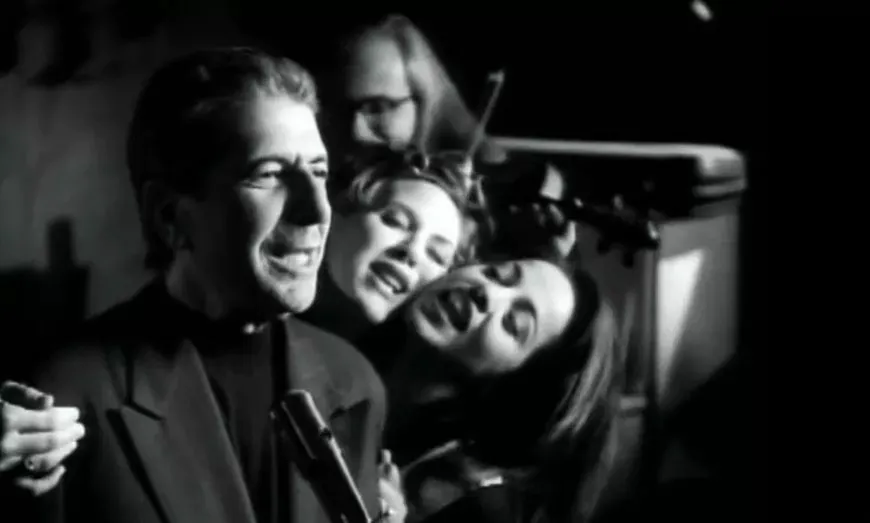
Above: Leonard Cohen (1934 – 2016), Closing Time video
In the darkness of her bedchamber, he hears her loneliness, senses her vulnerability and perceives the fragility of her guardedness.
His love is born out of empathy, not lust.
Thus the tragedy is cruel, because the man who sees her most deeply is the man whose gaze destroys her life.

When you close your eyes and go to sleep.
And it’s down to the sound of a heartbeat.
I can hear the things that you’re dreamin’ about
When you open up your heart and the truth comes out.
You tell me that you want me.
You tell me that you need me.
You tell me that you love me.
And I know that I’m right.
‘Cause I hear it in the night.
I hear the secrets that you keep.
When you’re talkin’ in your sleep.
I hear the secrets that you keep.
When you’re talkin’ in your sleep.
When I hold you in my arms at night.
Don’t you know you’re sleepin’ in a spotlight.
And all your dreams that you keep inside.
You’re tellin’ me the secrets that you just can’t hide.
You tell me that you want me.
You tell me that you need me.
You tell me that you love me.
And I know that I’m right.
‘Cause I hear it in the night.
I hear the secrets that you keep.
When you’re talkin’ in your sleep.
I hear the secrets that you keep.
When you’re talkin’ in your sleep.
I hear the secrets that you keep.
When you’re talkin’ in your sleep.
I hear the secrets that you keep.
When you’re talkin’ in your sleep.
He carries a guilty that is erotic, moral and existential.
Gyges’ torment layers itself:
- Guilt for violating her privacy
- Guilt for loving a woman he was not meant to love
- Guilt for obeying the King
- Guilt for seeing her vulnerability
- Guilt for causing the shame that destroys a marriage

He becomes trapped between his loyalty to Candaules, his love for Rhodope, his responsibility for the catastrophe, and his desire to save her from self-destruction.
When Rhodope says “Kill Candaules or I die.“, Gyges is confronted with an impossible moral geometry:
If he kills the King, he betrays his friend.
If he refuses, the woman he loves kills herself.

Gyges wins the Kingdom, but loses himself.
Even when he gains Rhodope and the crown, the triumph is hollow.
He knows she marries him to purify her shame, not because she truly loves him.
He knows his throne was built by bloodshed.
He knows his love was born from violation.
Rhodope’s suicide destroys Gyges utterly:
He loses the woman.
He loses any sense of moral legitimacy.
He inherits a Kingdom that rests on tragedy.
He becomes King, but is psychologically annihilated.
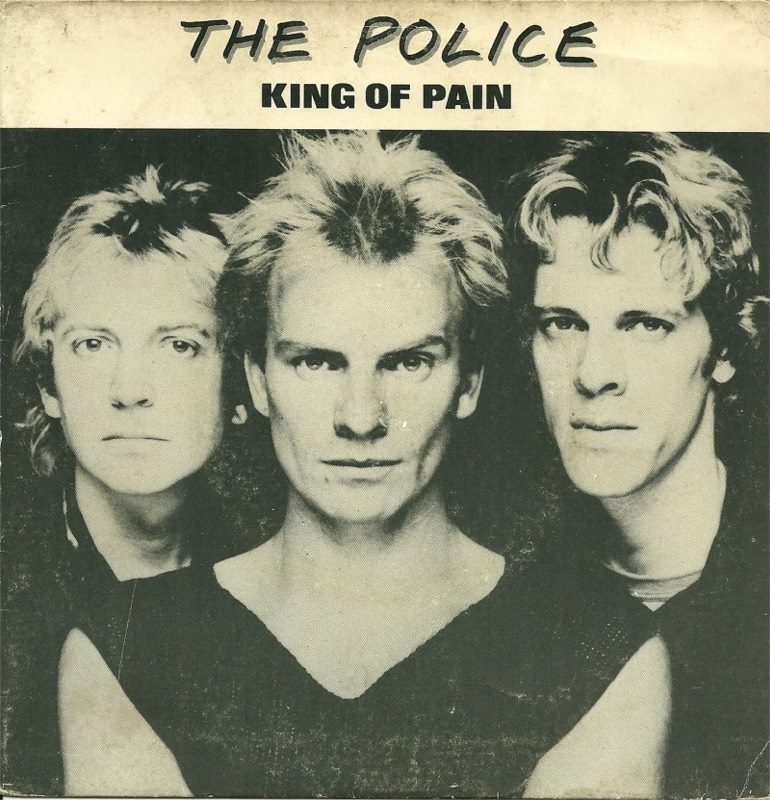
There’s a little black spot on the sun today.
It’s the same old thing as yesterday.
There’s a black hat caught in a high tree top.
There’s a flag pole rag and the wind won’t stop.

I have stood here before inside the pouring rain.
With the world turning circles running ’round my brain.
I guess I’m always hoping that you’ll end this reign.
But it’s my destiny to be the king of pain.

There’s a little black spot on the sun today.
(That’s my soul up there.)
It’s the same old thing as yesterday.
(That’s my soul up there.)
There’s a black hat caught in a high tree top.
(That’s my soul up there.)
There’s a flag pole rag and the wind won’t stop.
(That’s my soul up there.)

I have stood here before inside the pouring rain.
With the world turning circles running ’round my brain.
I guess I’m always hoping that you’ll end this reign.
But it’s my destiny to be the king of pain.

There’s a fossil that’s trapped in a high cliff wall.
(That’s my soul up there.)

There’s a dead salmon frozen in a waterfall.
(That’s my soul up there.)

There’s a blue whale beached by a springtime’s ebb.
(That’s my soul up there.)

There’s a butterfly trapped in a spider’s web.
(That’s my soul up there.)

I’ve stood here before inside the pouring rain.
With the world turning circles running ’round my brain.
I guess I’m always hoping that you’ll end this reign.
But it’s my destiny to be the king of pain.

There’s a king on a throne with his eyes torn out.

There’s a blind man looking for a shadow of doubt.

There’s a rich man sleeping on a golden bed.

There’s a skeleton choking on a crust of bread.

King of pain.

There’s a red fox torn by a huntsman’s pack.
(That’s my soul up there.)

There’s a black-winged gull with a broken back.
(That’s my soul up there.)

There’s a little black spot on the sun today.
It’s the same old thing as yesterday.

I’ve stood here before inside the pouring rain.
With the world turning circles running ’round my brain.
I guess I’m always hoping that you’ll end this reign.
But it’s my destiny to be the king of pain.

Candaules is a deeply tragic figure.
He is not a monster.
He is a lonely husband.
Rhodope’s sexual refusal means he is rejected by the woman he adores.
He feels undesirable.
He is ashamed but cannot speak of it.
His pride compensates for pain.
He uses vanity to hide his despair.
His error is not malice, but desperation.
His voyeurism by proxy is a displaced cry for help.
When he compels Gyges to spy on Rhodope, it is not bravado.
It is an act of anger, a confession of loss, a self-striking blow against the marriage, a plea:
“See what I cannot have.“
He cannot articulate his suffering, so he performs it.
His tragedy is blindness.
He fails to see Rhodope’s emotional insecurity, his own resentment toward her, Gyges’ compassion and the deep wrongness of what he is orchestrating.
He destroys the very intimacy he longs for.

The core of the tragedy is intimacy invisible.
Rhodope fears being seen only as a body.
Candaules fears he is not desired as a man.
Gyges sees too deeply and too soon and thus cannot see the danger.
All three are caught in different forms of invisibility.

Rhodope hides what she fears will be objectified.
Candaules hides the shame of being unwanted.
Gyges sees what he should not see and cannot unsee.
Each acts out of a longing to be understood.
Each act only deepens the misunderstanding.

Memories light the corners of my mind.
Misty water-colored memories of the way we were.
Scattered pictures of the smiles we left behind.
Smiles we gave to one another for the way we were.
Can it be that it was all so simple then,
Or has time re-written every line?
If we had the chance to do it all again.
Tell me, would we? Could we?
Memories may be beautiful and yet
What’s too painful to remember.
We simply choose to forget.
So it’s the laughter we will remember.
Whenever we remember the way we were.
The way we were.

The ring that grants invisibility reveals the true invisibilities:
- the invisible hurt in Candaules
- the invisible fear in Rhodope
- the invisible empathy in Gyges
The tragedy of the play is not the voyeurism.
It is that no one was ever truly seen by the one they loved.

If you could read my mind, love,
What a tale my thoughts could tell.
Just like an old time movie
‘Bout a ghost from a wishin’ well.
In a castle dark or a fortress strong
With chains upon my feet.
You know that ghost is me.
And I will never be set free
As long as I’m a ghost, you can’t see.

If I could read your mind, love,
What a tale your thoughts could tell.
Just like a paperback novel
The kind the drugstore sells.
When you reach the part where the heartaches come,
The hero would be me.
But heroes often fail.
And you won’t read that book again,
Because the ending’s just too hard to take.

I’d walk away like a movie star
Who gets burned in a three-way script.
Enter number two.
A movie queen to play the scene
Of bringing all the good things out in me
But for now love, let’s be real.
I never thought I could act this way
And I’ve got to say that I just don’t get it.
I don’t know where we went wrong,
But the feeling’s gone and I just can’t get it back.

If you could read my mind, love,
What a tale my thoughts could tell.
Just like an old time movie
‘Bout a ghost from a wishing well.
In a castle dark or a fortress strong
With chains upon my feet
The stories always end.
If you read between the lines
You’ll know that I’m just trying to understand
The feeling that you left.
I never thought I could feel this way
And I’ve got to say that I just don’t get it.
I don’t know where we went wrong,
But the feeling’s gone and I just can’t get it back.

Above: Gordon Lightfoot’s (1938 – 2023) star on Canada’s Walk of Fame
Candaules is driven not by lust, but by a deep narcissistic wound.
He is not secure in his masculinity.
He needs external witnesses to confirm that his wife is beautiful, that he possesses something enviable, that he is therefore “enough” as a man and a King.
Thus the act of showing Rhodope’s body is a desperate attempt to shore up a fragile ego, a perverse exhibitionism by proxy using Gyges as a mirror, a symbolic statement:
“If others envy me, then I am worthy.“
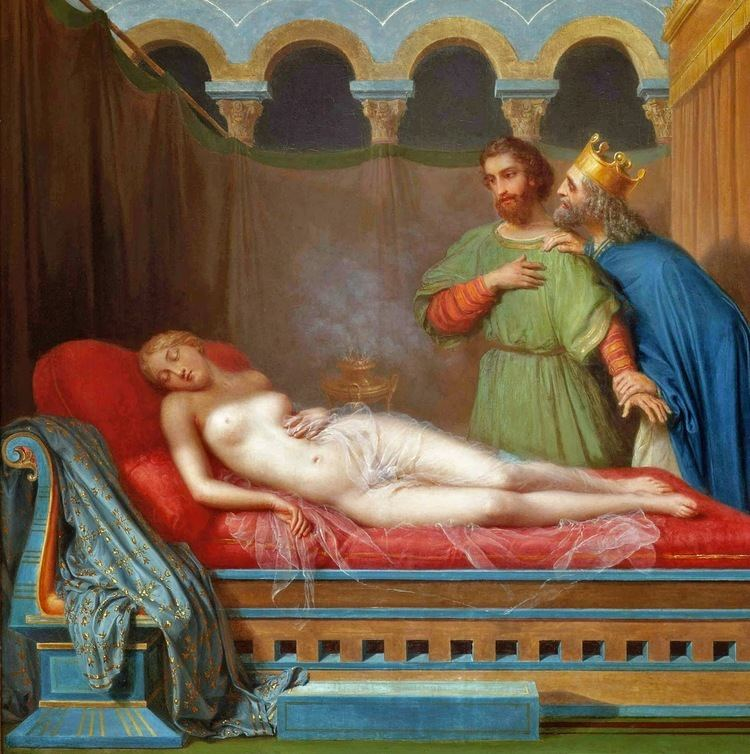
Rhodope withholding intimacy makes Candaules’ narcissistic insecurity intensify.
Her refusal becomes not just sexual rejection, but a castration-level wound, a blow to his sovereignty and identity.
His rage becomes the rage of the child who feels deprived of love and seeks outside validation.
The ring is less a magical device than a psychological one.
It is an attempt to control, penetrate and possess what he cannot command lovingly.

You don’t bring me flowers.
And you don’t sing me love songs.
You hardly talk to me anymore.
When I come through the door at the end of the day.
I remember when…
You couldn’t wait to love me.
Used to hate to leave me.
Now, after lovin’ me late at night.
When it’s good for you
And you’re feeling alright.
Well, you just roll over
And you turn off the light.
And you don’t bring me flowers anymore.

It used to be so natural
To talk about forever.
But ‘used to be’s’ don’t count anymore.
They just lay on the floor ’til we sweep them away.

And, baby, I remember…
All the things you taught me.
I learned how to laugh
And I learned how to cry.
Well, I learned how to love.
Even learned how to lie.
So you’d think I could learn
How to tell you goodbye.
You don’t bring me flowers anymore.

Rhodope’s psychology is rooted in objectification, but with a twist.
She withholds intimacy, not because she is cold, but because she senses she is valued only for the external.
She fears becoming merely a trophy wife, a symbol rather than a person.
She protects her deepest self by denying access to the surface one.

When Gyges intrudes, the intrusion is not merely physical.
It is ontological – common sense language.
Someone has seen her without her protective shell.
She has been seen as an object, not as a subject.
The boundaries of her womanhood and dignity have been violated, but when Gyges later confesses, she senses that he saw her vulnerability, not just her body.
Gyges felt remorse, which signals recognition of her humanity.
And that changes everything.

Gyges, the man in whom desire and guilt unite, becomes the tragic mediator, because he experiences the sight of Rhodope, not as conquest, but as awakening.
He feels both longing and guilt – an internal conflict that makes him capable of moral depth.

In psychoanalytic terms, Gyges sees not merely the woman, but the feminine – the anima, the soul image.
Rhodope becomes not object but ideal.
His guilt binds him to her emotionally, almost maternally.
He becomes the only man in the triangle who recognizes her inner life.

Psychologically, sexual refusal can activate fear of inadequacy, abandonment, the loss of masculine identity and jealous fantasy.
For Candaules, Rhodope’s refusal confirms his internal fear that he is unworthy.
He tries to compensate by sharing her image with Gyges.
In essence, he hopes Gyges’ admiration will repair his ego.
It is tragic, because it does the opposite.

He said, “Baby, what’s wrong with you?
Why don’t you use your imagination?
Nations go to war over women like you,
It’s just a form of appreciation.”
“Come on over here, lay your clothes on the chair.
Now let the lace fall across your shoulder.
Standing in the half light, you’re almost like her.
So take it slowly like your daddy told you.”

Strut, pout, put it out, that’s what you want from women.
Come on, baby, what’cha taking me for?
Strut, pout, cut it out, all taking and no giving.
Watch me, baby, while I walk out the door.

I said, “Honey, I don’t like this game,
You make me feel like a girl for hire
All this fascination with leather
And lace is just the smoke from another fire.”

He said, “Honey, don’t stop a speeding train
Before it reaches its destination.
Lie down here beside me, oh, have some fun, too.
Don’t turn away from your true vocation.”

Strut, pout, put it out, that’s what you want from women.
Come on baby, what’cha taking me for?
Strut, pout, cut it out, all taking and no giving.
Watch me, baby, while I walk out the door.

I won’t be your baby doll, be your baby doll.
I won’t be your baby doll, be your baby doll.

Rhodope withdraws, because she needs emotional recognition.
Candaules desires more intensely, because he feels entitled to her body.
When a wife withdraws and a husband feels entitled, the gap becomes charged with shame, resentment and projection.
The husband sees refusal as attack.
The wife sees his desire as objectification.
This is the heart of Hebbel’s tragedy.

For a couple to repair after withdrawal, the refusing partner must feel seen as a person and the desiring partner must feel respected in their vulnerability.
Candaules cannot see Rhodope as a subject.
Rhodope cannot forgive being treated as an object
Neither understands the other’s core wound.

Gyges, ironically, is the only one capable of empathy – but too late and in the wrong position.
Thus, restoration becomes impossible.
Candaules’ narcissism destroys trust.
Rhodope’s shame destroys the marriage.
Gyges’ remorse destroys himself.
Her suicide seals this.
No union born from violation can endure.
The tragedy of Gyges and his Ring ends long before Rhodope’s suicide.
It ends in the moment when each character becomes invisible to the others.

Candaules cannot see Rhodope’s fear.
Rhodope cannot see Candaules’ shame.
Gyges sees too much, too late, and against his will.

The ring does not create invisibility.
It reveals it.

Every marriage carries rooms the other cannot enter, places of longing, fear, desire, shame.
When these rooms remain unspoken, couples improvise in the dark, guessing at each other’s wounds, misreading silence as accusation and desire as threat.

Candaules believes he is unloved.
Rhodope believes she is unvalued.
Gyges believes he can repair what he helped shatter.
Each is wrong in a different way.
Each mistake is fatal.

He came from somewhere back in her long ago
The sentimental fool don’t see
Tryin’ hard to recreate
What had yet to be created once in her life
She musters a smile
For his nostalgic tale
Never coming near what he wanted to say
Only to realize
It never really was
She had a place in his life
He never made her think twice
As he rises to her apology
Anybody else would surely know
Just watching her go.
But a fool believes what he sees
No wise man has the power to reason away
What seems to be
Is always better than nothing
And nothing at all keeps sending him…
Somewhere back in her long ago
Where he can still believe there’s a place in her life
Someday, somewhere, she will return
She had a place in his life
He never made her think twice
As he rises to her apology
Anybody else would surely know
Just watching her go.
But a fool believes what he sees
No wise man has the power to reason away
What seems to be
Is always better than nothing
There’s nothing at all
But a fool believes what he sees…
What Hebbel dramatizes is not myth, but the anatomy of relational blindness.
A woman unseen becomes defensive.
A man unseen becomes desperate.
A friend who sees too clearly becomes dangerous.
Love without visibility becomes catastrophe.

Rhodope’s suicide, far from being the melodrama of a wronged queen, becomes the final attempt to reclaim the one thing she never had:
Authorship over her own life.
By choosing her death, she chooses visibility — not as an ornament, not as a possession, not as a symbol, but as a self.
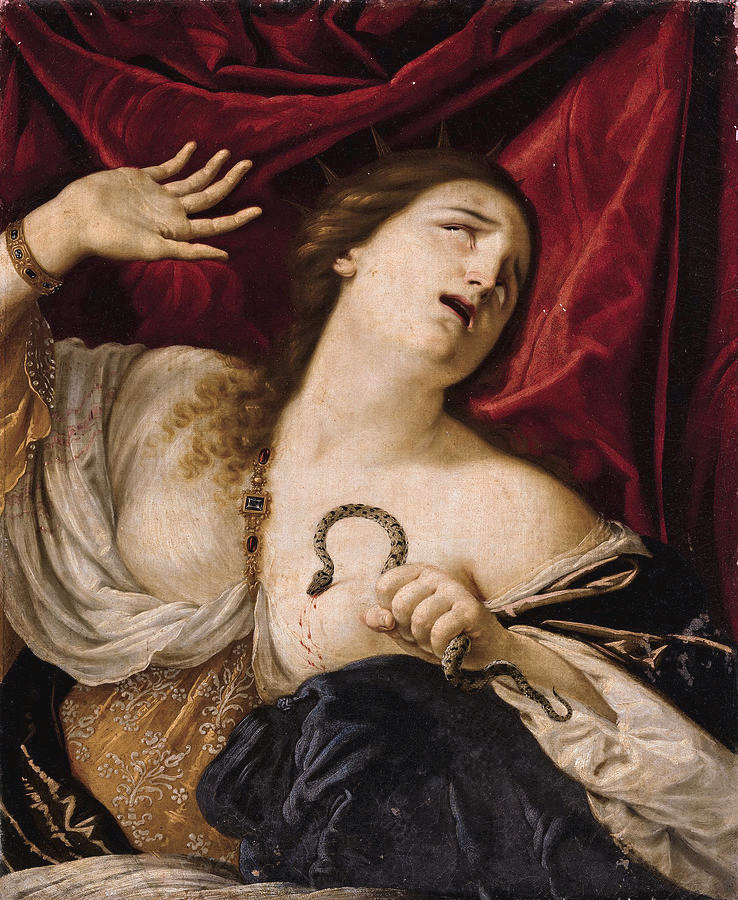
Above: The death of Cleopatra, Cesare Dandini
In the Temple of Hestia, she returns to the only flame that cannot be violated:
The inner fire of dignity.
The tragedy of Hebbel’s play is thus not erotic jealousy, or political ambition, or supernatural magic.
It is the simplest and most devastating of human failures:
The failure to see the person we love.

Oh, oh, oh
Oh, oh, oh
Oh, oh, oh, oh, oh
We couldn’t turn around
‘Til we were upside down.
I’ll be the bad guy now,
But know I ain’t too proud
I couldn’t be there
Even when I tried.
You don’t believe it.
We do this every time.
Seasons change and our love went cold.
Feed the flame, ’cause we can’t let go.
Run away, but we’re running in circles.
Run away, run away.
I dare you to do something.
I’m waiting on you again.
So I don’t take the blame.
Run away, but we’re running in circles.
Run away, run away, run away.
Let go.
I got a feeling that it’s time to let go.
I say so.
I knew that this was doomed from the get-go.
You thought that it was special, special.
But it was just the sex, though, the sex, though.
And I still hear the echoes (the echoes).
I got a feeling that it’s time to let it go, let it go.
Seasons change and our love went cold.
Feed the flame, ’cause we can’t let go.
Run away, but we’re running in circles.
Run away, run away.
I dare you to do something.
I’m waiting on you again.
So I don’t take the blame.
Run away, but we’re running in circles.
Run away, run away, run away.
Maybe you don’t understand what I’m going through.
It’s only me.
What you got to lose?
Make up your mind, tell me, what are you gonna do?
It’s only me.
Let it go.
Seasons change and our love went cold
Feed the flame, ’cause we can’t let go
Run away, but we’re running in circles.
Run away, run away.
I dare you to do something.
I’m waiting on you again.
So I don’t take the blame.
Run away, but we’re running in circles.
Run away, run away, run away.

Every relationship lives or dies on the ability to say:
“I see you — not as I wish you to be, not as I fear you to be, but as you are.“

Don’t go changing to try and please me.
You never let me down before, mmm.
Don’t imagine you’re too familiar,
And I don’t see you anymore.
I would not leave you in times of trouble.
We never could have come this far, mmm.
I took the good times. I’ll take the bad times.
I’ll take you just the way you are.
Don’t go trying some new fashion.
Don’t change the color of your hair, mmm.
You always have my unspoken passion.
Although I might not seem to care.
I don’t want clever conversation.
I never want to work that hard, mmm.
I just want someone that I can talk to.
I want you just the way you are.
I need to know that you will always be
The same old someone that I knew.
Oh, but what will it take until you believe in me
The way that I believe in you?
I said I love you. That’s forever.
And this I promise from the heart, mmm.
I couldn’t love you any better.
I love you just the way you are, right.
I don’t want clever conversation.
I never want to work that hard, mmm.
I just want someone that I can talk to.
I want you just the way you are.

Candaules saw beauty.
Gyges saw vulnerability.
Only Rhodope saw the truth.
And it killed her.

Invisibility is not a gift.
It is a wound.
And Hebbel’s tragedy warns us, with surgical clarity, that when people stop seeing one another’s hearts, they begin to destroy one another’s lives.
The invisible is never intangible.
When you were here before
Couldn’t look you in the eye.
You’re just like an angel.
Your skin makes me cry.
You float like a feather
In a beautiful world.
I wish I was special.
You’re so f—ing special.
But I’m a creep.
I’m a weirdo.
What the hell am I doing here?
I don’t belong here.
I don’t care if it hurts.
I want to have control.
I want a perfect body.
I want a perfect soul.
I want you to notice
When I’m not around.
You’re so f—ing special.
I wish I was special.
But I’m a creep.
I’m a weirdo.
What the hell am I doing here?
I don’t belong here.
Oh, oh.
She’s running out the door.
She’s running out.
She run, run, run, run.
Run.
Whatever makes you happy.
Whatever you want.
You’re so f—ing special.
I wish I was special.
But I’m a creep.
I’m a weirdo.
What the hell am I doing here?
I don’t belong here.
I don’t belong here.
Sources
Leonard Cohen, Closing Time
The Doobie Brothers, What a Fool Believes
Sheena Easton, Strut
Billy Joel, Just the Way You Are
Billy Joel, She’s Always a Woman
Billy Joel, The Stranger
Gordon Lightfoot, If You Could Read My Mind
The Police, King of Pain
Post Malone, Circles
Radiohead, Creep
The Romantics, Talking in Your Sleep
Barbara Streisand, The Way We Were
Barbara Streisand/Neil Diamond, You Don’t Bring Me Flowers
