
Dusk on Mtatsminda continued
Rest in Paris (part one of two)
Sunday 17 May 2026
Tbilisi, Georgia
“Let none bewail the bitterness of orphancy,
Nor weep if destitute of friend or kin is he,
But pity him whose soul’s bereaved by ruthless fate;
Once lost-’tis hard to find again a worthy mate.
Deprived of kin and friend the heart seems lone and dead
Yet soon it finds another one to love instead;
But if the soul does lose its mate, then it must bear
The curse of yielding all its hopes to black despair.
His faith is lost, he trusts no more this world of woe;
Distraught and wild, he shuns mankind, and does not know
To whom to trust the secrets of his troubled breast,
Afraid to feel again the faith it once possessed.
‘Tis hard to bear the anguish of a soul forlorn,
To shun all worldly joys and smiles or pleasures scorn;
The lonely soul forever mourns its friend and mate,
And heavy sighs bring calm to him thus doomed by fate.
“The Orphaned Soul“, Nikoloz Baratashvili

Above: Nikoloz Baratashvili Statue, Tbilisi, Georgia
Baratashvili died of malaria in Ganja at the age of 27.
His influence was long delayed, but as the next generation of Georgian literati rediscovered his lyrics, he was posthumously published, between 1861 and 1876, and idolized.
His reinterment from Ganja to Tbilisi in 1893 turned into a national celebration.
Since 1938, his remains have lain in the Mtatsminda Pantheon in Tbilisi.

Above: St. David’s Monastery, Mtatsminda Pantheon, Tbilisi, Georgia
In my last post I spoke at length about the Mtatsminda Pantheon.
How the Pantheon was conceived in 1915 but opened in 1929 during Soviet rule.
Its development and the selection of those commemorated took place within a changing political environment.
How it became a representation of modern Georgian nationhood, despite having been created and substantially populated during the Soviet period.
I also examined additions, omissions and the changing political significance of the site.
How a national pantheon is never simply a collection of people who were famous.
That it is also a record of the people subsequent generations have decided deserve to be remembered.

Above: St. David’s Church and Mtatsminda Pantheon, Tbilisi, Georgia
Natalie: How about just not dying alone?
Ryan: Starting when I was 12, we moved each one of my grandparents into a nursing facility.
My parents went the same way.
Make no mistake.
We all die alone.

Above: Poster of Up In The Air (2009 film)
I wondered:
How do other countries remember their writers?
The Panthéon (from Ancient Greek ‘temple to all the gods‘) is a monument in the 5th Arrondissement of Paris.
The Panthéon is one of Paris’s most imposing neoclassical buildings.
Standing on the Montagne Sainte-Geneviève, it overlooks the Latin Quarter and is recognisable by its enormous dome, classical columned portico and monumental proportions.
Above: Panthéon, Paris, France
The edifice was built between 1758 and 1790, from designs by Jacques-Germain Soufflot, at the behest of King Louis XV.

Above: Jacques-Germain Soufflot (1713 – 1780) was a French architect in the international circle that introduced neoclassicism. His most famous works are the Panthéon in Paris and the Hôtel-Dieu de Lyon in Lyon.
The King intended it as a church dedicated to Saint Geneviève, Paris’s patron saint, whose relics were to be housed in the church.

Above: Geneviève (419 – 502) was a consecrated virgin, and is one of the patron saints of Paris in the Catholic Church. She is also venerated in the Eastern Orthodox Church. Her feast day is on 3 January.
Neither Soufflot nor Louis XV lived to see the Church completed.

Above: French King Louıs XV (1710 – 1774)
By the time the construction was finished, the French Revolution had started.

Above: The storming of the Bastille Prison, Paris – 14 July 1789
The Storming of the Bastille was an act of political violence by revolutionary insurgents who attempted to storm and seize control of the medieval armoury, fortress and political prison known as the Bastille.
After four hours of fighting and 94 deaths, the insurgents were able to enter the Bastille.
The governor of the Bastille, Bernard-René Jourdan de Launay, and several members of the Garrison were killed after surrendering.
At the time, the Bastille represented royal authority in the centre of Paris.
The prison contained only seven inmates at the time of its storming and was already scheduled for demolition but was seen by the revolutionaries as a symbol of the monarchy’s abuse of power.
Its fall was the flashpoint of the French Revolution.
The National Constituent Assembly voted in 1791 to transform the Church of Saint Genevieve into a mausoleum for the remains of distinguished French citizens, modelled on the Pantheon in Rome which had been used in this way since the 17th century.

Above: Emblem of the National Constituent Assembly (1789 – 1791)

Above: Pantheon, Rome, Italy
The Pantheon is an ancient Polytheist temple, originally built under Roman Emperor Augustus (27 BC – AD 14) and reconstructed under Roman Emperor Hadrian (117–138).
Since 609, it has served as the Roman Catholic Basilica of Saint Mary and the Holy Martyrs with the special Pontifical privilege of immemorial status.
Thus the Panthéon acquired its famous inscription:
Aux grands hommes, la patrie reconnaissante. (“To great men, the grateful homeland“)
(Of the remains of 81 people, only six are women.)

Above: Panthéon, Paris, France
The first panthéonisé was Honoré Gabriel Riqueti, Comte de Mirabeau, although his remains were removed from the building a few years later.

Above: Honoré Gabriel Riqueti, Count of Mirabeau (1749 – 1791), known simply as Mirabeau, was a French writer, orator, and statesman, and a prominent figure of the early stages of the French Revolution.
The Panthéon was twice restored to church usage in the course of the 19th century — although Soufflot’s remains were transferred inside it in 1829 — until the French Third Republic (1870 – 1940) finally decreed the building’s exclusive use as a mausoleum in 1881.

Above: Flag of France
The placement of Victor Hugo’s remains in the crypt in 1885 was its first entombment in over 50 years.

Above: Final resting place of Victor Hugo, Crypt, Panthéon, Paris, France
The successive changes in the Panthéon’s purpose resulted in modifications of the pedimental sculptures and the capping of the dome by a cross or a flag.
Some of the originally existing windows were blocked up with masonry in order to give the interior a darker and more funereal atmosphere, which compromised somewhat Soufflot’s initial attempt at combining the lightness and brightness of the Gothic cathedral with classical principles.
The architecture of the Panthéon is an early example of Neoclassicism, surmounted by a dome.

Above: Panthéon, Paris, France
In 1851, Léon Foucault conducted a demonstration of diurnal motion at the Panthéon by suspending a pendulum from the ceiling, a copy of which is still visible today.

Above: Jean Bernard Léon Foucault (1819 – 1868) was a French physicist who invented the Foucault pendulum, a device demonstrating the effect of Earth’s rotation. He also made an early measurement of the speed of light, discovered eddy currents. He is credited with naming the gyroscope.

Above: Foucault’s pendulum, Panthéon, Paris, France – Foucault’s pendulum is a simple device, conceived as an experiment to demonstrate the Earth’s rotation.
If a long and heavy pendulum suspended from the high roof above a circular area is monitored over an extended period of time, its plane of oscillation (repetitive variation) appears to change spontaneously as the Earth makes its 24-hourly rotation.
This effect is greatest at the poles and diminishes with lower latitude until it no longer exists at Earth’s Equator.
As of December 2021 the remains of 81 people (75 men and six women) had been transferred to the Panthéon.

Above: Panthéon, Paris, France
More than half of all the panthéonisations were made under Napoléon’s rule during the First Empire (1808 – 1815).

Above: French Emperor Napoléon I (né Napoleone di Buonaparte) – Napoleon Bonaparte (1769 – 1821) was Emperor of the French from 18 May 1804 until his first abdication in 1814, with a brief restoration during the Hundred Days in 1815.
He rose to prominence as a general during the French Revolution and led a series of military campaigns across Europe and the Middle East during the French Revolutionary and Napoleonic Wars.
As a statesman, he implemented numerous legal and administrative reforms in France and Europe.
The Panthéon in Paris offers perhaps the most direct comparison with Mtatsminda.
Originally conceived as a church, it became a national necropolis during the French Revolution.
The Panthéon is particularly interesting to me, because entry represents an official act of national recognition.
The decision-making authority has changed over the centuries.
Today, it rests with the President of the French Republic.

Above: Current French President Emmanuel Macron
There is also an important distinction between burial and commemoration:
Some people are honoured through inscriptions or cenotaphs rather than having their remains interred there.
The official Panthéon website explains the selection process and its changing relationship with French republican values.
Is the French Panthéon celebrating writers for their literary achievements?
Or for what their lives and writings represent to the French Republic?

Above: Panthéon, Paris, France
Of the 81 people commemorated, only nine are writers.
Among the writers remembered, there are:
- François-Marie Arouet (1694 – 1778), known by his pen name Voltaire was a French Enlightenment writer, philosopher, satirist, and historian.

Above: Tomb and statue of Voltaire, Panthéon, Paris, France
Famous for his wit and his criticisms of the Catholic Church and slavery, Voltaire was an advocate of freedom of speech, freedom of religion, and separation of Church and State.
Voltaire produced works in almost every literary form, including plays, poems, novels, essays, histories, and scientific expositions.
He wrote more than 20,000 letters and 2,000 books and pamphlets.
Voltaire was one of the first authors to become renowned and commercially successful internationally.
He was an outspoken advocate of civil liberties and was at constant risk from the strict censorship laws of the Catholic French monarchy.
His polemics satirized intolerance and religious dogma, as well as the French institutions of his day.

Above: Voltaire
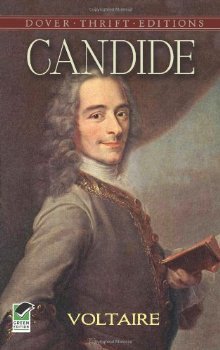
His best-known work and magnum opus, Candide, is a novella that comments on, criticizes, and ridicules many events, thinkers and philosophies of his time, most notably Gottfried Leibniz and his belief that our world is of necessity the “best of all possible worlds“.

Above: The title-page of the 1759 edition published by Cramer in Geneva, which reads, “Candide, or Optimism, translated from the German of Dr. Ralph.” – Candide, ou l’Optimisme is a French satire written by Voltaire, first published in 1759. The novella has been widely translated.

Above: Gottfried Leibniz (1646 – 1716) was a German polymath active as a mathematician, philosopher, scientist, engineer, inventor, historian and diplomat.
Alongside Isaac Newton, he is widely credited with the invention of calculus.
He is also credited with making foundational contributions to other areas of mathematics, such as binary arithmetic and statistics.
Leibniz has been called the “last true genius” due to his vast expertise across fields, which became a rarity after his lifetime with the coming of the Industrial Revolution and the spread of specialized labour.
He is a prominent figure in both the history of philosophy and the history of mathematics.
He wrote works on philosophy, theology, ethics, politics, law, history, philology, games, music, economics and other studies.
Leibniz also made major contributions to physics and technology, and anticipated notions that surfaced much later in probability theory, biology, medicine, geology, psychology, linguistics and computer science.
Leibniz contributed to the field of library science, developing a cataloguing system that came to serve as a model for many of Europe’s largest libraries.
His contributions to a wide range of subjects were scattered in various learned journals, in tens of thousands of letters and in unpublished manuscripts.
He wrote in several languages, primarily in Latin, French and German.
In philosophy and theology, Leibniz is most noted for his optimism, i.e. his conclusion that our world is, in a qualified sense, the best possible world that God could have created, a view sometimes lampooned by other thinkers.
By the time he left school, Voltaire had decided he wanted to be a writer, against the wishes of his father, who wanted him to become a lawyer.
Voltaire, pretending to work in Paris as an assistant to a notary, spent much of his time writing poetry.

Above: Paris, France
When his father found out, he sent Voltaire to study law, this time in Caen, Normandy.
But the young man continued to write, producing essays and historical studies.
Voltaire’s wit made him popular among some of the aristocratic families with whom he mixed.

Above: Hotel de Ville (City Hall) and the Abbaye aux Hommes, Caen, France
Caen is often considered the archetype of Normandy.
Caen is known for its historical buildings built during the reign of William the Conqueror (1028 – 1087), who was buried there, and for the Battle for Caen (6 June – 6 August 1944), heavy fighting that took place in and around Caen, destroying much of the city.
The city has now preserved the memory by erecting a memorial and a museum dedicated to peace, the Mémorial de Caen.
The Mémorial de Caen is a museum and war memorial in Caen, commemorating World War II and the Battle for Caen. More generally, the museum is dedicated to the history of the 20th century, mainly focused on the fragility of peace. Its intention is “pay a tribute to the martyred city of the liberation” but also to tell “what was the terrible story of the 20th century in a spirit of reconciliation“.

Above: Mémorial de Caen
In 1713, his father obtained a job for him as a secretary to the new French ambassador in the Netherlands, the Marquis de Châteauneuf, the brother of Voltaire’s godfather.
At The Hague, Voltaire fell in love with a French Protestant refugee named Catherine Olympe Dunoyer (known as ‘Pimpette‘).
Their affair, considered scandalous, was discovered by de Châteauneuf.
Voltaire was forced to return to France by the end of the year.

Above: Skyline of Den Haag (The Hague), Province of South Holland, Netherlands
The Hague (Den Haag) is the capital city of the South Holland province of the Netherlands.
The Hague is the country’s administrative centre and its seat of government.
It has been described as the country’s de facto capital since the time of the Dutch Republic, while Amsterdam is the official capital of the Netherlands.
The Hague is known as the global hub of international law and arbitration.
The International Court of Justice, the main judicial arm of the United Nations, is based in the city, as are the International Criminal Court, the Permanent Court of Arbitration, the Organisation for the Prohibition of Chemical Weapons, Europol, and approximately 200 other international governmental organizations.
Most of Voltaire’s early life revolved around Paris.
From early on, Voltaire had trouble with the authorities for critiques of the government.
As a result, he was twice sentenced to prison and once to temporary exile to England.
One satirical verse, in which Voltaire accused the Régent of incest with his daughter, resulted in an 11-month imprisonment in the Bastille.

Above: Philippe, Duke of Orléans (1674 – 1723), known as the Regent, was a French prince, soldier, and statesman who served as Regent of the Kingdom of France from 1715 to 1723.
In 1692, Philippe married his first cousin Françoise Marie de Bourbon (1677 – 1749), the youngest legitimized daughter of King Louis XIV (1638 1715).
The Comédie Française had agreed in January 1717 to stage his debut play, Œdipe.

Above: Oedipus (Œdipe) is a tragedy by the French dramatist and philosopher Voltaire that was first performed in 1718.
It was his first play and the first literary work for which he used the pen-name Voltaire. In adapting Sophocles’ (497 – 405 BC) Athenian tragedy Oedipus Rex, Voltaire attempted to rationalize the plot and motivation of its characters.
It opened in mid-November 1718, seven months after his release.
Its immediate critical and financial success established his reputation.

Above: Principal theatre of the Comédie Française, the Salle Richelieu, Paris, France
Both the Régent and King George I of Great Britain presented Voltaire with medals as a mark of their appreciation.

Above: British King George I (1660 – 1727)
Voltaire mainly argued for religious tolerance and freedom of thought.
He campaigned to eradicate priestly and aristo-monarchical authority, and supported a constitutional monarchy that protects people’s rights.

Above: Voltaire was imprisoned in the Bastille from 16 May 1717 to 15 April 1718 in a windowless cell with ten-foot-thick walls.
Voltaire’s next play, Artémire, set in ancient Macedonia, opened on 15 February 1720.
It was a flop.
Only fragments of the text survive.

Above: First publication of two fragments of Artémire, Amsterdam 1724 –
Artémire was Voltaire’s second tragedy in five acts.
When it failed at its premiere on 15 February 1720 at the Comédie Française, Voltaire withdrew it and cancelled the printing.
The action is set in Larissa in Thessaly after the death of Alexander the Great (356 – 323 BC).
Artémire, the virtuous wife of the usurper Cassandre, who actually loves the rightful aspirant of Philotas, is persecuted by her husband, and is ultimately saved by his unexpected death.
Voltaire instead turned to an epic poem about Henry IV of France that he had begun in early 1717.

Above: French King Henry IV (1553 – 1610)
Arouet adopted the name Voltaire in 1718, following his incarceration at the Bastille.
Its origin is unclear.
It is an anagram of AROVET LI, the Latinized spelling of his surname, Arouet, and the initial letters of le jeune (“the young“).
According to a family tradition among the descendants of his sister, he was known as le petit volontaire (“determined little thing“) as a child.
He resurrected a variant of the name in his adult life.
The name also reverses the syllables of Airvault, his family’s home town in the Poitou region.

Above: L’église abbatiale Saint-Pierre, Airvault, France
A writer such as Voltaire would have intended it to also convey connotations of speed and daring.
These come from associations with words such as voltige (acrobatics on a trapeze or horse), volte-face (a spinning about to face one’s enemies), and volatile (originally, any winged creature).

“Arouet” was not a noble name fit for his growing reputation, especially given that name’s resonance with à rouer (“to be beaten up“) and roué (“a profligate person“).
In a letter to Jean-Baptiste Rousseau in March 1719, Voltaire concludes by asking that, if Rousseau wishes to send him a return letter, he do so by addressing it to Monsieur de Voltaire.
A postscript explains:
“J’ai été si malheureux sous le nom d’Arouet que j’en ai pris un autre surtout pour n’être plus confondu avec le poète Roi.” (“I was so unhappy under the name of Arouet that I have taken another, primarily so as to cease to be confused with the poet Roi.“)
This probably refers to Adenes le Roi.

Above: Miniature of Adenet Le Roi (1240 – 1300), a French minstrel and poet
Voltaire is known also to have used at least 178 separate pen names during his lifetime.

Denied a licence to publish, in August 1722, Voltaire headed north to find a publisher outside France.
A publisher was eventually secured in The Hague.
In the Netherlands, Voltaire was struck and impressed by the openness and tolerance of Dutch society.

Above: Flag of the Netherlands
On his return to France, he secured a second publisher in Rouen, who agreed to publish La Henriade clandestinely.

Above: Cover of La Henriade – an epic poem of 1723 written by Voltaire.
The poem concerns and was written in honour of the life of Henry IV of France.
It is a celebration of his life.
The subject is the siege of Paris in 1589 by Henry III (1551 – 1589) in concert with Henry of Navarre, soon to be Henry IV, but its themes are the twin evils of religious fanaticism and civil discord. It also concerns the political state of France.
After Voltaire’s recovery from a month-long smallpox infection in November 1723, the first copies were smuggled into Paris and distributed.

Above: Rouen, France
While the poem was an instant success, Voltaire’s new play, Mariamne, was a failure when it first opened in March 1724.
Heavily reworked, it opened at the Comédie Française in April 1725 to a much-improved reception.

Above: Hérode et Mariamne or Mariamne is a 1724 tragedy by Voltaire.
Adapted from the writings of the historian Josephus (36 – 100), it is set in ancient Jerusalem.
It portrays the tragic death of Mariamne (died 29 BC) at the hands of her jealous husband, Herod the Great (72 – 1 BC), King of Judea, who suspects her of an intrigue with Varus, the Roman governor of Syria.
It was among the entertainments provided at the wedding of Louis XV and Marie Leszczyńska in September 1725.
Above: French King Louis XV (1710 – 1774)

Above: French Queen Marie Leszczyńska (1703 – 1768)
In early 1726, Guy Auguste de Rohan-Chabot (1683 – 1760) taunted Voltaire about his name change, who retorted that his name would win the esteem of the world, while Rohan would sully his own.
A furious Rohan arranged for his servants to beat Voltaire a few days later.
Seeking redress, Voltaire challenged Rohan to a duel, but the powerful Rohan family arranged for Voltaire to be arrested and imprisoned without trial in the Bastille on 17 April 1726.
Fearing indefinite imprisonment, Voltaire asked to be exiled to England as an alternative punishment, which the French authorities accepted.
On 2 May, he was escorted from the Bastille to Calais and embarked for England.

Above: Calais, France
Calais overlooks the Strait of Dover, the narrowest point in the English Channel, which is only 34 km (21 mi) wide here, and is the closest French town to England.
The White Cliffs of Dover can easily be seen from Calais on a clear day.
Calais is a major port for ferries between France and England.
The Channel Tunnel has connected Calais and Folkestone since 1994.
Voltaire circulated throughout English high society.
Voltaire’s exile in England greatly influenced his thinking.
He was intrigued by Britain’s constitutional monarchy in contrast to French absolutism and by the country’s greater freedom of speech and religion.

Above: Flag of the United Kingdom
He was influenced by the writers of the time and developed an interest in English literature, especially Shakespeare, who was still little known in Continental Europe.
Despite pointing out Shakespeare’s deviations from neoclassical standards, Voltaire saw him as an example for French drama, which, though more polished, lacked on-stage action.
Later, as Shakespeare’s influence began growing in France, Voltaire tried to set a contrary example with his own plays, decrying what he considered Shakespeare’s barbarities.

Above: English playwright/poet William Shakespeare (1564 – 1616)
After two and a half years in exile, Voltaire returned to France.
After a few months in Dieppe, the authorities permitted him to return to Paris.

Above: Dieppe, France
Dieppe is a seaport on the English Channel at the mouth of the river Arques.
A regular ferry service runs to Newhaven in England.
At a dinner, French mathematician Charles Marie de La Condamine proposed buying up the lottery that was organized by the French government to pay off its debts.

Above: Charles Marie de La Condamine (1701 – 1774) was a French explorer, geographer and mathematician.
He spent ten years in territory which is now Ecuador, measuring the length of a degree of latitude at the Equator and preparing the first map of the Amazon region based on astro-geodetic observations.
Furthermore he was a contributor to the Encyclopédie.
He also gained prominence as a passionate advocate for smallpox inoculation.
Voltaire joined the consortium, earning perhaps a million livres.
He invested the money cleverly and on this basis managed to convince the Court of Finances of his responsible conduct, allowing him to take control of a trust fund inherited from his father.
He was now indisputably rich.

Further success followed in 1732 with his play Zaïre, which when published in 1733 carried a dedication praising English liberty and commerce.
Zaïre (The Tragedy of Zara) is a five-act tragedy in verse by Voltaire.
Written in three weeks, it was given its first public performance on 13 August 1732 by the Comédie française in Paris.
It was a great success with the Paris audiences and marked a turning away from tragedies caused by a fatal flaw in the protagonist’s character to ones based on pathos.
The tragic fate of its heroine is caused not through any fault of her own, but by the jealousy of her Muslim lover and the intolerance of her fellow Christians.
Zaïre was notably revived in 1874 with Sarah Bernhardt in the title role.
It was the only one of Voltaire’s plays to be performed by the Comédie Française during the 20th century.
The play was widely performed in Britain well into the 19th century in an English adaptation by Aaron Hill and was the inspiration for at least thirteen operas.

Above: French stage actress Sarah Bernhardt (née Henriette-Rosine Bernard) (1844 – 1923) was a French stage actress who starred in some of the most popular French plays of the late 19th and early 20th centuries.
She played female and male roles.
“The queen of the pose and the princess of the gesture” with her “golden voice“, she made several theatrical tours worldwide and was one of the early prominent actresses to make sound recordings and act in motion pictures.
She was also an accomplished visual artist, as a painter and particularly as a sculptor.
Voltaire published his admiring essays on British government, literature, religion, and science in Letters Concerning the English Nation (1733).
In 1734, they were published in Rouen as Lettres philosophiques, causing a huge scandal.
Published without approval of the royal censor, the essays lauded British constitutional monarchy as more developed and more respectful of human rights than its French counterpart, particularly regarding religious tolerance.
The book was publicly burnt and banned.
Voltaire was again forced to flee Paris.

Above: Letters on the English (or Letters Concerning the English Nation) (Lettres philosophiques) are a series of essays written by Voltaire based on his experiences living in Great Britain between 1726 and 1729.
The book was published first in English in 1733 and then in French the following year, where it was seen as an attack on the French system of government and was rapidly suppressed.
In 1733, Voltaire met Émilie du Châtelet (Marquise du Châtelet), a mathematician and married mother of three, who was 12 years his junior and with whom he was to have an affair for 16 years.

Above: Émilie du Châtelet (1706 – 1749) was a French mathematician and physicist.
Her most recognized achievement is her philosophical magnum opus, Institutions de Physique (1740).
It circulated widely, generated heated debates, and was translated into German and Italian in 1743.
The Institutions covers a wide range of topics, including the principles of knowledge, the existence of God, hypotheses, space, time, matter and the forces of nature.
She is also known as the intellectual collaborator with and romantic partner of Voltaire.
In the two centuries since her death, numerous biographies, books and plays have been written about her life and work.
In the early 21st century, her life and ideas have generated renewed interest.
To avoid arrest after the publication of Lettres philosophiques, Voltaire took refuge at her husband’s Château at Cirey on the borders of Champagne and Lorraine.
Voltaire paid for the building’s renovation.
Émilie’s husband sometimes stayed at the Château with his wife and her lover.
The intellectual paramours collected around 21,000 books, an enormous number for the time.
Together, they studied these books and performed scientific experiments at Cirey, including an attempt to determine the nature of fire.

Above: Château de Cirey, Cirey sur Blaise, France
Having learned from his previous brushes with the authorities, Voltaire began his habit of avoiding open confrontation with the authorities and denying any awkward responsibility.
He continued to write plays, such as Mérope and began his long researches into science and history.

Above: Mérope (La Mérope Française) is a tragedy in five acts by Voltaire.
The text is a reworking by Voltaire of the Italian tragedy Merope (1713) by Scipione Maffei.
The action takes place at the court of Messene.
The Queen Dowager Merope, mourning her murdered husband Cresphonte regards the newcomer Egisthe as responsible for the murder of her son, when in fact he is her long-lost son.
He presents himself at court and eventually deposes and kills the tyrannical usurper Polyphonte, who had killed his father.
Egisthe then installs Mérope as Queen.
In December 1736, Voltaire moved to Holland for two months.
From mid-1739 to mid-1740 Voltaire lived largely in Brussels.

Above: Grand Place, Brussels, Belgium
Brussels is the capital of Belgium.
Since the end of the Second World War, it has been a major centre for international politics and home to numerous international organizations, politicians, diplomats and civil servants.
Brussels is the de facto capital of the European Union, as it hosts a number of principal EU institutions, including its administrative-legislative, executive-political, and legislative branches.
The secretariat of the Benelux (Belgium, Netherlands, Luxembourg) and the headquarters of the North Atlantic Treaty Organization (NATO) are also located in Brussels.
Brussels is known for its cuisine and gastronomic offer (including its local waffle, its chocolate, French fries and numerous types of beers),as well as its historical and architectural landmarks.
Some of them are registered as UNESCO World Heritage Sites.
Due to its long tradition of Belgian comics, Brussels is also hailed as a capital of the comic strip.
In August 1736, Frederick the Great, then Crown Prince of Prussia and a great admirer of Voltaire, initiated a correspondence with him.
In July 1740, Voltaire traveled to the Hague on behalf of Frederick in an attempt to dissuade a dubious publisher, van Duren, from printing without permission Frederick’s Anti-Machiavel.

Above: Anti-Machiavel is an 18th-century essay by Frederick the Great, King of Prussia and patron of Voltaire, consisting of a chapter-by-chapter rebuttal of The Prince, the 16th-century book by Niccolò Machiavelli (1469 – 1527).
In September, Voltaire and Frederick (now King) met for the first time in Moyland Castle near Cleves.

Above: Moyland Castle, Bedburg-Hau, Germany
In November, Voltaire was Frederick’s guest in Berlin for two weeks, followed by a meeting in September 1742 at Aix-la-Chapelle.

Above: Aachen (formerly Aix la Chapelle), Germany
Aachen was constituted as the main royal residence of the Frankish Empire (800 – 888) ruled by Charlemagne (748 – 814).
Because of that, the city is sometimes called the “cradle of Europe“.
It served as the coronation site where 31 Holy Roman Emperors were crowned Kings of the Germans from 936 to 1531
Voltaire was sent to Frederick’s court in 1743 by the French government as an envoy and spy to gauge Frederick’s military intentions in the War of the Austrian Succession (1740 – 1748).

Above: Prussian King Friedrich II (1712 – 1786)
Though deeply committed to the Marquise, Voltaire, by 1744, found life at her Château confining.
After the death of the Marquise in childbirth in September 1749, Voltaire briefly returned to Paris.
In mid-1750, he moved to Potsdam, Prussia, at the invitation of Frederick the Great.
The Prussian King (with the permission of Louis XV) made him a Chamberlain in his household, appointed him to the Order of Merit, and gave him a salary of 20,000 French livres a year.

Above: Potsdam, Germany
Potsdam was a residence of the Prussian kings and the German Emperor until 1918.
Its planning embodied ideas of the Age of Enlightenment:
Through a careful balance of architecture and landscape, Potsdam was intended as “a picturesque, pastoral dream” which would remind its residents of their relationship with nature and reason.
The city, which is over 1,000 years old, is widely known for its palaces, its lakes, and its overall historical and cultural significance.
Potsdam was also the location of the significant Potsdam Conference in 1945, the conference where the three heads of government of the USSR, the US, and the UK decided on the division of Germany following its surrender, a conference which defined Germany’s history for the following 45 years.

Above: The “Big Three” at the Potsdam Conference, Clement Attlee (UK), Harry S. Truman (US) and Joseph Stalin (USSR), 31 July 1945
The Filmstudio Babelsberg, founded in 1912, is the oldest large-scale film studio in the world.
Potsdam was named a UNESCO City of Film in 2019, joining UNESCO’s Creative Cities Network.

Voltaire had rooms at Sanssouci and Charlottenburg Palace.

Above: Sanssouci Castle, Potsdam, Germany

Above: Charlottenburg Palace, Berlin, Germany
Life went well for Voltaire, at first.
In 1751 he completed Micromégas, a piece of science fiction involving ambassadors from another planet witnessing the follies of humankind.

Above: Le Micromégas is a 1752 novella by Voltaire.
Along with his story “Plato’s Dream“, it is an early example in the literary genre of science fiction and has its place in the development of the history of literature.
The tale recounts the visit to Earth of a being from a planet circling the star Sirius, and of his companion from the planet Saturn.
The technique of using an outsider to comment on aspects of Western culture was popular in this period.
However, his relationship with Frederick began to deteriorate after he was accused of theft and forgery.
He encountered other difficulties:
An argument with Maupertuis, the President of the Berlin Academy of Science, provoked Voltaire’s Diatribe du docteur Akakia, which satirized some of Maupertuis’s theories and his persecutions of a mutual acquaintance, Johann Samuel König.

Above: Pierre Louis Moreau de Maupertuis (1698 – 1759) was a French mathematician, philosopher and man of letters.
He became the director of the Académie des Sciences and the first president of the Prussian Academy of Science, at the invitation of Frederick the Great.
Maupertuis made an expedition to Lapland to determine the shape of the Earth.
His work in natural history is interesting in relation to modern science since he touched on aspects of heredity and the struggle for life.

Above: German mathematician Johann Samuel König
This greatly angered Frederick, who ordered all copies of the document burned.
On 1 January 1752, Voltaire offered to resign as Chamberlain and return his insignia of the Order of Merit.
At first, Frederick refused until eventually permitting Voltaire to leave in March.
(Doctor Akakia (Histoire du Docteur Akakia et du Natif de St Malo) (1753) is a satirical book of a very biting nature by Voltaire, directed against pretentious pedants of science in the person of Maupertuis, the President of the Royal Academy of Sciences at Berlin.
It so excited the anger of Frederick the Great, the patron of the Academy, that “the Akakia was officially condemned in Prussia and burned by the public executioner on Christmas Eve of 1752“.)
On a slow journey back to France, Voltaire stayed at Leipzig and Gotha for a month each, and Kassel for two weeks, arriving at Frankfurt on 31 May.

Above: Leipzig, Germany

Above: Images of Gotha, Germany

Above: Hercules Monument, Kassel, Germany
The following morning, he was detained at an inn by Frederick’s agents, who held him in the city for over three weeks.
Voltaire’s luggage was ransacked and valuable items taken.

Above: Frankfurt am Main, Germany
Frankfurt is a global hub for commerce, culture, education, tourism and transportation.
It is the site of many global and European corporate headquarters.
Due to its central location in former West Germany, Frankfurt Airport became the busiest in Germany, one of the busiest in the world, the airport with the most direct routes in the world, and the primary hub for Lufthansa, the national airline of Germany and Europe’s largest airline.
Frankfurt Central Station is Germany’s second-busiest railway station after Hamburg Hbf, operated by Deutsche Bahn, the world’s largest railway company, whose Frankfurter division DB InfraGO manages the largest railway network in Europe.
Frankfurter Kreuz is the most-heavily used interchange in the EU.
Frankfurt is one of the major financial and business centers of Europe, with the headquarters of the European Central Bank.
Frankfurt’s DE-CIX is the world’s largest Internet exchange point.
The Frankfurt Book Fair is the world’s largest book fair.
Frankfurt’s skyline is shaped by some of Europe’s tallest skyscrapers, which has led to the term Mainhattan.
Voltaire’s attempts to vilify Frederick for his agents’ actions at Frankfurt were largely unsuccessful, including his Mémoires pour Servir à la Vie de M. de Voltaire, published posthumously, in which he also explicitly made mention of Frederick’s homosexuality, when he described how the King regularly invited pages, young cadets or lieutenants from his regiment to have coffee with him and then withdrew with the favourite for a brief sexual encounter.
However, the correspondence between them continued, and though they never met in person again, after the Seven Years’ War (1756 – 1763), they largely reconciled.

Voltaire’s slow progress toward Paris continued through Mainz, Mannheim, Strasbourg and Colmar, but in January 1754 Louis XV banned him from Paris.

Above: Mainz, Germany
Mainz is the birthplace of Johannes Gutenberg (1393 – 1468), who invented the printing press.

Above: Mannheim, Germany
Unusually for a German city, central Mannheim’s streets and avenues are laid out in a grid pattern, leading to its nickname as the Quadratestadt (Square City) and the tourism slogan “Leben im Quadrat” (“Life in the Square“).
Also, most of the streets in central Mannheim do not have street names.
The city blocks are instead referred to by letter and number.
Mannheim is well-known for its inventions, including the automobile, the bicycle and the tractor, leading to a nickname of the “city of inventions“.

Above: Strasbourg, France
Strasbourg is one of the de facto three main capitals of the European Union (alongside Brussels and Luxembourg), as it is the seat of several European institutions, such as the European Parliament, the Eurocorps and the European Ombudsman of the European Union.
An organization separate from the European Union, the Council of Europe (with its European Court of Human Rights, its European Directorate for the Quality of Medicines most commonly known in French as “Pharmacopée Européenne“, and its European Audiovisual Observatory) is also located in the city.
Together with Geneva (United Nations) and New York City (United Nations world headquarters), Strasbourg is among the few cities in the world that are not national capitals and host international organisations of the first order.
The city is the seat of many non-European international institutions such as the Central Commission for Navigation on the Rhine and the International Institute of Human Rights.

Above: Colmar, France
He turned for Geneva, near which he bought a large estate (Les Délices) in early 1755.

Above: Geneva, Switzerland
Geneva is a global city, an international financial centre and a worldwide centre for diplomacy, which has led to it being called the “Peace Capital“.
It hosts the highest number of international organizations in the world, including the headquarters of many agencies of the United Nations, the International Committee of the Red Cross and the International Federation of Red Cross and Red Crescent Societies.
It was where the Geneva Conventions on humanitarian treatment in war were signed, and, in the aftermath of World War I, it hosted the League of Nations.

Above: Voltaire Institute and Museum, Les Délices, Geneva, Switzerland
Les Délices (“The Delights“) was from 1755 to 1760 the home of the French philosopher Voltaire in Geneva.
Since 1952 it has housed the Institut et Musée Voltaire, a museum dedicated to his life and works.
Though he was received openly at first, the law in Geneva, which banned theatrical performances and the publication of The Maid of Orleans against his will soured his relationship with Calvinist Genevans.

Above: Portrait of Jeanne d’Arc (Joan of Arc)(1212 – 1231)
The Maid of Orleans was also certainly one of his more contentious works.
An epic and scandalous satire concerning the life of the not-yet-canonised Joan of Arc (“the Maid of Orleans“), the poem was outlawed, burned and banned throughout a great portion of Europe during the 18th and the 19th centuries.
Containing mockery and satirical commentary on the life and antics of its subject, the poem itself has variously been described as “bawdy” and “licentious“.
In late 1758, he bought an even larger estate at Ferney, on the French side of the Franco-Swiss border.

Above: Château de Voltaire, Ferney-Voltaire, France
Early in 1759, Voltaire completed and published Candide, ou l’Optimisme.
This satire on Leibniz’s philosophy of optimistic determinism remains Voltaire’s best-known work.
He would stay in Ferney for most of the remaining 20 years of his life.

Above: Ferney-Voltaire, France
In 1764, he published one of his best-known philosophical works, the Dictionnaire philosophique, a series of articles mainly on Christian history and dogmas.

Above: The Dictionnaire philosophique is an encyclopedic dictionary published by Voltaire in 1764.
The alphabetically arranged articles often criticize the Roman Catholic Church, Judaism, Islam, and other institutions.
From 1762, as an unmatched intellectual celebrity, he began to champion unjustly persecuted individuals, most famously the Huguenot merchant Jean Calas.
Calas had been tortured to death in 1763, supposedly because he had murdered his eldest son for wanting to convert to Catholicism.
His possessions were confiscated.
His two daughters were taken from his widow and forced into Catholic convents.
Voltaire, seeing this as a clear case of religious persecution, managed to overturn the conviction in 1765.

Above: French merchant Jean Calas (1698 – 1762)
In February 1778, Voltaire returned to Paris for the first time in over 25 years, partly to see the opening of his latest tragedy, Irène.
The five-day journey was too much for the 83-year-old.
He believed he was about to die on 28 February, writing:
“I die adoring God, loving my friends, not hating my enemies, and detesting superstition.”
He recovered.
In March he saw a performance of Irène, being treated by the audience as a returning hero.

Above: Irène is a tragedy in five acts by Voltaire, and his penultimate play.
It premiered in Paris on 16 March 1778.
The play was written as part of Voltaire’s plan to make a triumphal return to Paris after having spent nearly 20 years in self-imposed exile in Ferney.
He wished to end his life with a great theatrical success that would secure his position for posterity and prevent his enemies from taking any action against him.
He therefore set about writing a classical tragedy that would affirm his reputation and enable his return to the centre of French cultural life.
Irène, compelled by her family to marry Nicéphore, Emperor of Constantinople, loves the prince Alexis.
Alexis, returning victorious from campaign to Constantinople against the will of the Emperor, wishes to declare his love to Irène, but Nicéphore orders him to leave the city.
Alexis refuses, so the Emperor orders his arrest and execution.
Warned by his attaché Memnon, Alexis and his army confront the Emperor.
Defeated by Alexis but spared, Nicéphore is killed by the people.
Alexis ascends the throne.
As a widow, Irène is then obliged to enter a convent by her father Léonce.
Irène renounces her love for Alexis at her father’s insistence.
Furious that Léonce will deprive him of his love, Alexis puts the father in chains.
Irène appeals for his release and then kills herself, unable to reconcile the claims of love and duty.

Above: Illustration of Irène
Voltaire soon became ill again.
He died on 30 May 1778.
The accounts of his deathbed have been numerous and varying.
It has not been possible to establish the details of what precisely occurred.
His enemies related that he repented and accepted the last rites from a Catholic priest, or that he died in agony of body and soul, while his adherents told of his defiance to his last breath.
According to one story of his last words, when the priest urged him to renounce Satan, he replied:
“This is no time to make new enemies.“

Above: The house in Paris where Voltaire died
Because of his well-known criticism of the Church, which he had refused to retract before his death, Voltaire was denied a Christian burial in Paris, but friends and relations managed to bury his body secretly at the Abbey of Scellières in Champagne, where Marie Louise’s brother was Abbot.
His heart and brain were embalmed separately.

Above: Abbey of Scellières, Romilly sur Seine, France
The town of Ferney, where Voltaire lived out the last 20 years of his life, was officially named Ferney-Voltaire in honor of its most famous resident, in 1878.
His Château is a museum.

Above: Voltaire Statue, Ferney-Voltaire, France
Voltaire’s library is preserved intact in the National Library of Russia at Saint Petersburg.

Above: National Library of Russia, Saint Petersburg, Russia
In the Zürich of 1916, the theatre and performance group who would become the early avant-garde Dada movement named their theater the Cabaret Voltaire.

Above: Cabaret Voltaire, Zürich, Switzerland
A late-20th-century industrial music group later adopted the same name.

Above: Cabaret Voltaire are an English music group formed in Sheffield in 1973 and initially composed of Stephen Mallinder, Richard H. Kirk and Chris Watson.
(Left to right) Richard H. Kirk, Stephen Mallinder, Chris Watson
Named after the Zürich nightclub that fostered the early Dada movement, the band are often characterized as among the most innovative and influential electronic acts of their era.
Astronomers have bestowed Voltaire’s name on the Voltaire Crater on Deimos and the Asteroid 5676 Voltaire.

Above: Deimos (a moon of the planet Mars)
DIGRESSION
Cabaret Voltaire was a small artistic venue established in Zürich in February 1916, during the First World War.
It was founded by German poet and performer Hugo Ball and his partner, singer and performer Emmy Hennings.
Zürich was a neutral city during the war and had become a refuge for artists, intellectuals and political exiles from across Europe.
The founders and their associates wanted somewhere to experiment with artistic expression beyond the conventions of established culture.
The original establishment was a modest tavern.
The artists rented a room at the back, where they organized performances involving poetry, music, dance, theatre and visual art.

Above: Poster for the opening of the Cabaret Voltaire on 5 February 1916
Among those associated with the early Cabaret Voltaire were:

Above: Hugo Ball (1886 – 1927) was a German author, poet and essentially the founder of the Dada movement in European art in Zürich in 1916.
Among other accomplishments, Ball was a pioneer in the development of sound poetry.

His best known works include the “Dada Manifesto“, the Dadaist nonsense poem “Karawane“, the poetry collection 7 schizophrene Sonette, the edited diary Flight out of Time, the Christian anarchist polemic book Critique of the German Intelligentsia and the novels Flametti, or The Dandyism of the Poor and Tenderenda the Fantast.

Above: Emmy Hennings (née Emma Maria Cordsen) (1885 –1948) was a German poet and performing artist, and co-founder of the Dadaist Cabaret Voltaire with her second husband Hugo Ball.
Known as the “star of the show“, Hennings has been the subject of numerous creative works, including a best-selling novel, a graphic novel, short films and various works of visual art.

Above: Tristan Tzara (né Samuel Rosenstock) also known as S. Samyro (1896 – 1963) was a Romanian and French avant-garde poet, essayist and performance artist.
Active as a journalist, playwright, literary and art critic, composer and film director, he was known best for being one of the founders and central figures of the anti-establishment Dada movement.
Tzara’s shows at the Cabaret Voltaire and Zunfthaus zur Waag, as well as his poetry and art manifestos, became a main feature of early Dadaism.
His work represented Dada’s nihilistic side, in contrast with the more moderate approach favored by Hugo Ball.
In 1960, he was among the intellectuals who protested against French actions in the Algerian War.
Tristan Tzara was an influential author and performer, whose contribution is credited with having created a connection from Cubism and Futurism to the Beat Generation, Situationism and various currents in rock music.
A friend and collaborator of numerous modernist figures, Tzara was in a relationship from 1917 to 1922 with Maja Kruscek, before marrying the Swedish artist and poet Greta Knutson in 1925.

Above: Hans Peter Wilhelm Arp (1886 – 1966), better known as Jean Arp in English, was a German-French sculptor, painter and poet.
He was known as a Dadaist and an abstract artist.
In 1915 he moved to Switzerland to take advantage of Swiss neutrality.
Arp later told the story of how, when he was notified to report to the German consulate in Zürich, he pretended to be mentally ill in order to avoid being drafted into the German Army:
After crossing himself whenever he saw a portrait of Paul von Hindenburg, Arp was given paperwork on which he was told to write his date of birth on the first blank line.

Above: German President Paul von Hindenburg (1847 – 1934)
Accordingly, Arp wrote “16/9/87“; he then wrote “16/9/87” on every other line as well, then drew one final line beneath them and, “without worrying too much about accuracy“, calculated their sum.
The German authorities believed him.
In 1916, Hugo Ball opened the Cabaret Voltaire, which was to become the centre of Dada activities in Zürich for a group that included Arp.
Throughout the 1930s and until the end of his life, he wrote and published essays and poetry.
He produced several small works made of multiple elements that the viewer could pick up, separate, and rearrange into new configurations.

Above: Sophie Henriette Gertrud Taeuber-Arp (1889 – 1943) was a Swiss artist, painter, sculptor, textile designer, furniture and interior designer, architect, and dancer.
Born in 1889 in Davos and raised in Trogen, Switzerland, she attended a trade school in St. Gallen and, later, art schools in Germany, before moving back to Switzerland during the First World War.
At an exhibition in 1915, she met for the first time the German-French artist Jean Arp, whom she married shortly after.
It was during these years that they became associated with the Dada movement, which emerged in 1916, and Taeuber-Arp’s most famous works, such as Dada Head (1920), date from these years.

Above: Dada Head (1920), Sophie Tauber
They moved to France in 1926, where they stayed until the invasion of France during the Second World War, at the event of which they went back to Switzerland.
In early 1943, Taeuber-Arp missed the last tram home one night and slept in a snow-covered summer house.
She died there of accidental carbon monoxide poisoning caused by an incorrectly operated stove at the house of Max Bill.
Despite having largely been overlooked since her death, she is considered one of the most important artists of concrete art and geometric abstraction of the 20th century.

Above: Marcel Janco (common rendition of the Romanian name Marcel Hermann Iancu) (1895 – 1984) was a Romanian and Israeli visual artist, architect and art theorist.
He was the co-inventor of Dadaism and a leading exponent of Constructivism in Eastern Europe.
In the 1910s, he co-edited the Romanian art magazine Simbolul.
Janco was a practitioner of Art Nouveau, Futurism and Expressionism before contributing his painting and stage design to Tzara’s literary Dadaism.
He parted with Dada in 1919, when he and painter Hans Arp founded a Constructivist circle, Das Neue Leben.
He designed some of the most innovative landmarks of downtown Bucharest.
He worked in many art forms, including illustration, sculpture and oil painting.
Janco was one of the leading Romanian Jewish intellectuals of his generation.
Targeted by antisemitic persecution before and during World War II, he emigrated to Palestine in 1941.
He was a founder of Ein Hod, a Utopian art colony.
Cabaret Voltaire became the birthplace of the Dada movement.
Dada was an avant-garde artistic and literary movement that rejected conventional artistic standards, established cultural assumptions and the perceived absurdities of the society that had produced the First World War.
Its practitioners experimented with nonsense poetry, sound poetry, collage, performance, masks and unconventional combinations of artistic disciplines.

Above: Grand opening of the first Dada exhibition: International Dada Fair, Berlin, 5 June 1920
Dadaism was an international art movement that developed in the context of World War I, its aftermath, and the Futurist movement.
First established in Zürich, it later quickly spread to Berlin, Paris, New York City and a variety of artistic centers in Europe and Asia.
The Dada movement focused on rejecting prevailing ideas surrounding art, and more broadly in society.
The movement influenced later styles, like the avant-garde and downtown music movements, and groups including Surrealism, nouveau réalisme, pop art, and Fluxus.
In turn, it itself also did not arise out of nowhere.
35 years earlier, an art movement similar to Dadaism in general, called Fumism, was known in Paris.
One of its most memorable moments occurred on 23 June 1916, when Hugo Ball performed his sound poem Karawane wearing an extraordinary costume resembling a magical bishop.
Rather than delivering conventional poetry, he produced sequences of invented sounds, exploring language beyond its ordinary meaning.

Above: Ball, reading “Karawane“, Cabaret Voltaire, 1916
TO MAKE A DADAIST POEM
Take a newspaper.
Take some scissors.
Choose from this paper an article of the length you want to make your poem.
Cut out the article.
Next carefully cut out each of the words that makes up this article and put them all in a bag.
Shake gently.
Next take out each cutting one after the other.
Copy conscientiously in the order in which they left the bag.
The poem will resemble you.
And there you are – an infinitely original author of charming sensibility, even though unappreciated by the vulgar herd.
The original Cabaret Voltaire operated for only five months, closing on 23 June 1916.
Yet the movement it helped establish would influence modern art, literature, theatre and cultural criticism internationally.
The venue has since been restored and operates as a cultural institution, with exhibitions, performances, a bar and a Dada library
The name Cabaret Voltaire is particularly intriguing.
It is generally associated with the 18th century French philosopher Voltaire, whose advocacy of reason, freedom of expression and opposition to intolerance made him an important intellectual predecessor to many later challenges to established authority.
Whether the founders intended a direct tribute to him is not entirely certain, but the association is compelling.

Above: Cover of the first edition of the publication Dada, Tristan Tzara, Zürich, 1917
There is also a geographical curiosity.
Vladimir Lenin was living nearby, at Spiegelgasse 14, during his Zürich exile.
Thus, in 1916, two very different forms of revolutionary activity were taking place within a few doors of each other:
The political revolution contemplated by Lenin and the artistic rebellion of the Dadaists.

Above: Russian revolutionary Vladimir Lenin (1870 – 1924)
The Panthéon asks us to consider whom a nation chooses to honour.
Cabaret Voltaire asks us to consider what happens when artists refuse to accept the world as it is.
One is concerned with remembrance.
The other with experimentation.
One celebrates established reputation.
The other emerged from a gathering of people who were largely outsiders, exiles and unconventional thinkers.
Yet both remind us that writing and artistic expression can outlive the circumstances in which they were created.
There is perhaps a further question worth considering:
Does a writer become immortal because a nation honours them?
Or does a nation honour them because their work has already achieved a kind of immortality?
We cannot know how future generations will judge a writer’s work.
We can, however, decide whether what we write is worth writing.
A writer may aspire to be remembered, but they must first have the courage to write something worth remembering.

Voltaire was also known to have been an advocate for coffee, drinking it at every turn:
50 times a day, according to Frederick the Great.
Three times a day, said Wagniere.
It has been suggested that high amounts of caffeine stimulated his creativity.

His book Candide was listed as one of The 100 Most Influential Books Ever Written, by Martin Seymour-Smith.

In the 1950s, the bibliographer and translator Theodore Besterman started to collect, transcribe and publish all of Voltaire’s writings.
He founded the Voltaire Institute and Museum in Geneva where he began publishing collected volumes of Voltaire’s correspondence.
On his death in 1976, he left his collection to the University of Oxford, where the Voltaire Foundation became established as a department.

Above: Theodore Besterman (1904 – 1976) was a Polish-born British psychical researcher, bibliographer, biographer and translator.
In 1945 he became the first editor of the Journal of Documentation.
From the 1950s he devoted himself to studies of the works of Voltaire.
The Foundation has published the Complete Works of Voltaire, a chronological series in 205 volumes completed in 2022, more than 50 years after the first volume appeared.
It also publishes the series Oxford University Studies in the Enlightenment, begun by Bestermann as Studies on Voltaire and the Eighteenth Century, which has reached more than 500 volumes.

Voltaire experienced imprisonment in the Bastille, exile in England and repeated conflicts with French authorities.
His writings attracted admiration and hostility in equal measure.
He became an enormously influential figure during his lifetime, but his relationship with the Establishment remained difficult.
He was not an obscure writer awaiting rediscovery.
He was already a celebrated, controversial public intellectual.
Voltaire is frequently remembered as an Enlightenment philosopher, champion of reason and critic of religious intolerance.
But that description doesn’t adequately convey the pleasure of reading him.
His writing is mischievous, ironic, economical and frequently outrageous.
He can expose the absurdity of an institution or an argument with a few carefully chosen sentences.

Above: Voltaire Statue, Hermitage Museum, St. Petersburg, Russia
Take Candide.
We can research Voltaire’s criticism of optimism, particularly the philosophy associated with Leibniz.
We can watch an adaptation or read an academic explanation.
But neither quite reproduces the experience of following Candide through one absurd catastrophe after another, while the author calmly dismantles the assumption that everything happens for the best.
The humour is part of the argument.
The Voltaire Foundation at Oxford makes an important observation:
Voltaire’s writing constantly plays with different voices, personae and masks.
We cannot always take the apparent authorial voice at face value.
Why read him?
Because he teaches us to question what we are told, and to recognize that laughter can be a formidable instrument of intellectual independence.
- Jean-Jacques Rousseau (1712 – 1778) was a Genevan philosopher, writer and composer.
His political philosophy was influential during the Age of Enlightenment, as well as during the French Revolution.

Above: Jean-Jacques Rousseau
Rousseau wrote his Discourse on Inequality, which argues that private property is the source of social inequality, and The Social Contract, which outlines his ideas for what makes a legitimate political order.


Rousseau’s sentimental novel Julie, or the New Heloise (1761) was an example of his contributions to preromanticism and romanticism in fiction.

Above: Julie, first edition, title page
His Émile, or On Education (1762) is a treatise on the place of the individual in society.

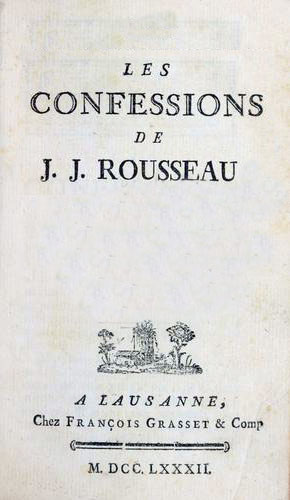
Rousseau also wrote some autobiographical writings, such as the posthumously published Confessions (1770) and Reveries of the Solitary Walker (1778) — which featured an increased focus on subjectivity and introspection.

Rousseau was born on 28 June 1712.
He later related:
“I was born almost dying.
They had little hope of saving me.”.
His mother died of puerperal fever nine days after his birth, which he later described as “the first of my misfortunes“.
He and his older brother François were brought up by their father and a paternal aunt.
When Rousseau was five, his father sold the house the family had received from his mother’s relatives.
While the idea was that his sons would inherit the principal when grown up and he would live off the interest in the meantime, in the end, the father took most of the substantial proceeds.

Above: The house where Rousseau was born: 40 Grand Rue, Geneva, Switzerland
With the selling of the house, the Rousseau family moved out of the upper-class neighbourhood and into an apartment house in a neighbourhood of craftsmen — silversmiths, engravers and watchmakers.
Growing up around craftsmen, Rousseau would later contrast them favourably to those who produced more aesthetic works, writing:
“Those important persons who are called artists rather than artisans, work solely for the idle and rich, and put an arbitrary price on their baubles.”
Rousseau was also exposed to class politics in this environment, as the artisans often agitated in a campaign of resistance against the privileged class running Geneva.

Above: Flag of the Swiss Canton of Geneva
Rousseau had no recollection of learning to read, but he remembered how when he was five or six his father encouraged his love of reading:
Every night, after supper, we read some part of a small collection of adventure stories, which had been my mother’s.
My father’s design was only to improve my reading and he thought these entertaining works were calculated to give me a fondness for it, but we soon found ourselves so interested in the adventures they contained, that we alternately read whole nights together and could not bear to give over until after a volume.
Sometimes, in the morning, on hearing the swallows at our window, my father, quite ashamed of this weakness, would cry:
“Come, come, let us go to bed.
I am more a child than thou art.”
(Confessions)
Rousseau’s reading of escapist stories affected him.
He later wrote that they “gave me bizarre and romantic notions of human life, which experience and reflection have never been able to cure me of“.
After they had finished reading the novels, they began to read a collection of ancient and modern classics left by his mother’s uncle.

Of these, his favourite was Plutarch’s Lives of the Noble Greeks and Romans, which he would read to his father while he made watches.
Rousseau saw Plutarch’s work as another kind of novel — the noble actions of heroes — and he would act out the deeds of the characters he was reading about.
In his Confessions, Rousseau stated that the reading of Plutarch’s works and “the conversations between my father and myself to which it gave rise, formed in me the free and republican spirit“.

Above: Plutarch (50 – 120) was a Greek and later Roman philosopher, historian, biographer, essayist and priest at the Temple of Apollo in Delphi.
He is known primarily for his Parallel Lives, a series of biographies of illustrious Greeks and Romans, and Moralia, a collection of essays and speeches.
Witnessing the local townsfolk participate in militias made a big impression on Rousseau.
Throughout his life, he would recall one scene where, after the volunteer militia had finished its manoeuvres, they began to dance around a fountain and most of the people from neighbouring buildings came out to join them, including him and his father.
Rousseau would always see militias as the embodiment of popular spirit in opposition to the armies of the rulers, whom he saw as disgraceful mercenaries.

When Rousseau was 10, his father, an avid hunter, got into a legal quarrel with a wealthy landowner on whose lands he had been caught trespassing.
To avoid certain defeat in the courts, he moved away to Nyon in the territory of Bern, taking Rousseau’s aunt Suzanne with him.
He remarried.
From that point, Jean-Jacques saw little of him.
Jean-Jacques was left with his maternal uncle, who packed him and his son, Abraham Bernard, away to board for two years with a Calvinist minister in a hamlet outside Geneva.
Here, the boys picked up the elements of mathematics and drawing.
Rousseau, who was always deeply moved by religious services, for a time even dreamed of becoming a Protestant minister.
Virtually all information about Rousseau’s youth has come from his posthumously published Confessions, in which the chronology is somewhat confused, though recent scholars have combed the archives for confirming evidence to fill in the blanks.
At age 13, Rousseau was apprenticed first to a notary and then to an engraver who beat him.
At 15, he ran away from Geneva (on 14 March 1728) after returning to the city and finding the city gates locked due to the curfew.

In adjoining Savoy he took shelter with a Roman Catholic priest, who introduced him to Françoise-Louise de Warens, age 29.
She was a noblewoman of a Protestant background who was separated from her husband.
As a professional lay proselytizer, she was paid by the King of Piedmont to help bring Protestants to Catholicism.

Above: Les Charmettes, where Rousseau lived with Françoise-Louise de Warens from 1735 to 1736, now a museum dedicated to Rousseau, Chambery, France
They sent the boy to Turin, the capital of Savoy (which included Piedmont, in what is now Italy), to complete his conversion.
This resulted in his having to give up his Genevan citizenship, although he would later revert to Calvinism to regain it.
In converting to Catholicism, both de Warens and Rousseau were likely reacting to Calvinism’s insistence on the total depravity of man.
Leo Damrosch writes:
“An 18th century Genevan liturgy still required believers to declare ‘that we are miserable sinners, born in corruption, inclined to evil, incapable by ourselves of doing good’“.
De Warens was attracted to Catholicism’s doctrine of forgiveness of sins.
Finding himself on his own, since his father and uncle had more or less disowned him, the teenage Rousseau supported himself for a time as a servant, secretary and tutor, wandering in Italy and France.
During this time, he lived on and off with de Warens, whom he idolized.
Maurice Cranston notes:
“Madame de Warens took him into her household and mothered him.
He called her ‘Maman’ and she called him ‘petit.’”
Flattered by his devotion, de Warens tried to get him started in a profession and arranged formal music lessons for him.
At one point, he briefly attended a seminary with the idea of becoming a priest.
Rousseau had been an indifferent student, but during his 20s, which were marked by long bouts of hypochondria, he applied himself in earnest to the study of philosophy, mathematics and music.
At 25, he came into a small inheritance from his mother and used a portion of it to repay de Warens for her financial support of him.

Above: Françoise-Louise de Warens (née Louise Éléonore de la Tour du Pil, also called Madame de Warens) (1699 – 1762), was the benefactress and mistress of Jean-Jacques Rousseau.
Warens was born in Vevey, into a Swiss Protestant family who had immigrated to Annecy, but became a Roman Catholic in 1726 in order to receive a church pension which had been instated to increase the spread of Roman Catholicism near Geneva, then a bastion of Protestantism.
She was known to have led a liberal life for a woman of her time.
She annulled her marriage to M. de Warens in 1726 after failing in a clothing business.
Rousseau met her for the first time on Palm Sunday 1728.
It was said that she was a spy and a converter for Savoy, then part of the Kingdom of Sardinia.
Though Warens was originally a teacher to Rousseau, they became sexually engaged after she openly initiated him in the matters of love and “intimacy“.
Françoise-Louise de Warens died in poverty in 1762 in Chambéry, of which Rousseau did not learn until six years afterwards.
Rousseau describes his relationship with her in his Confessions.
At 27, he took a job as a tutor in Lyon.

Above: Lyon, France
The city is recognized for its cuisine and gastronomy, as well as historical and architectural landmarks.
The districts of Old Lyon, the Fourvière hill, the Presqu’île and the slopes of the Croix-Rousse are inscribed on the UNESCO World Heritage List.
Lyon was historically an important area for the production and weaving of silk.
Lyon has played a significant role in the history of cinema since Auguste and Louis Lumière invented the cinematograph there.

Above: August Lumière (1862 – 1954) and Louıs Lumière (1864 – 1948) were French manufacturers of photography equipment, best known for their Cinématographe motion picture system and the short films they produced between 1895 and 1905, which places them among the earliest filmmakers.
Their screening of a single film on 22 March 1895, for around 200 members of the Société d’encouragement pour l’industrie nationale (Society for the Development of the National Industry) in Paris was probably the first presentation of projected film.
Their first commercial public screening on 28 December 1895, for around 40 paying visitors and invited relations, has traditionally been regarded as the birth of cinema.
The city is also known for its light festival, the Fête des lumières, which begins every 8 December and lasts for four days, earning Lyon the title of “Capital of Lights“.
Lyon hosts the international headquarters of Interpol, the International Agency for Research on Cancer, as well as Euronews.
Lyon will be the centre of the 2030 Winter Olympics.

In 1742, Rousseau moved to Paris to present the Académie des Sciences with a new system of numbered musical notation he believed would make his fortune.
His system, intended to be compatible with typography, is based on a single line, displaying numbers representing intervals between notes and dots and commas indicating rhythmic values.
Believing the system was impractical, the Academy rejected it, though they praised his mastery of the subject, and urged him to try again.

Above: The Institut de France in Paris where the Academy is housed
From 1743 to 1744, Rousseau had an honorable but ill-paying post as a secretary to the Comte de Montaigue, the French ambassador to Venice.

Above: Venezia (Venice), Italia (Italy)
It is built on a group of 126 islands that are separated by expanses of open water and by canals; portions of the city are linked by 472 bridges.
The islands are in the shallow Venetian Lagoon, an enclosed bay lying between the mouths of the Po and the Piave rivers.
Venice has been known as “La Dominante“, “La Serenissima“, “Queen of the Adriatic“, “City of Water“, “City of Masks“, “City of Bridges“, “The Floating City“, and “City of Canals“.
The lagoon and the city within the lagoon were inscribed as a UNESCO World Heritage Site in 1987, covering an area of 70,176.4 hectares (173,410 acres).
Venice is known for several important artistic movements – especially during the Italian Renaissance – and has played an important role in the history of instrumental and operatic music.
It is the birthplace of Baroque music composers Tomaso Albinoni and Antonio Vivaldi.
In the 21st century, Venice remains a very popular tourist destination and a major cultural centre.
It has often been ranked one of the most beautiful cities in the world.
It has been described by The Times as one of Europe’s most romantic cities and by The New York Times as “undoubtedly the most beautiful city built by man“.
However, the city faces challenges, including overtourism, pollution, tide peaks, and cruise ships sailing too close to buildings.
Because Venice and its lagoon are under constant threat, Venice’s UNESCO listing has been under constant examination.
This awoke in him a lifelong love for Italian music, particularly opera:
I had brought with me from Paris the prejudice of that city against Italian music, but I had also received from nature a sensibility and niceness of distinction which prejudice cannot withstand.
I soon contracted that passion for Italian music with which it inspires all those who are capable of feeling its excellence.
In listening to barcaroles, I found I had not yet known what singing was…
(Confessions)
Rousseau’s employer routinely received his stipend as much as a year late and paid his staff irregularly.
After 11 months, Rousseau quit, taking from the experience a profound distrust of government bureaucracy.

Above: Palazzo Surian Bellotto belonging to Tommaso Querini at 968 Cannaregio Venice that served as the French Embassy during Rousseau’s period as Secretary to the Ambassador
Returning to Paris, the penniless Rousseau befriended and became the lover of Thérèse Levasseur, a seamstress who was the sole support of her mother and numerous misbehaving siblings.
At first, they did not live together, though later Rousseau took Thérèse and her mother in to live with him as his servants, and himself assumed the burden of supporting her large family.
According to his Confessions, before she moved in with him, Thérèse bore him a son and as many as four other children.
Rousseau wrote that he persuaded Thérèse to give each of the newborns up to a foundling hospital, for the sake of her “honour“.
“Her mother, who feared the inconvenience of a brat, came to my aid, and Thérèse allowed herself to be overcome”
(Confessions).
In his letter to Madame de Francueil in 1751, he first pretended that he was not rich enough to raise his children, but in Confessions he gave the true reasons of his choice:
“I trembled at the thought of entrusting them to a family ill brought up, to be still worse educated.
The risk of the education of the foundling hospital was much less“.
Ten years later, Rousseau made inquiries about the fate of his son, but unfortunately no record could be found.
When Rousseau subsequently became celebrated as a theorist of education and child-rearing, his abandonment of his children was used by his critics, as the basis for his arguments.

Above: Marie-Thérèse Levasseur (1721 – 1801) was the domestic partner, mistress, wife and widow of Genevan philosopher Jean-Jacques Rousseau.
Le Vasseur met Rousseau in Paris in 1745.
Le Vasseur was working as a laundress and chambermaid at the Hotel Saint-Quentin in the rue des Cordiers, where Rousseau took his meals.
She was 24 years old at the time, he was 33.
Thérèse is described in Rousseau’s Confessions as a woman of low intelligence, exploited by her family.
Therese provided Rousseau with support and care.
When he died, she was the sole inheritor of his belongings, including manuscripts and royalties.
Beginning with some articles on music in 1749, Rousseau contributed numerous articles to Diderot and D’Alembert’s great Encyclopédie, the most famous of which was an article on political economy written in 1755.

Above: It was the first encyclopedia to include contributions from many named contributors and the first to describe the mechanical arts.
Its secular tone, which included articles skeptical about Biblical miracles, angered both religious and government authorities.
In 1758 it was banned by the Catholic Church.
In 1759, the French government banned it as well, although this ban was not strictly enforced.
Many of the initial contributors to the Encyclopédie left the project as a result of its controversies and some were even jailed.
D’Alembert left in 1759, making Diderot the sole editor.
Diderot also became the main contributor, writing around 7,000 articles.
He continued working on the project until 1765.
He was increasingly despondent about the Encyclopédie by the end of his involvement in it and felt that the entire project might have been a waste.
Nevertheless, the Encyclopédie is considered one of the forerunners of the French Revolution.
Rousseau’s ideas were the result of an almost obsessive dialogue with writers of the past, filtered in many cases through conversations with Diderot.
Rousseau saw the concept of natural selection “as an agent for improving the human species“.

Above: Denis Diderot (1713 – 1784) was a French philosopher, art critic and writer, best known for serving as co-founder, chief editor, and contributor to the Encyclopédie along with Jean le Rond d’Alembert.
In 1749, Rousseau was paying daily visits to Diderot, who had been thrown into the fortress of Vincennes under a lettre de cachet for opinions in his “Lettre sur les aveugles“, that hinted at materialism, a belief in atoms and natural selection.

Above: The Château de Vincennes is a former fortress and royal residence next to the town of Vincennes, on the eastern edge of Paris, alongside the Bois de Vincennes.
It was largely built between 1361 and 1369, and was a preferred residence, after the Palais de la Cité, of French kings from the 14th to 16th century.
It is particularly known for its “donjon” or keep, a fortified central tower (the tallest in Europe) built in the 14th century and for the chapel, Sainte-Chapelle de Vincennes, begun in 1379 but not completed until 1552, which is an exceptional example of Flamboyant Gothic architecture.
Because of its fortifications, the Château was often used as a royal sanctuary in times of trouble and as a prison and military headquarters.
The chapel was listed as an historic monument in 1853 and the keep was listed in 1913.
Most of the building is now open to the public.

Above: In Letter on the Blind for the Use of those who can see (Lettre sur les aveugles à l’usage de ceux qui voient) (1749), Denis Diderot takes on the question of visual perception, a subject that, at the time, experienced a resurgence of interest due to the success of medical procedures that allowed surgeons to operate on cataracts and certain cases of blindness from birth.
Speculations were then numerous upon what the nature and use of vision was, and how much perception, habit, and experience allow individuals to identify forms in space, to perceive distances and to measure volumes, or to distinguish a realistic work of art from reality.
According to Diderot’s essay, a blind person who is suddenly able to see for the first time does not immediately understand what he sees, and he must spend some amount of time establishing rapports between his experience of forms and distances (understandings that he first acquired by touch) and the images that were thereafter apparent to him by sight.
Rousseau had read about an essay competition sponsored by the Académie de Dijon to be published in the Mercure de France on the theme of whether the development of the arts and sciences had been morally beneficial.

Above: Académie des Sciences, Arts et Belle Lettres, Dijon, France
The Académie des Sciences, Arts et Belles-Lettres de Dijon still exists, and still offers the prize.
Rousseau wrote that while walking to Vincennes (about three miles from Paris), he had a revelation that the arts and sciences were responsible for the moral degeneration of humankind, who were basically good by nature.
Rousseau’s 1750 Discourse on the Arts and Sciences was awarded the first prize and gained him significant fame.

Above: A Discourse on the Moral Effects of the Arts and Sciences (1750), (Discours sur les sciences et les arts) and commonly referred to as The First Discourse, is an essay by Rousseau which argued that the arts and sciences corrupt human morality.
It was Rousseau’s first successfully published philosophical work, and the first expression of his influential views about nature vs. society, to which he would dedicate the rest of his intellectual life.
This work is considered one of his most important works.
Rousseau continued his interest in music.
He wrote both the words and music of his opera The Village Soothsayer, which was performed for King Louis XV in 1752.

Above: Le devin du village (“The Village Soothsayer“) is a one-act French opera (intermède) by Rousseau, who also wrote the libretto.
It was the first work in the repertory of the Académie Royale de Musique for which the text and music were by the same author.
It was first performed on 18 October 1752 before the royal court at Fontainebleau, and for the public, on 1 March 1753 at the Théâtre du Palais Royal (now the Royal Opera) in Paris.

Above: Palais Garnier (top) and Opéra Bastille (bottom), today’s homes of the Paris Opera
King Louis XV loved the piece so much that he offered Rousseau the great honor of a life pension.
To the exasperation of his friends, Rousseau turned down the great honour, bringing him notoriety as “the man who had refused a king’s pension“.

Above: French King Louis XV in coronation robes
Rousseau also turned down several other advantageous offers, sometimes with a brusqueness bordering on truculence that gave offense and caused him problems.
However, the opera became one of the most popular of its day and brought him both wealth and fame.
The opera was also performed at the wedding of the future Louis XVI and Marie Antoinette.

Above: French King Louis XVI (1754 – 1793)

Above: French Queen Marie Antoinette (1755 – 1793)
An English translation by Charles Burney, The Cunning Man, was performed in London in 1762.

Above: Charles Birney (1726 – 1814) was an English music historian, composer and musician.
Rousseau’s work was the object of a parody in the Singspiel Bastien und Bastienne by the 12-year-old Mozart.

Above: Wolfgang Amadeus Mozart (1756 – 1791) was a Classical composer and musician.
He completed more than 800 works in his life — including outstanding examples of most of the genres of his time: symphonies, concertos, chamber music, opera and choral music.
He is regarded as one of the greatest composers in the history of Western music.
To the exasperation of his friends, Rousseau turned down the great honour, bringing him notoriety as “the man who had refused a king’s pension“.
He also turned down several other advantageous offers, sometimes with a brusqueness bordering on truculence that gave offense and caused him problems.

Above: Jean-Jacques Rousseau
The same year, the visit of a troupe of Italian musicians to Paris, and their performance of Giovanni Battista Pergolesi’s La serva padrona, prompted the Querelle des Bouffons, which pitted protagonists of French music against supporters of the Italian style.

Above: Giovanni Battista Draghi (1710 – 1736) (usually referred to as Giovanni Battista Pergolesi) was an Italian Baroque composer, violinist, and organist, leading exponent of the Baroque.
He is considered one of the greatest Italian musicians of the first half of the 18th century.
Despite his short life and few years of activity (he died of tuberculosis at the age of 26), he managed to create works of high artistic value and historical importance, such as La serva padrona (The Maid Turned Mistress), which played an important role in the development and diffusion of the opera buffa in Europe, L’Olimpiade, considered one of the finest opere serie of the early 18th century, and Stabat Mater, which is among the most important works of sacred music of all time.
In his lifetime, he wrote a total of 10 works for the stage, including 3 two-part intermezzos.
(The Querelle des Bouffons (“Quarrel of the Comic Actors“), also known as the Guerre des Bouffons (“War of the Comic Actors“), was the name given to a battle of musical philosophies that took place in Paris between 1752 and 1754.
The controversy concerned the relative merits of French and Italian opera.
It was also known as the Guerre des Coins (“War of the Corners“), with those favoring French opera in the King’s corner, and those favoring Italian opera in the Queen’s corner.
It was sparked by the reaction of literary Paris to a performance of Giovanni Battista Pergolesi’s short intermezzo La serva padrona at the Académie royale de musique in Paris on 1 August 1752.
La serva padrona was performed by an itinerant Italian troupe of comic actors, known as buffoni (bouffons in French, hence the name of the quarrel).
In the controversy that followed, critics such as Jean-Jacques Rousseau, along with other writers associated with the Encyclopédie, praised Italian opera buffa.
They attacked French lyric tragedy, a style promoted by French composers.
Rousseau was an enthusiastic supporter of the Italians, making an important contribution with his Letter on French Music.)
On returning to Geneva in 1754, Rousseau reconverted to Calvinism and regained his official Genevan citizenship.
In 1755, Rousseau completed his second major work, the Discourse on the Origin and Basis of Inequality Among Men, which elaborated on the arguments of the Discourse on the Arts and Sciences.
Above: Discourse on the Origin and Basis of Inequality Among Men (Discours sur l’origine et les fondements de l’inégalité parmi les hommes), also commonly known as The Second Discourse, is a 1755 treatise by Rousseau, on the topic of social inequality and its origins.
The work was written in 1754 as Rousseau’s entry in a competition by the Academy of Dijon.
Rousseau first exposes in this work his conception of a human state of nature and of human perfectibility, an early idea of progress.
He then explains the way in which, in his view, people may have established civil society.
This leads him to conclude that private property is the original source and basis of all inequality.
He also pursued an unconsummated romantic attachment with the 25-year-old Sophie d’Houdetot, which partly inspired his epistolary novel Julie, ou la nouvelle Héloïse (also based on memories of his idyllic youthful relationship with Mme de Warens).
Sophie was the cousin and houseguest of Rousseau’s patroness and landlady Madame d’Épinay, whom he treated rather high-handedly.
He resented being at Mme. d’Épinay’s beck and call and detested what he viewed as the insincere conversation and shallow atheism of the Encyclopédistes whom he met at her table.

Above: Sophie d’Houdetot (1730 – 1813) was a French noblewoman.
She is remembered primarily for the brief but intense love she inspired in Rousseau in 1757, but she was also for 50 years in a relationship with the poet and academician Jean François de Saint-Lambert (1716 – 1803).
Wounded feelings gave rise to a bitter three-way quarrel between Rousseau and Madame d’Épinay, her lover, the journalist Grimm and their mutual friend, Diderot, who took their side against Rousseau.

Above: Louise d’Épinay (1726 – 1783), better known as Mme d’Épinay, was a French writer, a saloniste and woman of fashion, known on account of her liaisons with Friedrich Melchior, Baron von Grimm, and Jean-Jacques Rousseau, who gives unflattering reports of her in his Confessions, as well as her acquaintanceship with Denis Diderot, Jean le Rond d’Alembert, Baron d’Holbach and other French men of letters during the Enlightenment.

Above: Friedrich Melchior, Baron von Grimm (1723 – 1807) was a German-born French-language journalist, art critic, diplomat and contributor to the Encyclopédie ou Dictionnaire raisonné des sciences, des arts et des métiers.
In 1765 Grimm wrote Poème lyrique, an influential article for the Encyclopédie on lyric and opera librettos.
Grimm became interested in opera reform.
According to Martin Fontius, a German literary theorist, “sooner or later a book entitled The Aesthetic Ideas of Grimm will have to be written.”
In 1751, Grimm was introduced by Rousseau to Madame d’Épinay, with whom he began a 30-year liaison two years later, which led after four years to an irreconcilable rupture between him, Diderot and Rousseau.
Grimm and d’Holbach supported financially the mother of Thérèse Levasseur.
Instead of Rousseau, Grimm accompanied Mme. d’Épinay to Geneva to visit doctor Théodore Tronchin.
Rousseau believed Grimm had made her pregnant.
Grimm criticized Rousseau’s Julie, or the New Heloise and Émile, or On Education.
Rousseau was induced by his resentment to give in his Confessions a malicious portrait of Grimm’s character.
Diderot later described Rousseau as being “false, vain as Satan, ungrateful, cruel, hypocritical, and wicked.
He sucked ideas from me, used them himself and then affected to despise me.”
Rousseau’s break with the Encyclopédistes coincided with the composition of his three major works, in all of which he emphasized his fervent belief in a spiritual origin of man’s soul and the Universe, in contra-distinction to the materialism of Diderot.

Above: Denis Diderot Statue, Langres, France
During this period, Rousseau enjoyed the support and patronage of Charles II François Frédéric de Montmorency-Luxembourg and the Prince de Conti, two of the richest and most powerful nobles in France.
Charles II François Frédéric de Montmorency (1702 – 1764) was a French aristocrat who held a number of titles, including 8th Duke of Piney-Luxembourg, 2nd Duke of Montmorency, Prince of Aigremont and of Tingry, Count of Bouteville, of Lassé, of Dangu and of Luxe.
A Peer of France, he was made a Marshal of France in 1757 and the governor of Normandy in 1762.
He gave refuge to Rousseau at the “Small Castle” at Montmorency during 1759 to 1762 when he was quarreling with Madame d’Epinay, his protectress.

Above: Château de Montmorency

Above: Louis François de Bourbon, or Louis François I, Prince of Conti (1717 – 1776), was a French nobleman who became the Prince of Conti from 1727 to his death, succeeding his father, Louis Armand II de Bourbon.
Conti inherited literary tastes from his father, was a brave and skillful general, and a diligent student of military history.
His mistress, the cultivated Comtesse de Boufflers, presided over a salon at his home in Paris, which attracted many men of letters. Through his mistress, he became a patron of Jean Jacques Rousseau.
These men truly liked Rousseau and enjoyed his ability to converse on any subject, but they also used him as a way of getting back at Louis XV and the political faction surrounding his mistress, Madame de Pompadour.

Above: Jeanne Antoinette Poisson, Marquise de Pompadour (1721 – 1764), commonly known as Madame de Pompadour, was a member of the French court.
She was the official chief mistress of King Louis XV from 1745 to 1751.
She remained influential as court favourite until her death.
Pompadour took charge of the King’s schedule and was a valued aide and advisor, despite her frail health and many political enemies.
She secured titles of nobility for herself and her relatives.
She built a network of clients and supporters.
She was particularly careful not to alienate the popular Queen, Marie Leszczyńska.
On 8 February 1756, the Marquise de Pompadour was named as the 13th lady-in-waiting to the Queen, a position considered the most prestigious at the court, which accorded her honours.
Pompadour was a major patron of architecture and decorative arts, especially porcelain.
Hostile critics at the time generally tarred her as a malevolent political influence, but historians are more favorable, emphasizing her successes as a patron of the arts and a champion of French pride.
Modern historians suggest that the critics of Pompadour were driven by fears over the overturning of the existing hierarchies that Pompadour’s power and influence represented, as a woman who was not born into the aristocracy.
(One of my favourite Doctor Who episodes when I come across the name of Madame de Pompadour:

Madame de Pompadour is one of the main characters in “The Girl in the Fireplace“, the 4th episode of the second series of the second run of the Doctor Who revival.
The episode is set in France throughout the 18th century.
In the episode, repair androids from a spaceship from the 51st century create time windows to stalk Madame de Pompadour throughout her life.
They seek to remove her brain as a replacement part for their spaceship at a particular point in her life as they believe her to be compatible with the ship.)

Above: Sophia Myles (Madame de Pompadour) and David Tennant (10th Doctor), “The Girl in the Fireplace“, Doctor Who, 6 May 2006
Even with them, however, Rousseau went too far, courting rejection when he criticized the practice of tax farming, in which some of them engaged.
(Farming or tax-farming is a technique of financial management in which the management of a variable revenue stream is assigned by legal contract to a third party and the holder of the revenue stream receives fixed periodic rents from the contractor.
It is most commonly used in public finance, where governments (the lessors) lease or assign the right to collect and retain the whole of the tax revenue to a private financier (the farmer), who is charged with paying fixed sums (sometimes called “rents“, but with a different meaning from the common modern term) into the Treasury.
Farming in this sense has nothing to do with agriculture, other than in a metaphorical sense.)

Rousseau’s 800-page novel of sentiment, Julie, ou la nouvelle Héloïse, was published in 1761 to immense success.
The book’s rhapsodic descriptions of the natural beauty of the Swiss countryside struck a chord in the public and may have helped spark the subsequent 19th century craze for Alpine scenery.

In 1762, Rousseau published Of the Social Contract, Principles of Political Right in April.
Even his friend Antoine-Jacques Roustan felt impelled to write a polite rebuttal of the chapter on civil religion in the Social Contract, which implied that the concept of a Christian republic was paradoxical since Christianity taught submission rather than participation in public affairs.
Rousseau helped Roustan find a publisher for the rebuttal.

Rousseau published Émile, or On Education in May.
A famous section of Émile, “The Profession of Faith of a Savoyard Vicar“, was intended to be a defense of religious belief.
Rousseau’s choice of a Catholic vicar of humble peasant background (plausibly based on a kindly prelate he had met as a teenager) as a spokesman for the defense of religion was in itself a daring innovation for the time.
The vicar’s creed was that of Unitarianism.
Because it rejected original sin and divine revelation, both Protestant and Catholic authorities took offense.
Moreover, Rousseau advocated the opinion that, insofar as they lead people to virtue, all religions are equally worthy, and that people should therefore conform to the religion in which they have been brought up.
This religious indifferentism caused Rousseau and his books to be banned from France and Geneva.
He was condemned from the pulpit by the Archbishop of Paris, his books were burned and warrants were issued for his arrest.
Former friends could not accept his views and wrote violent rebuttals.
A sympathetic observer, David Hume “professed no surprise when he learned that Rousseau’s books were banned in Geneva and elsewhere“.
Rousseau, he wrote, “has not had the precaution to throw any veil over his sentiments and, as he scorns to dissemble his contempt for established opinions, he could not wonder that all the zealots were in arms against him.
The liberty of the press is not so secured in any country as not to render such an open attack on popular prejudice somewhat dangerous.“

After Rousseau’s Émile had outraged the French Parliament, an arrest order was issued by Parliament against him, causing him to flee to Switzerland.
Subsequently, when the Swiss authorities also proved unsympathetic to him — condemning both Émile and The Social Contract —Voltaire issued an invitation to Rousseau to come and reside with him, commenting that:
“I shall always love the author of the ‘Vicaire savoyard’ whatever he has done, and whatever he may do.
Let him come here to Ferney!
He must come!
I shall receive him with open arms.
He shall be master here more than I.
I shall treat him like my own son.“
Rousseau later expressed regret that he had not replied to Voltaire’s invitation.

Above: Château de Voltaire
In 1762, Rousseau was living in the vicinity of Montmorency, north of Paris.
He had just published two enormously consequential works:
- Émile, or On Education
- The Social Contract
Both provoked powerful opposition.
The controversy surrounding Émile was particularly serious.
Its discussion of religion, especially the section known as the Profession of Faith of the Savoyard Vicar, was considered heretical by religious authorities.
On 9 June 1762, the Parlement of Paris ordered the book burned and issued a warrant for Rousseau’s arrest.
He fled France.

Rousseau’s difficulties did not end when he crossed the French border.
His destination was Switzerland, where he hoped to find refuge in a country with which he had personal and historical connections.
He was, after all, a native of Geneva.

Above: Flag of Switzerland
News reached him that Geneva had also condemned Émile and The Social Contract.
His books were publicly burned there.
His native city, where he had hoped to find some protection, had now turned against him.
The authorities in Geneva were concerned about his religious and political arguments.
His criticism of established religious authority and his ideas about sovereignty and legitimate government were particularly unwelcome.
Geneva also had considerable influence in the surrounding Swiss political environment.

Above: Geneva, Switzerland
The authorities in Bern were not inclined to offer him indefinite protection in the face of the controversy.
On 14 June 1762, he arrived at Yverdon, which was then within the territory of the Canton of Bern.
Yverdon is not Bern itself.
It is a town in what is now the Canton of Vaud, Switzerland.

Above: Yverdon les Bains Castle, Switzerland
On 9 July 1762, Rousseau learned that the Bernese authorities intended to issue an order expelling him from their territories.
Rather than wait for the formal decree, he departed Yverdon.

Above: Yverdon les Bains, Switzerland
The following day, 10 July, he arrived at Môtiers, in the Principality of Neuchâtel.
This was an important distinction:
Neuchâtel was then under the sovereignty of Frederick the Great of Prussia, rather than the Canton of Bern.
Rousseau had found another refuge, although it would prove temporary.

Above: Môutiers, Switzerland
The village is often associated with absinthe (“the green fairy“), since a nearly 100-year ban on the liquor was lifted when the French Senate voted to repeal the prohibition in April 2011.
Môtiers then became the focal point of production and promotion of the liquor.
The national Maison de l’Absinthe (Absinthe Museum) is located in the former courthouse, where absinthe distillers were formerly prosecuted.

The Château d’Ivernois is an historic building complex dating back to the early 18th century, now owned by the Burkhardt-Felder Foundation.
The Foundation was established by Gerard and Theresa Burkhardt-Felder in 2002, who had lived in Australia for 25 years, where they developed an interest in both Aboriginal Australian art and motor cars.
Gerard Burkhardt-Felder was a merchant banker, and at one time chairman of Mount Edon Gold Mines in Western Australia.
Between 2003 and 2006, they converted a former agricultural building (built in 1721) and riding hall (built in 1856) into two museums:
One dedicated to Aboriginal Australian art, called La Grange.
The other to motor cars, called Le Manège.
La Grange, the Aboriginal art museum, is a large exhibition space that has hosted a series of exhibitions showcasing the work of world-famous Aboriginal artists.
It also houses a permanent collection, which includes both traditional and contemporary Aboriginal Australian art, from bark paintings and ceremonial objects to modern painting on canvas.
La Grange opened in 2008, opened with an exhibition of 53 works, including boomerangs, Tiwi sculptures, and a large work by a group of artists from Wangkatungka.
Le Manège houses a permanent exhibition of cars, ranging in date of manufacture from 1897 to 1980.
Of the 23 cars in the museum in 2009, 14 had been purchased in Australia.

Above: Château d’Ivernois, Môutiers, Switzerland
On 11 July 1762, Rousseau wrote to Frederick, describing how he had been driven from France, from Geneva, and from Bern and seeking Frederick’s protection.
He also mentioned that he had criticized Frederick in the past and would continue to be critical of Frederick in the future, stating however:
“Your Majesty may dispose of me as you like.”
Frederick, still in the middle of the Seven Years’ War, then wrote to the local governor of Neuchâtel, Marischal Keith, who was a mutual friend of theirs:
We must succor this poor unfortunate.
His only offense is to have strange opinions which he thinks are good ones.
I will send a hundred crowns, from which you will be kind enough to give him as much as he needs.
I think he will accept them in kind more readily than in cash.
If we were not at war, if we were not ruined, I would build him a hermitage with a garden, where he could live as I believe our first fathers did.
I think poor Rousseau has missed his vocation.
He was obviously born to be a famous anchorite, a desert father, celebrated for his austerities and flagellations.
I conclude that the morals of your savage are as pure as his mind is illogical.“
Rousseau, touched by the help he received from Frederick, stated that from then onwards he took a keen interest in Frederick’s activities.
As the Seven Years’ War (1756 – 1763) was about to end, Rousseau wrote to Frederick again, thanking him for the help received and urging him to put an end to military activities and to endeavor to keep his subjects happy instead.
Frederick made no known reply but commented to Keith that Rousseau had given him a “scolding“.

Above: Locator map of the competing sides of the Seven Years War before outset of the war (mid-1750s).
For more than two years (1762–1765) Rousseau lived at Môtiers, spending his time in reading and writing and meeting visitors.
As a pastime, he took up the local tradition of bobbin lace making.

In the meantime, the local ministers had become aware of the apostasies in some of his writings and resolved not to let him stay in the vicinity.
The Neuchâtel Consistory summoned Rousseau to answer a charge of blasphemy.
He wrote back asking to be excused due to his inability to sit for a long time due to his ailment.
Rousseau’s own pastor, Frédéric-Guillaume de Montmollin, started denouncing him publicly as an Antichrist.
In one inflammatory sermon, Montmollin quoted Proverbs 15:8:
“The sacrifice of the wicked is an abomination to the Lord, but the prayer of the upright is his delight.”
This was interpreted by everyone to mean that Rousseau’s taking Communion was detested by the Lord.
The ecclesiastical attacks inflamed the parishioners, who proceeded to pelt Rousseau with stones when he would go out for walks.
Around midnight of 6–7 September 1765, stones were thrown at the house Rousseau was staying in, and some glass windows were shattered.
When a local official, Martinet, arrived at Rousseau’s residence he saw so many stones on the balcony that he exclaimed:
“My God, it’s a quarry!“
At this point, Rousseau’s friends in Môtiers advised him to leave the town.

Since he wanted to remain in Switzerland, Rousseau decided to accept an offer to move to a tiny island, the Île de St.-Pierre, having a solitary house.
Rousseau eventually found what seemed an ideal retreat:
The Île Saint-Pierre (St Peter’s Island), on Lake Biel.
There was a certain irony here.
The island belonged to the Canton of Bern, the very authority that had expelled him in 1762.
Nevertheless, Rousseau sought permission to settle there.
Initially, he believed that the Bernese authorities might allow him to remain.
He arrived in September 1765 and spent several weeks enjoying the relative tranquillity of the island.
He devoted much of his time to walking, studying plants and writing.
Here, despite the remoteness of his retreat, visitors sought him out as a celebrity.

Above: St. Peter’s Island as seen from Twann/Douanne
There is something particularly revealing in Rousseau’s relationship with St Peter’s Island.
He had become increasingly disillusioned with society and its institutions.
The island offered him an opportunity to withdraw from public controversy and enjoy a simpler existence.

Above: St. Peter’s Island (Île de St. Pierre), Switzerland
In the Fifth Walk of Reveries of the Solitary Walker, he describes the extraordinary contentment he experienced there.
He writes about the pleasure of walking, collecting plants, observing nature and simply existing without the demands and disturbances of society.
It is a very different Rousseau from the political philosopher of The Social Contract.
It illustrates the tension between Rousseau’s intellectual ambitions and his desire for personal tranquillity.
He wanted to engage with society, challenge its institutions and propose alternatives.
Yet he increasingly found himself seeking refuge from the very society he wished to reform.
And perhaps that is the most interesting aspect of his story:
The man who wrote about the relationship between the individual and society eventually found himself unable to live peacefully within it.
Before his expulsion, Rousseau spent two months on the island in 1765, calling it the “happiest time of his life“.

The respite did not last.
On 17 October 1765, the Senate of Bern ordered Rousseau to leave the island and all Bernese territory within 15 days.
He replied, requesting permission to extend his stay, and offered to be incarcerated in any place within their jurisdiction with only a few books in his possession and permission to walk occasionally in a garden while living at his own expense.
The Senate’s response was to direct Rousseau to leave the island, and all Bernese territory, within 24 hours.
On 29 October 1765 he left the Île de St.-Pierre and moved to Strasbourg.

Above: Strasbourg, France
At this point he received invitations from several parties in Europe, and soon decided to accept Hume’s invitation to go to England.
On 9 December 1765, having secured a passport from the French government, Rousseau left Strasbourg for Paris where he arrived a week later and lodged in a palace of his friend, the Prince of Conti.
Here he met David Hume, and also numerous friends and well-wishers, and became a conspicuous figure in the city.
At this time, Hume wrote:
“It is impossible to express or imagine the enthusiasm of this nation in Rousseau’s favor.
No person ever so much enjoyed their attention.
Voltaire and everybody else are quite eclipsed.“

Above: David Hume (né David Home) (1711 – 1776) was a Scottish philosopher, historian, economist and essayist who is known for his highly influential system of empiricism, philosophical scepticism and metaphysical naturalism.
Beginning with A Treatise of Human Nature (1740), Hume strove to create a naturalistic science of man that examined the psychological basis of human nature.
Hume rejected the existence of innate ideas, holding that all our ideas derive ultimately from impressions, but in his fork he distinguished relations of ideas, known a priori, from matters of fact, whose knowledge rests on experience.
Hume argued that inductive reasoning and belief in causality cannot be justified empirically.
Instead, they result from custom and mental habit.
People never actually perceive that one event causes another but experience only the “constant conjunction” of events.
This problem of induction means that to draw any causal inferences from past experience, it is necessary to presuppose that the future will resemble the past.
This metaphysical presupposition cannot itself be grounded in prior experience.
An opponent of philosophical rationalists, Hume held that passions rather than reason govern human behaviour, proclaiming that “Reason is, and ought only to be the slave of the passions.”
Hume was also a sentimentalist who held that ethics are based on emotion or sentiment rather than abstract moral principle.
He maintained an early commitment to naturalistic explanations of moral phenomena and is usually accepted by historians of European philosophy to have first clearly expounded the is–ought problem, or the idea that a statement of fact alone can never give rise to a normative conclusion of what ought to be done.
Hume denied that people have an actual conception of the self, positing that they experience only a bundle of sensations and that the self is nothing more than this bundle of perceptions connected by an association of ideas.
Hume’s compatibilist theory of free will takes causal determinism as fully compatible with human freedom.
His philosophy of religion, including his rejection of miracles and critique of the argument from design, was especially controversial.
During his lifetime, Hume was chiefly known as a historian and essayist, as his History of England became a bestseller, while his Treatise initially received little notice and his supposed atheism saw him passed over for university chairs.
Hume left a legacy that affected utilitarianism, logical positivism, the philosophy of science, early analytic philosophy, cognitive science, theology and many other fields and thinkers.
Immanuel Kant credited Hume as the inspiration that had awakened him from his “dogmatic slumbers“.

Above: Immanuel Kant (né Emanuel Kant) (1724 – 1804) was a German philosopher.
Born in Königsberg in the Kingdom of Prussia, he is considered one of the central thinkers of the Enlightenment.
His comprehensive and systematic works in epistemology, metaphysics, logic, ethics, aesthetics, political theory, and philosophy of religion have made him one of the most influential and highly discussed figures in modern Western philosophy.
On 4 January 1766, Rousseau left Paris with Hume, the merchant De Luze (an old friend of Rousseau), and Rousseau’s pet dog Sultan.
After a four-day journey to Calais, where they stayed for two nights, the travelers embarked on a ship to Dover.

Above: Dover, England

Above: The White Cliffs of Dover
On 13 January 1766, they arrived in London.
Soon after their arrival, David Garrick arranged a box at the Drury Lane Theatre for Hume and Rousseau on a night when the King and Queen also attended.
Garrick was himself performing in a comedy by himself, and also in a tragedy by Voltaire.
Rousseau became so excited during the performance that he leaned too far and almost fell out of the box.
Hume observed that the King and Queen were looking at Rousseau more than at the performance.
Afterwards, Garrick served supper for Rousseau, who commended Garrick’s acting:
“Sir, you have made me shed tears at your tragedy, and smile at your comedy, though I scarce understood a word of your language.“

Above: David Garrick (1716 – 1779) was an English actor who wrote, produced and influenced nearly all aspects of 18th century European theatrical practice.
He appeared in several amateur theatricals, and with his appearance in the title role of Shakespeare’s Richard III, audiences and managers began to take notice.
Impressed by his portrayals of Richard III and several other roles, Charles Fleetwood engaged Garrick for a season at the Theatre Royal, Drury Lane in the West End.
He remained with the Drury Lane company for the next five years and purchased a share of the theatre with James Lacy.
This purchase inaugurated 29 years of Garrick’s management of the Drury Lane, during which time it rose to prominence as one of the leading theatres in Europe.
At his death, three years after he retired from Drury Lane and the stage, he was given a lavish public funeral at Westminster Abbey where he was buried in Poets’ Corner.
As an actor, Garrick promoted realistic acting that departed from the bombastic style that was entrenched when he first came to prominence.
His acting delighted many audiences and his direction of many of the top actors of the English stage influenced their styles as well.
During his tenure as manager of Drury Lane, Garrick also sought to reform audience behaviour.
While this led to some discontent among the theatre-going public, many of his reforms eventually did take hold.
Garrick also sought reform in production matters, bringing an overarching consistency to productions that included set design, costumes and even special effects.

Above: Theatre Royal, Drury Lane, London, England
At this time, Hume had a favorable opinion of Rousseau.
In a letter to Madame de Brabantane, Hume wrote that after observing Rousseau carefully he had concluded that he had never met a more affable and virtuous person.
According to Hume, Rousseau was “gentle, modest, affectionate, disinterested, of extreme sensitivity“.
Initially, Hume lodged Rousseau in the house of Madam Adams in London, but Rousseau began receiving so many visitors that he soon wanted to move to a quieter location.
An offer came to lodge him in a Welsh monastery.
He was inclined to accept it, but Hume persuaded him to move to Chiswick.

Above: St. Nicholas Church, Chiswick, England
Chiswick is a district in West London.
It contains Hogarth’s House, the former residence of the 18th-century English artist William Hogarth, Chiswick House, a neo-Palladian villa regarded as one of the finest in England and Fuller’s Brewery, London’s largest and oldest brewery.
People who have lived in Chiswick include:

Above: Alexander Pope (1688 – 1744) was an English poet, translator, and satirist who is considered one of the most prominent English poets of the early 18th century.
He is best known for his satirical and discursive poetry, including An Essay on Criticism (1711), The Rape of the Lock (1717), The Dunciad (1743), and for his translations of Homer (8th century BC)..
Pope is often quoted in The Oxford Dictionary of Quotations, some of his verses having entered common parlance (e.g. “damning with faint praise” or “To err is human. To forgive, divine.“).

Above: William Butler Yeats (1865 – 1939) was an Irish poet, dramatist, writer and literary critic who was one of the foremost figures of 20th-century literature.
He was awarded the 1923 Nobel Prize in Literature.
He later served two terms as a Senator of the Irish Free State.
His major works include The Land of Heart’s Desire (1894), Cathleen ni Houlihan (1902), The Wild Swans at Coole (1919) and The Tower (1928).

Above: Ugo Foscolo (1778 – 1827) (né Niccolò Foscolo) was an Italian writer, revolutionary and poet.
He is remembered for his 1807 long poem Dei Sepolcri, for writing what is considered the first modern Italian novel, The Last Letters of Jacopo Ortis (1798) and the carmen The Graces (1812).
His novel The Last Letters of Jacopo Ortis (1798), which was described by the 1911 Encyclopædia Britannica as a more politicized version of Johann Wolfgang von Goethe’s The Sorrows of Young Werther:
“For Foscolo’s hero embodies the mental sufferings and suicide of an undeceived Italian patriot just as Goethe’s hero places before us the too-delicate sensitiveness, embittering and at last cutting short the life of a private German scholar.“
The story of The Last Letters of Jacopo Ortis had a groundwork of melancholy fact.
Jacopo Ortis had been a real person.
He was a young student from Padua.
He committed suicide there under circumstances akin to those described by Foscolo.
Foscolo, like many of his contemporaries, had thought much about suicide.
In the case of Foscolo, as in that of Goethe, the effect produced on the writer’s mind by the composition of the work seems to have been beneficial.
He had seen the ideal of a great national future rudely shattered, but he did not despair of his country.
He sought relief in now turning to gaze on the ideal of a great national poet.

Above: Vincent Willem van Gogh (1853 – 1890) was a Dutch painter who is among the most famous and influential figures in the history of Western art.
In just over a decade he created about 2,100 artworks, including around 860 oil paintings, most of them in the last two years of his life.
They include landscapes, still lifes, portraits and self-portraits.
They are characterized by bold colours and dramatic, impulsive and expressive brushwork that contributed to the foundations of modern art.
His suicide at age 37 followed years of mental illness and poverty.
Van Gogh drew as a child and was serious, quiet and thoughtful.
As a young man he worked as an art dealer, often travelling, but became depressed after he was transferred to London.
He turned to religion.
He spent time as a Protestant missionary in southern Belgium.
He drifted in ill health and solitude before taking up painting, having moved back home with his parents.
His early works, mostly still lifes and depictions of peasant labourers, contain few signs of the vivid colour that distinguished his later work.
As his work developed he created a new approach to still lifes and local landscapes.
His paintings grew brighter in colour as he developed a style that became fully realized during his stay in Arles in the south of France in 1888.
During this period he broadened his subject matter to include series of olive trees, wheat fields and sunflowers.
Van Gogh suffered from psychotic episodes and delusions and though he worried about his mental stability, he often neglected his physical health, did not eat properly and drank heavily.
His friendship with Gauguin ended after a confrontation with a razor, when in a rage, he severed part of his own left ear.
He spent time in psychiatric hospitals.
His depression continued.
On 27 July 1890, Van Gogh shot himself in the chest with a revolver.
He died from his injuries two days later.
Van Gogh was unsuccessful during his lifetime and was considered a madman and a failure.
He became famous after his suicide.
He exists in the public imagination as the quintessential misunderstood genius, the artist “where discourses on madness and creativity converge“.
His reputation began to grow in the early 20th century.
He attained widespread critical, commercial and popular success over the ensuing decades.
He is remembered as an important but tragic painter, whose troubled personality typifies the romantic ideal of the tortured artist.

Above: Camille Pissarro (1830 – 1903) was a Danish-French painter born on the island of Saint Thomas (now in the US Virgin Islands, but then in the Danish West Indies).
In 1873 he helped establish a collective society of fifteen aspiring artists, becoming the “pivotal” figure in holding the group together and encouraging the other members.
Pissarro was the “dean of the Impressionist painters“, not only because he was the oldest of the group, but also “by virtue of his wisdom and his balanced, kind, and warmhearted personality“.

Above: Edward Morgan Forster (1879 – 1970) was an English author.
He is best known for his novels, particularly A Room with a View (1908), Howards End (1910) and A Passage to India (1924).
He also wrote numerous short stories, essays, speeches and broadcasts, as well as biographies and pageant plays.
His short story “The Machine Stops” (1909) is often viewed as the beginning of technological dystopian fiction.
The story describes a world in which most of the human population has lost the ability to live on the surface of the Earth due to extreme climate changes and toxic air.
Each individual now lives in isolation below ground in a small standard room, with all survival, comfort and entertainment needs met by the omnipotent, global Machine.
Travel to the surface is permitted but is unpopular and rarely necessary.
Communication is made via a kind of instant messaging/video conferencing machine with which people conduct their only activity: the sharing of ideas and what passes for knowledge.
The main theme of the story is the danger that humanity faces when it becomes overly reliant on technology for its survival.
A less obvious, though equally important theme is what Forster refers to as “the sin against the body“.
This occurs when people’s intellectual refinement and spirituality advance to such a point that they become disconnected from their physical bodies and are unable to adapt to changing environments.
Many of Forster’s novels examine class differences and hypocrisy.
His views as a humanist are at the heart of his work.
He was nominated for the Nobel Prize in Literature in 22 separate years.

Above: Pete Townshend is an English musician and songwriter.
He is the co-founder, guitarist, keyboardist, second lead vocalist, and principal songwriter of the Who, one of the most influential rock bands of the 1960s and 1970s.
His aggressive playing style, poetic songwriting techniques and authorship of two rock operas with the Who, as well as other projects, have earned him critical acclaim.

Above: John Entwistle (1944 – 2002) was an English singer, songwriter, musician, composer and record producer, best known as the bass guitarist for the rock band the Who.
Entwistle’s music career spanned over four decades.
Nicknamed “The Ox” and “Thunderfingers“, he was the band’s only member with formal musical training.
He also provided backing and occasional lead vocals plus some French horn or trumpet.
Entwistle was inducted into the Rock and Roll Hall of Fame as a member of the Who in 1990.
Renowned for his musical abilities, Entwistle is widely regarded as one of the greatest and most influential rock bassists of all time.

Above: Phil Collins is an English singer, drummer, songwriter, record producer and actor.
He is best known as the drummer and later lead vocalist of the rock band Genesis, and for his highly successful solo career.
Between 1982 and 1990, Collins achieved three UK and seven US number-one singles as a solo performer.
His work with Genesis, his solo material and collaborations with other prominent musicians resulted in more US top-40 singles than any other artist during the 1980s.
One of the world’s best-selling music artists, Collins has sold over 100 million albums worldwide with Genesis and as a solo artist, making him one of only three recording artists, alongside Paul McCartney and Michael Jackson, to have sold more than 100 million albums as a solo artist and in a band.
Ranked by Rolling Stone as one of the 100 Greatest Drummers of All Time, he was inducted into the Modern Drummer Hall of Fame in 2012.
Collins was inducted into the Rock and Roll Hall of Fame as a member of Genesis in 2010 and as a solo artist in 2026.
Perhaps there is something in Chiswick water?
Rousseau now asked for Thérèse to rejoin him.
On 22 March 1766, Rousseau and Thérèse set forth for Wootton, against Hume’s advice.
Hume and Rousseau would never meet again.
Initially Rousseau liked his new accommodation at Wootton Hall and wrote favorably about the natural beauty of the place, and how he was feeling reborn, forgetting past sorrows.

Above: Wootton, England
On 1 January 1766, Grimm included in his Correspondance littéraire a letter said to have been written by Frederick the Great to Rousseau.
It had actually been composed by Horace Walpole as a playful hoax.
Walpole had never met Rousseau, but he was well acquainted with Diderot and Grimm.
The letter soon found wide publicity.
Hume is believed to have been present, and to have participated in its creation.
This letter was one of the reasons for the later rupture in Hume’s relations with Rousseau.

Above: Horace Walpole, 4th Earl of Orford (1717 – 1797) was a British politician, writer, historian and antiquarian.
His literary reputation rests on the first Gothic novel, The Castle of Otranto (1764), and his Letters, which are of significant social and political interest.
On 3 April 1766 a daily newspaper published the letter constituting Horace Walpole’s hoax on Rousseau — without mentioning Walpole as the actual author.
That the editor of the publication was Hume’s personal friend compounded Rousseau’s grief.
Gradually articles critical of Rousseau started appearing in the British press.
Rousseau felt that Hume, as his host, ought to have defended him.
Moreover, in Rousseau’s opinion, some of the public criticism contained details to which only Hume was privy.
Further, Rousseau was aggrieved to find that Hume had been lodging in London with François Tronchin, son of Rousseau’s enemy in Geneva.
About this time, Voltaire anonymously (as always) published his Letter to Dr. J.-J. Pansophe in which he gave extracts from many of Rousseau’s prior statements which were critical of life in England.
The most damaging portions of Voltaire’s writeup were reprinted in a London periodical.
Rousseau now decided that there was a conspiracy afoot to defame him.

A further cause for Rousseau’s displeasure was his concern that Hume might be tampering with his mail.
The misunderstanding had arisen because Rousseau tired of receiving voluminous correspondence whose postage he had to pay.
Hume offered to open Rousseau’s mail himself and to forward the important letters to Rousseau.
This offer was accepted.
However, there is some evidence of Hume intercepting even Rousseau’s outgoing mail.

After some correspondence with Rousseau, which included an 18-page letter from Rousseau describing the reasons for his resentment, Hume concluded that Rousseau was losing his mental balance.
On learning that Rousseau had denounced him to his Parisian friends, Hume sent a copy of Rousseau’s long letter to Madame de Boufflers.
She replied stating that, in her estimation, Hume’s alleged participation in the composition of Horace Walpole’s faux letter was the reason for Rousseau’s anger.

When Hume learnt that Rousseau was writing the Confessions, he assumed that the present dispute would feature in the book.
In October 1766 Hume’s version of the quarrel was translated into French and published in France.
In November it was published in England.
Grimm included it in his Correspondance littéraire.
Ultimately:
…the quarrel resounded in Geneva, Amsterdam, Berlin, and St. Petersburg.
A dozen pamphlets redoubled the bruit.
Walpole printed his version of the dispute.
Boswell attacked Walpole.
Mme. de La Tour’s “Precis sur M. Rousseau” called Hume a traitor.
Voltaire sent him additional material on Rousseau’s faults and crimes, on his frequentation of “places of ill fame”, and on his seditious activities in Switzerland.
George III “followed the battle with intense curiosity”.
After the dispute became public, due in part to comments from notable publishers like Andrew Millar, Walpole told Hume that quarrels such as this only end up becoming a source of amusement for Europe.
Diderot took a charitable view of the mess:
“I knew these two philosophers well.
I could write a play about them that would make you weep, and it would excuse them both.“
Amidst the controversy surrounding his quarrel with Hume, Rousseau maintained a public silence, but he resolved now to return to France.
To encourage him to do so swiftly, Thérèse advised him that the servants at Wootton Hall sought to poison him.
On 22 May 1767 Rousseau and Thérèse embarked from Dover for Calais.
On 22 May 1767, Rousseau reentered France even though an arrest warrant against him was still in place.
He had taken an assumed name, but was recognized.
A banquet in his honour was held by the city of Amiens.

Above: Amiens, France
A central landmark of the city is Amiens Cathedral, the largest Gothic cathedral in France.
Amiens also has one of the largest university hospitals in France, with a capacity of 1,200 beds.
The author Jules Verne lived in Amiens from 1871 until his death in 1905, and served on the city council for 15 years.
Amiens is the birthplace of current French president Emmanuel Macron.
Amiens has an important historical and cultural heritage, on which a significant amount of tourism is based.
Apart from the cathedral, there are the hortillonnages, the Jules Verne House, the Tour Perret, the Musée de Picardie, the zoo, and the Saint-Leu and Saint-Maurice neighborhoods.
During December, the town hosts the largest Christmas market in northern France.

Above: Jules Verne (1828 – 1905) was a French novelist, poet and playwright.
His collaboration with the publisher Pierre-Jules Hetzel led to the creation of the Voyages extraordinaires, a series of bestselling adventure novels including Journey to the Center of the Earth (1864), Twenty Thousand Leagues Under the Seas (1870), and Around the World in Eighty Days (1872).
His novels are generally set in the second half of the 19th century, taking into account contemporary scientific knowledge and the technological advances of the time.
In addition to his novels, he wrote numerous plays, short stories, autobiographical accounts, poetry, songs, and scientific, artistic and literary studies.
His work has been adapted for film and television since the beginning of cinema, as well as for comic books, theater, opera, music and video games.
Verne is considered to be an important author in France and most of Europe, where he has had a wide influence on the literary avant-garde and on surrealism.
Jules Verne has been the second most-translated author in the world since 1979, ranking below Agatha Christie and above William Shakespeare.
He has sometimes been called the “father of science fiction“.
In the 2010s, he was the most translated French author in the world.

Above: Tomb of Jules Verne, Amiens, France
French nobles offered him a residence at this time.
Initially, Rousseau decided to stay in an estate near Paris belonging to Mirabeau.
Subsequently, on 21 June 1767, he moved to a chateau of the Prince of Conti in Trie.

Above: Town Hall, Trie-Château, France
Around this time, Rousseau started developing feelings of paranoia, anxiety and of a conspiracy against him.
Most of this was just his imagination at work, but on 29 January 1768, the theatre at Geneva was destroyed through burning.
Voltaire mendaciously accused Rousseau of being the culprit.

Above: Geneva, Switzerland
In June 1768, Rousseau left Trie, leaving Thérèse behind, and went first to Lyon, and subsequently to Bourgoin.
He now invited Thérèse to this place and married her, under his alias “Renou” in a faux civil ceremony in Bourgoin on 30 August 1768.

Above: City Centre, Bourgoin, France
In January 1769, Rousseau and Thérèse went to live in a farmhouse near Grenoble.
Here he practiced botany and completed the Confessions.
At this time he expressed regret for placing his children in an orphanage.

Above: Images of Grenoble
Grenoble is the largest metropolis in the Alps, ahead of Innsbruck and Bolzano.
A significant European scientific centre, the city advertises itself as the “Capital of the Alps“, due to its size and its proximity to the mountains.
The 10th Olympic Winter Games were held here in 1968.
It was the birthplace of Stendhal and Seyhan Kurt.

Above: Marie-Henri Beyle (1783 – 1842), better known by his pen name Stendhal, was a French writer.
Best known for the novels Le Rouge et le Noir (The Red and the Black, 1830) and La Chartreuse de Parme (The Charterhouse of Parma, 1839), he is highly regarded for the acute analysis of his characters’ psychology and considered one of the early and foremost practitioners of realism.
Stendhal is also known for De l’amour, his work on “passionate love” in which the concept of “crystallization” was invented.
The book was mostly ignored after publishing, but has been lauded posthumously as one of the first “modern” attempts at understanding love.
Sharon Brehm, a president of the American Psychological Association,[9] has called Stendhal “a first-rate psychologist before the official term was coined“.

Above: Seyhan Kurt is a French-Turkish poet, writer, anthropologist and sociologist.
In his 2021 book From Household to Home State, he emphasized the importance of not only architecture, but also disciplines such as anthropology and sociology that examine daily practices, regulations and consumption phenomena when dealing with the concept of “Turkish house“.
In his study, he adopted an interdisciplinary method by utilizing different fields from Turkish cinema to oral culture:
Seyhan Kurt’s book From Household to Home State traces the image of the “Turkish house”, which dates from the 19th century to the present day, historically, anthropologically, sociologically, architecturally, and economically.
According to Kurt, this image has a direct relationship to collective memory.
Therefore, the “Turkish house” has a meaning that refers to daily life here, as well as to architecture.
The author investigates the concepts of “while” and “time” by giving examples from Anatolian life, Turkish literature, thought, and cinema under the title of “In Respect of While, Time and Urban Space”.
These basic concepts are some of the most important arguments in comprehending the historical, social and economic processes that a society goes through.
In Istanbul and eventually in Anatolia, clock interiors of the household type and clock towers in the town square since the end of the 19th century have transformed the world of thought and individual-city relations.
How this process occurred, including encountered problems, is explained comprehensively by using the texts of significant writers and thinkers.
The author begins with objects to describe the transformation of the Turkish house.
Wall clocks, showcases, curtains, lace, microwave ovens, American kitchens, furniture on one side.
Cedar, courtyard, tandoor, hearth, gizzard, closet, gushane, doors, knockers, “who came windows” on the other side.
Seyhan Kurt’s book examines this concept of Turkish House, but starting from the perception of time, he looks at the use of space, the placement of things and daily life.
Crime has been a concern in Grenoble for decades, in particular drug trafficking, and more recently racketeering, especially in the construction field.
Crime in Grenoble and its area has grown significantly in the 2020s.
In 2020 there were seven shootings recorded.
In 2022, nine different shootings were recorded in under two months.
In March 2024, there was a shooting in the suburb of Saint-Bruno, which was one of the primary “deal-points” of rival drug gangs.
A few months later, seven shootings were recorded over summer, leading to criticism of the Mayor, Éric Piolle.
On 12 February 2025, a grenade was thrown into a pub,
A week later, a ram-raid car was used in an arson attack on a recently-opened public library.
In March 2025 a former druglord was assassinated on the A41 highway.
Several more killings of young men were recorded in December of that year.
Grenoble is an interesting case because its reputation for crime has become closely connected to a wider debate in France about drug trafficking, organised criminal networks, urban inequality and the effectiveness of local policing.
Grenoble’s crime problem is not simply a matter of ordinary street crime increasing.
Much of the concern centres on organised drug trafficking and the violence associated with competing criminal networks.
Grenoble and its surrounding towns, particularly Échirolles, have established drug-trafficking networks operating through neighbourhood distribution points.
These can be extremely lucrative.
A 2024 investigation by Le Monde reported that some locations were generating estimated daily turnover of €10,000–€35,000.
Control of these locations means control of a valuable source of income.
When a leading dealer is arrested, imprisoned or killed, competitors may attempt to take over the territory.
This can trigger retaliation and further violence.
The result is an ongoing struggle over individual neighbourhoods rather than simply a conventional crime problem.
The violence has become particularly alarming because of the weapons being used.
Reports describe shootings involving assault rifles, including Kalashnikov-type weapons, and attacks intended to intimidate rival dealers.
In May 2026, a series of shootings in the Grenoble metropolitan area resulted in multiple deaths.
Le Dauphiné Libéré reported seven deaths in drug-related settling of scores since the beginning of that year.
Organized criminal networks need people to act as lookouts, couriers, sellers and, increasingly, enforcers.
Young people can be attracted by relatively immediate financial rewards, particularly where legitimate employment opportunities are limited.
This creates a particularly damaging cycle:
Young recruits become exposed to criminal violence.
Some become perpetrators themselves.
The wider French drug market has also seen violence outsourced to relatively inexperienced young assailants recruited through encrypted messaging services.
Some neighbourhoods around Grenoble have experienced concentrated poverty, unemployment, housing difficulties and social exclusion.
Where criminal organisations establish a presence, they can exploit economic vulnerability, intimidate residents and undermine confidence in public institutions.
The consequences extend well beyond those directly involved in trafficking.
Ordinary residents become victims of intimidation, shootings and the deterioration of their neighbourhoods.
Grenoble is situated in the French Alps, close to major transport connections linking southeastern France with Lyon, the Mediterranean region, Switzerland and Italy.
Its position makes it an important regional centre, although geography alone does not explain its criminal problems.
The local drug market, established trafficking networks and competition between criminal groups are more immediate explanations.
A 2025 investigation by Le Parisien specifically examined Grenoble’s geographical position when considering why the city experienced recurring drug-related violence.
The response has included:
- Increased police presence in affected neighbourhoods.
- Investigations targeting organised trafficking networks.
- Arrests and prosecutions.
- Operations involving several government agencies, not just the police.
- Measures intended to disrupt the physical infrastructure used by dealers.
In July 2026, a major coordinated operation across Grenoble and Échirolles resulted in nearly 100 arrests, most connected with drug trafficking.
Seven neighbourhoods were targeted.
Nevertheless, the problem is difficult to resolve.
Arresting individuals does not necessarily dismantle the market that supports the criminal organization.
Another group may simply attempt to occupy the vacant territory.
The reputation of Grenoble as the Chicago of France has circulated for years. It is a memorable journalistic label, but it risks obscuring the differences between neighbourhoods, types of crime and the experiences of ordinary residents.
Indeed, a 2025 assessment in Le Parisien raised precisely this question: whether the dramatic reporting of individual incidents accurately represented the overall development of crime.
I would describe Grenoble’s predicament as a combination of three problems:
- An established and profitable illegal drug market.
- Competition between criminal organisations, increasingly involving firearms and targeted violence.
- The difficulty of restoring lasting public authority in neighbourhoods where criminal networks have become entrenched.
There is also a wider French dimension.
Grenoble is not alone.
Marseille, Nantes, Lyon and several smaller French cities have experienced serious violence connected with drug trafficking.
The issue has become a major national concern.
There is an interesting contrast between the Grenoble of Rousseau’s time and the Grenoble of today.
Rousseau sought refuge in the surrounding region because he feared the authorities and the consequences of his writings.
Today, residents in certain neighbourhoods are concerned about the ability of public institutions to protect them from criminal organisations.
Different centuries, different circumstances, but an enduring question about the relationship between individuals, society and the institutions responsible for protecting them.
On 10 April 1770, Rousseau and Thérèse left for Lyon where he befriended Horace Coignet, a fabric designer and amateur musician.
At Rousseau’s suggestion, Coignet composed musical interludes for Rousseau’s prose poem Pygmalion.
This was performed in Lyon together with Rousseau’s romance The Village Soothsayer to public acclaim.
On 8 June, Rousseau and Thérèse left Lyon for Paris.
They reached Paris on 24 June.
In Paris, Rousseau and Thérèse lodged in an unfashionable neighborhood of the city, the Rue Platrière — now called the Rue Jean-Jacques Rousseau.
He now supported himself financially by copying music and continued his study of botany.

At this time also, he wrote his Letters on the Elements of Botany.
These consisted of a series of letters Rousseau wrote to Mme Delessert in Lyon to help her daughters learn the subject.
These letters received widespread acclaim when they were eventually published posthumously.
“It’s a true pedagogical model, and it complements Emile,” commented Goethe.

In order to defend his reputation against hostile gossip, Rousseau had begun writing the Confessions in 1765.
In November 1770, these were completed, and although he did not wish to publish them at this time, he began to offer group readings of certain portions of the book.
Between December 1770 and May 1771, Rousseau made at least four group readings of his book with the final reading lasting 17 hours.
A witness to one of these sessions, Claude Joseph Dorat, wrote:
I expected a session of seven or eight hours.
It lasted fourteen or fifteen.
The writing is truly a phenomenon of genius, of simplicity, candor and courage.
How many giants reduced to dwarves!
How many obscure but virtuous men restored to their rights and avenged against the wicked by the sole testimony of an honest man!“
After May 1771, there were no more group readings because Madame d’Épinay wrote to the Chief of Police, who was her friend, to put a stop to Rousseau’s readings so as to safeguard her privacy.
The police called on Rousseau, who agreed to stop the readings.
His Confessions were finally published posthumously in 1782.

In 1772, Rousseau was invited to present recommendations for a new constitution for the Polish–Lithuanian Commonwealth, resulting in the Considerations on the Government of Poland, which was to be his last major political work.

Above: Flag of Poland
Also in 1772, Rousseau began writing Rousseau, Judge of Jean-Jacques, which was another attempt to reply to his critics.
He completed writing it in 1776.
The book is in the form of three dialogues between two characters.
A “Frenchman” and “Rousseau“, who argue about the merits and demerits of a third character — an author called Jean-Jacques.
It has been described as his most unreadable work.
In the foreword to the book, Rousseau admits that it may be repetitious and disorderly, but he begs the reader’s indulgence on the grounds that he needs to defend his reputation from slander before he dies.

In 1766, Rousseau had impressed Hume with his physical prowess by spending ten hours at night on the deck in severe weather during the journey by ship from Calais to Dover while Hume was confined to his bunk.
“When all the seamen were almost frozen to death, he caught no harm.
He is one of the most robust men I have ever known.”, Hume noted.
His urinary disease had also been greatly alleviated after he stopped listening to the advice of doctors.
At that time, it was often better to let nature take its own course rather than subject oneself to medical procedures.
His general health had also improved.

On 24 October 1776, as he was walking on a narrow street in Paris, a nobleman’s carriage came rushing by from the opposite direction.
Flanking the carriage was a galloping Great Dane belonging to the nobleman.
Rousseau was unable to dodge both the carriage and the dog and was knocked down by the Great Dane.
He seems to have suffered a concussion and neurological damage.
His health began to decline.
Rousseau’s friend Corancez described the appearance of certain symptoms which indicate that Rousseau started suffering from epileptic seizures after the accident.

In 1777, Rousseau received a royal visitor, when the Holy Roman Emperor Joseph II came to meet him.
His free entry to the Opera had been renewed by this time and he would go there occasionally.

Above: Holy Roman Emperor Joseph II (1741 – 1790)
At this time also (1777 – 1778), he composed one of his finest works, Reveries of a Solitary Walker, ultimately interrupted by his death.

In the spring of 1778, the Marquis Girardin invited Rousseau to live in a cottage in his château at Ermenonville.

Above: René Louis de Girardin, Marquis of Vauvray (1735 – 1808), was Rousseau’s last pupil.
He created the Parc Jean-Jacques Rousseau at Ermenonville, the first French landscape garden.
It was inspired by Rousseau’s ideas.
De Girardin was the author of De la composition des paysages (1777), which strongly influenced the style of the modern French landscape garden.

Above: The Temple of Modern Philosophy, a folly inspired by Rousseau.
This building was left unfinished on purpose, symbolizing that “knowledge would never be complete and that philosophy will progress“.
Rousseau and Thérèse went there on 20 May.
Rousseau spent his time at the Château in collecting botanical specimens and teaching botany to Girardin’s son.
He ordered books from Paris on grasses, mosses and mushrooms and made plans to complete his unfinished Emile and Sophie and Daphnis and Chloe.

On 1 July, a visitor commented that “men are wicked” to which Rousseau replied with “men are wicked, yes, but man is good“.
In the evening there was a concert in the Château in which Rousseau played on the piano his own composition of the Willow Song from Othello.
On this day also, he had a hearty meal with Girardin’s family.

Above: Château d’Ermenonville, France
The next morning, as he was about to go teach music to Girardin’s daughter, he died of cerebral bleeding resulting in an apoplectic stroke.
It is now believed that repeated falls, including the accident involving the Great Dane, may have contributed to Rousseau’s stroke.

Following his death, Grimm, Madame de Staël and others spread the false news that Rousseau had committed suicide.
According to other gossip, Rousseau was insane when he died.
All those who met him in his last days agree that he was in a serene frame of mind at this time.

Above: Anne Louise Germaine de Staël-Holstein (née Necker) (1766 – 1817), commonly known as Madame de Staël, was a prominent Genevan and French novelist, woman of letters, philosopher and political theorist in both Parisian and Genevan intellectual circles.
Her literary works, emphasizing individuality and passion, left an enduring imprint on European intellectual thought.
De Staël’s repeated championing of Romanticism contributed significantly to its widespread recognition.
Within her work, de Staël not only advocates for the necessity of public expression but also sounds cautionary notes about its potential hazards.
On 4 July 1778, Rousseau was buried on the Île des Peupliers, a tiny, wooded island in a lake at Ermenonville, which became a place of pilgrimage for his many admirers.
On 11 October 1794, his remains were moved to the Panthéon, where they were placed near those of Voltaire.

Above: The tomb of Rousseau in the crypt of the Panthéon, Paris
Rousseau presents a rather different experience.
Where Voltaire invites us to look critically at the world around us, Rousseau frequently invites us to look inward.
His Confessions is particularly important.
It is not simply an autobiography providing information about an 18th century intellectual.
It is an attempt to expose the individual behind the public reputation.
Rousseau asks us to consider identity, memory, motivation, vulnerability, vanity and the complicated relationship between how we see ourselves and how others see us.
His Émile explores education and the development of the individual.
His The Social Contract examines the relationship between the individual and society.
Reading Rousseau is not necessarily agreeing with Rousseau.
Indeed, some of his arguments, including his attitudes towards women, deserve serious criticism.
But reading him allows us to encounter the arguments in their full complexity rather than accepting somebody else’s interpretation.
There is a particularly interesting scholarly observation that Rousseau regarded reading as something capable of transforming the reader’s developing sense of self.

Why read him?
Because the encounter with another person’s thoughts can become an examination of our own.
This is why when I travel I look for those who have written in or about the places where they lived or visited.
Why do we read?
To know we are not alone in the Universe.
A pantheon, a cemetery, are places where the dead lie.
A book is where a writer lives.
(To be continued….)
