Rest in Peace – Part One
Sunday 17 May 2026
Tbilisi, Georgia
O thou, Mtatsminda, a holy mount, those slopes of thine,
All deserted, all thoughtful and all wild at eves,
Are that beauteous when there fall celestial dews,
As, in the evening, there gleamth around that subtle shine.
Ah, what kind of Mystery is setting in thy environments!
From thy slope the eye can watch,
ah, what enchanting earthly garments!
Flowers are scatter’d down on meadows as on holy tablets living,
Incensing up their sweet odour like an Incense of Thanksgiving!
The time recall I, the eve, as, sunk in grief,
I walk’d the path of thine, the nebulous rock,
Enjoying the calm vesper – a friend to talk,
It too, like me, was wistful, with no relief.
Ah, all the nature in those instants was soften’d, in-beauty-lav’d,
So that, High Sky, deep in my heart thy image is still well engrav’d!
Nowadays, too, regarding up thy azure, my thoughts yearn to thee,
But unable to reach thy dome, they scatter in the ether sea.
Beholding thee, I do forget this mundane world,
Beyond thee, somewhere, my heart-thought seekth for a hav’n –
The spirits’ holt – to leave down here all of the vain…
Alas, the mortal e’er ignore the will of God!
With love regarding the high skies, deep thoughtful stood I on the hill,
Stood all enlac’d with a May dusk,
which did the clefts with silence fill,
At times, along the running brooks,
slow breezes did there sigh and whine,
By this, all of the vicinity echo’d with the heart of mine.
Nikoloz Baratashvili

Above: Mtatsminda Pantheon, Tbilisi, Georgia
Nikoloz Baratashvili (1817 – 1845) was a Georgian poet.
Baratashvili’s poetry is the peak of Georgian romanticism.
As a thinker and artist, Baratashvili paved the way for the entire nineteenth century literature in Georgia.
Baratashvili’s first artistically complete poem is
Dusk Over Mtatsminda.
The main theme is the romantic elevation, freeing oneself from earthly burdens and trying to connect with the mysterious, eternal forces of the Universe.
The reader can feel a romantic aspiration to be freed of earthly burdens and joined with secret natural forces.
This poem was completed by 1836.
He was only 19 years old.

Above: Nikoloz Baratashvili Monument, Tbilisi, Georgia
Consider the circumstances in which this young man was living.
Georgia had lost its monarchy and political independence.

Above: Flag of Georgia
The failed Georgian conspiracy of 1832 had further damaged the prospects of those seeking national restoration.
DIGRESSION
It was proposed to invite the Russian commander-in-chief in Georgia together with other members of their administration to a grand ball in Tbilisi and at a given signal they would all be assassinated.

Above: Flag of the Russian Empire (1721 – 1917)
The Georgians would then seize the Daryal Pass to prevent Russian reinforcements.

Above: Darial Gorge. Terek River Valley, Georgia
Prince Aleksandre of Georgia, son of the Georgian King Erekle II, would return from Persia to be proclaimed King of Georgia.

Above: Alexander, Prince of Georgia (1770 – 1844)
The ball at which the Russian officers and administration members were to be killed was scheduled for 20 November 1832, but it was unexpectedly postponed, first to 9 December, then to 20 December.
Early in December the whole affair was revealed to the authorities by one of the conspirators, Prince Iese Palavandishvili, and all of them were arrested.
Ten of the accused conspirators were sentenced to death but later reprieved and deported to distant Russian provinces instead, largely because of their aristocratic status.
The 1832 plot, though unsuccessful, would play an important role in the future national liberation movement that Georgians would seek to organize more fruitfully.

Above: Coat of arms of Georgia
End of Digression
His once distinguished aristocratic family was experiencing financial difficulties.
He dreamed of studying in Russia, but his family could not afford it.
A physical disability prevented him from pursuing the military career he had wanted.

Above: The childhood accident that left him permanently lame is a powerful biographical episode. One account places the fall in 1832 and says he broke both legs, although only one remained impaired. His lameness prevented him from pursuing the military career he wanted.
His feelings for Ekaterine Chavchavadze were unrequited, adding another dimension to his emotional difficulties.

Above: Ekaterine Chavchavadze (1816 – 1882)
He eventually became a government clerk, a position far removed from the ambitions of his youth.
Above: Nikoloz Baratashvili
We know the poem belongs to the early period of his literary development.
We know its emotional atmosphere is one of melancholy, solitude and spiritual longing.
We also know that he remembers an evening in May spent walking on Mtatsminda.
But we should distinguish between the poet’s documented circumstances and our interpretation of what inspired a particular poem.
I have not found convincing evidence that the poem was written in response to one identifiable personal event or romantic disappointment.
That distinction matters.
We don’t want to turn a complex poet into a convenient biographical anecdote.

Above: Nikoloz Baratashvili
Mtatsminda translates as Holy Mountain.
Its other name, Mamadaviti, refers to Father David, one of the thirteen Assyrian Fathers associated with the spread of Christianity in Georgia.
The mountain overlooks Tbilisi and has a long religious and cultural history.

Above: St. David’s Church and Mtatsminda Pantheon
For Baratashvili, however, it becomes something more than a geographical location.
It is a place where the individual can withdraw from the ordinary world, contemplate nature and confront the mysteries of existence.
That is the starting point of the poem.
Above: View of Tbilisi from Mtatsminda
In Dusk on Mtatsminda, we encounter the poet exploring the predicament of the individual.
This work can be read as an examination of dignity and the struggle to preserve something precious in circumstances beyond one’s control.
The poem is particularly interesting because it develops through a sequence of emotional and philosophical movements.
The opening establishes the mountain as a sacred, almost otherworldly place.
Dew, flowers, silence and twilight create an atmosphere of extraordinary tranquillity.
The poet is not simply describing a beautiful view.
He is establishing a relationship between the external landscape and his internal condition.
Nature becomes a companion.
The poem then introduces the narrator’s personal experience:
I still recall that lovely eve when full of grief
Thy paths I trod, O dusky Mount, to seek relief;“
The mountain becomes a place of refuge.
There is a particularly interesting Romantic idea here:
Nature can understand the individual in a way that human society cannot.
The poet feels isolated, but he is not entirely alone.
The mountain, the sky and the surrounding landscape offer companionship.
The poem moves beyond simple melancholy.
The sky becomes an object of spiritual longing.
The poet wishes to escape the limitations of ordinary human existence and reach something eternal.
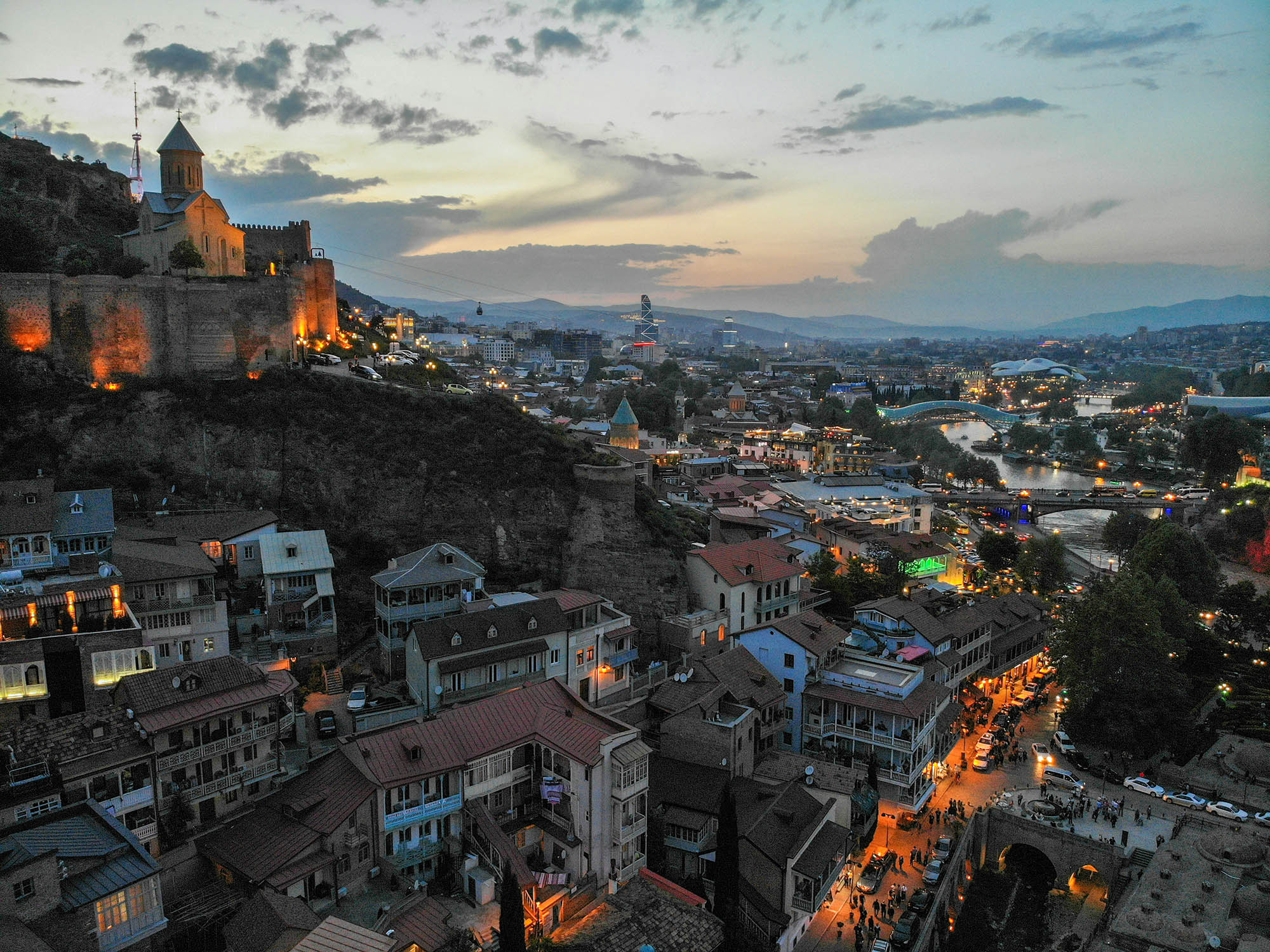
Above: Mtatsminda, Tbilisi, Georgia
But there is a problem.
The heavens seem beautiful and inviting, yet human aspirations cannot necessarily reach them.
The poem expresses a tension between the unlimited desires of the human spirit and the limitations imposed upon mortal existence.
This is one of its most recognizably Romantic characteristics.
Above: Tbilisi, Georgia
One of my favourite ideas in the poem is the transformation of the mountain into a friend.
The poet sees the mountain as possessing both smiles and tears.
His own grief appears to merge with the sadness of the landscape.
This is personification, certainly, but it also has a deeper purpose:
The poet is no longer an isolated individual looking at nature.
He is participating in it.
The mountain becomes a reflection of his own emotional state.

Above: Tbilisi, Georgia
And then comes the conclusion.
The final stanza offers something rather different from the despair that has preceded it.
The poet finds comfort in the evening, in its solitude and silence.
Yet the final image is not darkness.
It is morning.
The concluding lines read:
For morn will break, and sunshine’s beam will make the shades of darkness flee.“
This is important.
The poem does not pretend that suffering can be eliminated.
Nor does it offer an easy solution to the problems of human existence.
Instead, it proposes that darkness is not necessarily permanent.
The mountain provides the poet with a temporary sanctuary, but the real discovery is that hope can survive even when the circumstances that produced his sorrow remain unresolved.
Above: Tbilisi, Georgia
The Mtatsminda Pantheon of Writers and Public Figures is not simply a cemetery containing the remains of famous Georgians.
It is a physical representation of how Georgia remembers its cultural and intellectual history.

Above: St David’s, Mtatsminda Pantheon, Tbilisi, Georgia
The Mtatsminda Pantheon of Writers and Public Figures is a necropolis in Tbilisi, where some of the most prominent writers, artists, scholars, and national heroes of Georgia are buried.
It is located in the churchyard around St David’s Church “Mamadaviti” on the slope of Mount Mtatsminda (“Holy Mountain“) and was officially established in 1929.

Above: Mtatsminda Pantheon, Tbilisi, Georgia
Atop the mountain is Mtatsminda Park, an amusement park owned by the municipality of Tbilisi.

Above: Mtatsminda Park, Tbilisi, Georgia
The first celebrities to be buried at this place were the Russian writer Alexander Griboyedov and his Georgian wife Nino Chavchavadze.
DIGRESSION

Above: Russian ambassador/writer Alexander Griboyedov
Alexander Sergeyevich Griboyedov was a Russian diplomat, playwright, poet and composer.
His one notable work is the 1823 verse comedy Woe from Wit.
He was Russia’s ambassador to Qajar Persia, where he and all the embassy staff were massacred by an angry mob in the aftermath of the ratification of the Treaty of Turkmenchay (1828), which confirmed the cession to Russia of Persia’s northern territories comprising Transcaucasia and parts of the North Caucasus.
Griboyedov played a pivotal role in the ratification of the Treaty.
The immediate cause for the incident was Griboyedov giving refuge to Armenians who had escaped from the harems of the Persian shah and his son.

Above: Title page of Griboyedov’s manuscript Woe from Wit (1923)
The play was a compulsory work in Russian literature lessons in Soviet schools.
It is still considered a golden classic in modern Russia and other minority Russian-speaking countries.

Above: Princess Nino Chavchavadze
Princess Nino Chavchavadze (1812 – 1857) was a daughter of the famous Georgian prince and poet Alexander Chavchavadze (1786 – 1846) and wife of Russian diplomat and playwright Alexander Griboyedov.
Nino was raised in Tsinandali Palace, eastern Georgia, where her father was writing his historical novels and poetry.
When Nino turned 16, she met Russian poet and novelist Alexander Griboyedov during one of her father’s parties in Tiflis.

Above: Tsinandali Palace, Telavi, Kakheti, Georgia
Griboyedov proposed to her soon after the meeting and they married at Tbilisi Sioni Cathedral on 22 August 1828.

Above: Sioni Cathedral, Tbilisi, Georgia
Later in the same year, she accompanied her husband on his fatal mission to Persia, but Nino became ill and Griboyedov chose to leave her in Tabriz.
After hearing of her husband’s death in Teheran on 30 January 1829, Nino gave birth to a premature child, who died soon after.
Pursuant to Griboyedov’s will, Nino reburied him to Mount Mtatsminda and ordered a grave stone with the inscription in Russian:
“Your spirit and achievements will be remembered for ever.
Why still does my love outlive you?”
This epitaph also figures in the novel Ali and Nino by Kurban Said when the couple visits the gravesite in Tbilisi.

Above: Ali and Nino Statue, Batumi, Adjara, Georgia
She never remarried, rejecting her numerous suitors (including the prominent Georgian poet and military commander, Grigol Orbeliani, who, inspired with hopeless passion towards Nino for 30 years, also never married) and winning universal admiration for her fidelity to his memory.
End of Digression
DIGRESSION

Above: Georgian poet/general Prince Grigol Orbeliani (1804 – 1883)
One of the most colorful figures in the 19th-century Georgian culture, Orbeliani is noted for his patriotic poetry, lamenting Georgia’s lost independence and the deposition of the Royal House of Bagration.
At the same time, he spent decades in the Imperial Russian Army, rising to the highest positions in the imperial administration in the Caucasus.
Grigol was born into the Georgian aristocracy, with royal connections through his mother.
Orbeliani had close family and friendly ties with the contemporary Georgian aristocratic and literary élite:
- Nikoloz Baratashvili, the most important poet of Georgian Romanticism, was his sisterly nephew
- Orbeliani was in love with Griboyedov’s widow and Alexander Chavchavadze’s daughter, Nino, who inspired the poet with desperate, but courtly passion for nearly 30 years.
- He was a cousin of the two poets and generals – Alexander and Vakhtang Orbeliani.
He was 13 years older than Nikoloz, old enough to be an uncle but young enough to be a companion to a growing nephew.
He was already a soldier in Russian service when the 1832 conspiracy took place.
He had been involved in the opposition movement, although the extent of his participation is important to qualify.
He was arrested in Novgorod in March 1833, after a Georgian translation of Kondraty Ryleev’s Nalivaiko’s Confession was found among his belongings.
The investigation did not establish that he had actively participated in the planned coup.
He was imprisoned for three months and subsequently sent to serve in a regiment at Vilnius.
There is an interesting detail here:
Ryleev was a Russian Decembrist poet executed after the failed uprising of 1825.

Above: Russian poet / Decembrist revolutionary Kondraty Ryleyev (1795 – 1826)
Grigol’s translation of his work suggests that Georgian resistance to imperial rule was connected to a wider literary and political world.
Poetry and political aspiration were not separate compartments.
But the most revealing evidence of Grigol’s influence on Nikoloz comes later, in their correspondence.
Baratashvili’s surviving letters describes a relationship that went well beyond family obligation.
Nikoloz sent Grigol his poems and sought his literary judgement.
He confided his happiness and disappointments, including his romantic attachments, and treated his uncle as someone with whom he could share his more troubled thoughts.
There is a lovely little indication of their intimacy:
In the earlier letters Nikoloz addresses him as uncle, but later he calls him “my beloved brother Grigol“.
He also teases him about women and romantic entanglements.
This was not a distant, solemn relationship between an eminent aristocrat and a deferential nephew.
There was affection, humour and a degree of equality.
Grigol was himself a poet, a representative of Georgian Romanticism.
Although Orbeliani’s earliest writings are in prose dating to 1824, his prose pieces have fallen into oblivion.
Most of his poetry is noted for patriotic motifs and extravagant praise of wine and women.
Like his contemporary Georgian romanticists, Orbeliani’s lyrics are pervaded with laments over the lost past and the fall of the Georgian monarchy.
What distinguishes him, however, is his love for street poetry and the ashug minstrelsy (a singer-poet and bard who accompanies his song— be it a dastan (traditional epic story) or a shorter original composition — with a long-necked lute.)

Above: Ashik Ağalar Mikayılov playing the saz
Orbaliani’s poetry prior to the collapse of the 1832 conspiracy is remarkably bellicose and optimistic, while post-1832 lyrics are more elegiac, infused with sentimental patriotic feelings about the irretrievable glory of the past.
His best and longest works is an ode A Toast, or A Night Feast after War near Yerevan.
A nostalgic memory of military glory, the poem begins by honoring all those who have fallen in defense of their homeland, then the poet travels through history, celebrating all Georgia’s tribes, kings, heroes, and martyrs.
Finally, an elegiac mood replaces the exaltation, as the poet returns from his fantasy and memoirs to see just himself and one other link to that past still living.
Nikoloz could therefore turn to Orbeliani not only as a relative but as a fellow writer.
The poem Merani, among others, was sent to him.

Above: Image showing a handwritten letter attributed to Nikoloz Baratashvili, alongside a portrait of the poet.
End of Digression
She spent most of her unhappy life in the Tsinandali residence, frequently visiting Tiflis and her sister, Ekaterine, in Mingrelia.

Above: Flag of the Principality of Mingrelia (1463 – 1867)
DIGRESSION
Nikoloz Baratashvili and Ekaterine Chavchavadze belonged to the same aristocratic Georgian circle.
She was the daughter of Alexandre Chavchavadze, the poet, general and influential figure in Georgian cultural life.
They were childhood friends.
Baratashvili was close to the Chavchavadze family.
Ekaterine became the object of his romantic attachment.
He dedicated several poems to her in 1839, including:
- To the Daughter of Prince Chavchavadze
- The Earring
- To the Player of the Piano

Above: Ekateriné Dadiani, Princess of Mingrelia (née Chavchavadze)
The Georgian Encyclopedia identifies Ekaterine as the direct addressee of these poems and describes his love as unrequited.

But here is where the story becomes more complicated.
The National Library of Georgia’s biographical account of Ekaterine says that she retained tender feelings for Baratashvili throughout her life.
She also preserved a notebook containing his poems, which he had given her, and carried it with her even during her years in Russia and Europe.

Above: National Library of Georgia, Tbilisi, Georgia
Why did she marry David Dadiani instead of Nikoloz Baratashvili?
David Dadiani (1813 – 1853) was not simply a wealthy rival who happened to arrive at the right moment.
He was heir to the ruling House of Dadiani in Samegrelo.
His marriage had considerable political significance.
There are two strands to the story.
The personal strand:
David met Ekaterine through the Chavchavadze family circle.
The Dadiani historical collection describes him falling in love with her when he returned to Tbilisi in 1838 and became a frequent visitor to the family estate at Tsinandali.
Ekaterine had several aristocratic suitors, but David won her favour.
They married in 1839 at Kashveti Church in Tbilisi.
The political strand:
David’s father, Levan, was struggling to maintain the authority of the Dadiani dynasty.
He needed his son to assume responsibility for Samegrelo.
Marriage was a requirement for the ruler.
David needed to marry promptly to secure his position.
The historical account makes this political urgency quite explicit.
Ekaterine, therefore, was marrying into a ruling dynasty at a moment when its future was uncertain.
She would become its princess and eventually its regent.
It is tempting to imagine that she chose security and status over the sensitive young poet.
But I would be careful about that interpretation.
David was apparently genuinely in love with her.
The evidence suggests that she returned his affection.

Above: David Dadiani, Prince of Mingrelia
What did Baratashvili have to offer?
This is where the contrast becomes particularly poignant.
Baratashvili was of distinguished aristocratic ancestry.
He was not an unsuitable nobody.
Indeed, his uncle was Grigol Orbeliani and his family was connected to the Georgian nobility.
But his circumstances were difficult:
- His family had fallen into financial hardship.
- A childhood injury left him lame and prevented his intended military career.
- He could not afford the further education in Russia that he wanted.
- Instead of the career he had imagined, he became a government clerk.
The Georgian Encyclopedia describes these disappointments, together with his unrequited love for Ekaterine, as contributing to his spiritual distress.
David, meanwhile, was a man with a political future, a principality to govern and the means to exercise considerable influence.
Yet I would resist turning this into a simple contest between the practical prince and the romantic poet.
We have no reliable evidence that Ekaterine rejected Baratashvili because he was poor, physically disabled or professionally unsuccessful.
Nor do we have a surviving account of a formal proposal from Baratashvili and her refusal.
That distinction matters.
There is something extraordinary about what happened after Baratashvili’s death.
He died in Ganja in October 1845, aged just 27.
His poetry had not yet achieved the reputation it would later enjoy.
Ekaterine kept the notebook of his poems.
Years later, when Ilia Chavchavadze visited her in St Petersburg, she showed him the collection.
Ilia recognised the importance of the work and helped bring Baratashvili’s poetry to a wider readership.
The Georgian Encyclopedia confirms that Baratashvili’s poems were almost forgotten among his contemporaries and that Ilia became acquainted with them through Ekaterine’s manuscript collection.
Think about that for a moment.
The woman who did not marry the poet became one of the principal guardians of his literary legacy.
And perhaps that is the most moving part of the story.
We cannot know precisely what she felt for him, but she clearly did not regard him as an insignificant figure from her youth.
Baratashvili was fascinated by the choices individuals make when confronted by circumstances larger than themselves.
In his historical poem, Irakli II must choose between alternatives that both carry terrible consequences.
In his personal life, Baratashvili also encountered the limits of individual desire.
He could love Ekaterine, but he could not determine the course of her life.
There is a distinction, though:
We should not equate Ekaterine’s marriage with a political defeat or suggest that she was simply swept along by dynastic necessity.
She made a choice.
The evidence suggests that she had affection for David.
Perhaps the most interesting question is not why she chose David over Nikoloz, but what became of the affection between Ekaterine and Nikoloz after that choice.
Ekaterine’s preservation of his poems gives us reason to believe that Baratashvili remained important to her.
Whether that importance was romantic love, enduring friendship, regret or some combination of these, we cannot establish.
And I think that uncertainty is worth preserving.
It makes the story more human, not less.

Above: Nikoloz Baratashvili
End of Digression
Nino died in 1857.
She was buried next to Griboyedov.
On the burial stone of Alexandr Griboyedov at the Mtatsminda Pantheon in Tbilisi, the statue of Nino is depicted weeping over the death of her beloved husband.

Above: Mtatsminda Pantheon, Tbilisi, Georgia
The mountain’s religious significance and its commanding position above Tbilisi made it a particularly meaningful location.
According to Georgia’s National Tourism Administration, 53 people from the 19th and 20th centuries are buried there, including writers, artists, scientists and public figures.

Above: Mtatsminda Pantheon, Tbilisi, Georgia
The Pantheon is administered by the Government of Tbilisi and is frequented by locals as well as the city’s visitors.

Above: Flag of Tbilisi
The earliest attempt to create a Pantheon in Tbilisi was the Pantheon of Kukia, which the Dramaturgical Society of Georgia began work on to honour its artists by 1900, but which had disappeared by the 1950s.

Above: Kukia Cemetery, Tbilisi, Georgia
Later, the Society for Spreading Literacy Among Georgians managed to established the Didube Pantheon in 1915.
Above: Didube Pantheon
DIGRESSION
This cemetery is the final resting place of many of Georgia’s most prominent writers, artists, scientists, public figures, and political leaders.
Among those buried here are painter Elene Akhvlediani, former Prime Minister Zurab Zhvania, sculptor Zurab Tsereteli – creator of the Chronicles of Georgia, endurance athlete and world traveler Jumber Lezhava, and many others.
Above: Grave of Elene Akvlediani
Elene Akhvlediani (1898 – 1975) was a 20th-century Georgian painter, graphic artist, and theater decorator.
Akhvlediani is famous for her depictions of Georgian towns, for her illustrations for the works of Georgian poets Ilia Chavchavadze and Vazha-Pshavela, and for designing plays in the Marjanishvili Theater in Tbilisi.
Above: Grave of Georgian Prime Minister Zurab Zhvania (1963 – 2005)
Zhvania died early in the morning of 3 February 2005 from what officials claimed was carbon monoxide poisoning caused by an inadequately ventilated gas heater.
He was in a rented apartment with Raul Usupov, deputy governor of Georgia’s Kvemo Kartli region, at the time.
Usupov also died.
Guards entered the house after there was no word from Zhvania for several hours to find him in an armchair and Usupov in the kitchen.
Details of the incident are still limited, although officials have said there was a gas-powered heating stove in the main room of the house, where a table was set up with a backgammon set lying open upon it.
Immediately after the incident, Georgia’s Interior Minister Vano Merabishvili said there was no reason to suspect foul play.
Bodies were taken to the coroner’s office, where a preliminary examination showed both died from carbon monoxide poisoning.
There were reports of serious technical violations when the gas heaters were installed, with officials saying there was no ventilation in the apartment.
However, Zhvania’s family members have questioned the official version of the death.
President Mikheil Saakashvili, at an emergency Cabinet meeting, said:
“In Zurab Zhvania, Georgia has lost a great patriot, who devoted his entire life to serving the motherland.
Zurab’s death is a great blow to Georgia and to me personally.
I lost a very close friend, a reliable adviser and a great ally.
I want to call on you all to be strong, because there is no greater responsibility than loyal service to our country and our people.”
As of March 2014, Mikheil Saakashvili was wanted by the Georgian Prosecutor’s office for questioning in an investigation carried out for the purpose of establishing circumstances surrounding Zhvania’s death.
Years after the incident, Zhvania’s death remains at the center of Georgia’s political life.
Above: Grave of Zurab Tsereteli
Zurab Konstantinovich Tsereteli (1934 – 2025) was a Georgian painter, sculptor and architect known for large-scale and at times controversial monuments.
Tsereteli served as the President of the Russian Academy of Arts from 1997 until his death.
In 1990, Good Defeats Evil, Tsereteli’s interpretation of St. George slaying the dragon as an allegory for world peace in the modern age, was unveiled at the United Nations Headquarters in New York City.

Above: Good Defeats Evil, New York City
In the 1990s, Tsereteli continued to work on public commissions for the city of Moscow, which many insist was due to his personal friendship with Mayor Yuri Luzhkov.
The most significant of these projects include: the reconstruction of Cathedral of Christ the Savior, Manege Square, the War Memorial Complex on Poklonnaya Gora, the Moscow Zoo, as well as the 98m tall Peter the Great, monument erected in 1997, which has elicited mixed feelings among the citizens of Moscow.

Above: Peter the Great, Moscow, Russia
The Birth of the New Man was inaugurated in Seville, Spain in 1995, in celebration of the European discovery of the New World by Christopher Columbus.

Above: The Rise of the New Man, Seville, Spain
In 2006, Tsereteli unveiled his monument To the Struggle Against World Terrorism, or The Tear of Grief, in Bayonne, New Jersey.
It was donated to the US as an official gift by Russia in the aftermath of 9/11 attacks to show support and solidarity for the American people.
Above: The Tear of Grief, Bayonne, New Jersey, USA
In 2005, Holocaust was donated by Russia to Israel and opened in Jerusalem.

Above: Holocaust, Jerusalem, Israel

Above: Chronicles of Georgia, Tbilisi, Georgia
Above: Grave of Jumber Lezhava
Jumber Lezhava is a remarkable Georgian, because his story combines travel, physical endurance, personal loss, national history and an extraordinary determination to keep moving.
He was not a young adventurer taking a gap year.
He was 54 years old when he set off on his bicycle to travel around the world.
He was 63 when he returned.
And he did it during one of the most difficult periods in modern Georgian history.
Jumber Lezhava (23 July 1939 – 25 July 2014) was born in Tbilisi.
He graduated from the Georgian Polytechnic Institute in 1966 as an electrical engineer.
His life took an unexpected turn following a serious abdominal operation in 1987.
During his recovery he developed his own physical training system.
Between 1990 and 1992, he established world and Guinness records for push-ups performed from a horizontal position.
He continued improving those records, with a further achievement in 2001.
He was already an extraordinary endurance athlete before he became a world traveller.
The National Parliamentary Library of Georgia records his engineering background, sporting achievements and subsequent expedition.
Why did he leave?
There is a very human explanation.
His wife had died.
In an interview reported by the Los Angeles Times when he returned to Georgia in November 2002, he explained his decision in remarkably simple terms:
I couldn’t sit at home.”
He decided to travel.
The bicycle became his means of doing so.
I find that detail more revealing than any of the records.
This was not simply a man seeking fame or attempting to prove something to the world.
It was also a man confronting bereavement and deciding that he still had a life to live.
The expedition of 3,333 days began on 13 August 1993.
It took him across Asia, Australia and Oceania, North and South America, Europe and Africa.
He also visited Antarctica twice.
He wore out nine bicycles.
The Los Angeles Times reported that he covered approximately 164,000 miles (264,000 km).
Lezhava began his expedition in August 1993.
Georgia was experiencing civil conflict, the war in Abkhazia, economic collapse and political instability.
His principal supporter was Zhuli Shartava, a Georgian politician who was later captured and killed during the fall of Sukhumi in September 1993.
With Shartava’s death, Lezhava lost an important source of financial support.
He continued with limited resources, sometimes sleeping outdoors and struggling to find food.
A recent account by the Tbilisi bicycle organization Hippo Velo describes this period and the role of Shartava in helping launch the expedition.
There is something rather extraordinary about the timing:
While Georgia was struggling to establish its own future, one Georgian was travelling the world carrying the country’s name with him.
Lezhava was not merely an athlete or an adventurer.
Georgia’s Ministry of Foreign Affairs gave him the title of Travelling Diplomat in 1993.
UNESCO awarded him a World Sportsman diploma in 1999.
In 2009, Tbilisi named him an Honorary Citizen.
He also became known internationally as a symbol of endurance and determination.
His philosophy was expressed in a memorable sentence:
I don’t know where the limits of human ability lie.”
Lezhava died on 25 July 2014, two days after his 75th birthday.
He is buried at the Didube Pantheon in Tbilisi.
His records, photographs and diaries have provided material for the documentary To the Moon by Bicycle, directed by Giorgi Kharebava, and the book Traveler’s Notes, published by Artanuji in 2023.
What did Lezhava see during those 3,333 days?
He recorded more than 50,000 photographs and thousands of pages of observations.
That is potentially an extraordinary human document, not simply a sporting record.
Perhaps the real story is not that a Georgian cycled around the world, but that he spent nine years meeting the world:
One person, one road and one country at a time.

Above: Jumber Lezhava
Even if you aren’t familiar with the names, the Didube Pantheon is worth visiting for its remarkable grave monuments and sculptural decorations alone.
Some are true works of art, and unlike anything you’ll find in an ordinary Georgian cemetery.
Above: Didube Pantheon, Tbilisi, Georgia
End of Digression
In 1929, the Government of the Soviet Union, which controlled Georgia at the time, established another pantheon on a former cemetery near the Mtatsminda Church.

Above: Flag of the Soviet Union (1922 – 1991)
Under Soviet rule, the Didube Pantheon was nearly abolished in the 1930s.

Above: Flag of the Georgian Soviet Socialist Republic (1921 – 1991)
There was an order issued in 1934 to remove unknown or unimportant tombs from Mtatsminda and to transfer some distinguished people, including Nikoloz Baratashvili and Vazha-Pshavela from Didube to Mtatsminda.
DIGRESSION

Above: Georgian poet Vazha-Pshavela (1861 – 1915)
Vazha-Pshavela, simply referred to as Vazha, is the pen name of the Georgian poet and writer Luk’a Razik’ashvili.
Vazha-Pshavela began his literary career in the mid-1880s.
In his works, he depicted the everyday life and psychology of his contemporary Pshavs with remarkable insight.
He authored numerous significant literary works, including 36 epics, around 400 poems (“Aluda Ketelauri“, “Bakhtrioni“, “Gogotur and Apshina“, “Host and Guest“, “The Snake-Eater“, “Eteri“, “Mindia“, etc.), plays, stories, as well as literary criticism, journalism, and scholarly articles of ethnographic interest.
Even in fiction, he portrayed the life of the Georgian highlander with near-ethnographic precision, encompassing an entire mythological worldview.
In his poetry, he addressed the heroic past of his people and celebrated their struggle against both external and internal adversaries (poems “A Wounded Snow Leopard” (1890), “A Letter of a Pshav Soldier to His Mother” (1915), etc.).
In his finest epic works, Vazha-Pshavela explores the interactions of individuals with society, humanity with nature, and human love with love of country.
The conflict between an individual and a temi (community) is central in the epics Aluda Ketelauri (1888) and Guest and Host (1893).
In both works, the protagonists question and ultimately reject outdated communal laws in their personal journey toward a higher humanity that transcends parochial norms.
A recurring theme in Vazha-Pshavela’s work is the dignity and resilience of a strong-willed people, alongside their zeal for freedom.
These ideas are further explored in the play The Rejected One (1894).
He idealized the Pshavs’ traditional rituals, moral purity, and ‘non-degeneracy‘, contrasting them with the values of what he considered a ‘false civilization‘.
He asserted that:
“Every true patriot is cosmopolitan and every genuine cosmopolitan is a patriot.“
In the epic Snake-Eater (1901), the wise man Mindia dies because he cannot reconcile his ideals with the demands of his family and society.
The central motif of Mindia consuming serpent’s flesh in an attempted suicide — which instead grants him occult knowledge — mirrors the folk tale motif found in The White Snake (Brothers Grimm).
The epic Bakhtrioni (1892) recounts the role of the Georgian highland tribes in the uprising of Kakheti (East Georgia) against the Iranian oppressors in 1659.
Vazha-Pshavela also excelled in portraying nature in Georgian poetry, expressing his profound love through vivid and dynamic landscapes imbued with tension and internal conflict.
His poetic language, rich in the nuances of Georgian, achieves remarkable precision.
Through translations, his works have reached an international audience.
To date, his poems and narratives have been published in more than 20 languages.
Vazha-Pshavela died in Tiflis on 10 July 1915 and was buried in the ancient capital of his native land.
He received the honour of interment in the prestigious Pantheon of Mtatsminda Mountain in recognition of both his literary achievements and his role in Georgia’s National Liberation movement.
As Donald Rayfield writes, the mountaineer poet Vazha-Pshavela is “qualitatively of a greater magnitude than any other Georgian writer“.
End of Digression
This order marked the fall of Didube’s status and the rise of Mtatsminda’s.
In 1937, the Pantheon’s administration adopted regulations indicating that the decision-making council should consist mainly of government official, party members and Georgian scholars.
Because of the totalitarian system, it was easy to create the impression that the Mtatsminda Pantheon was the most desirable place of rest for Georgians, an impression which still persisted in 2014.
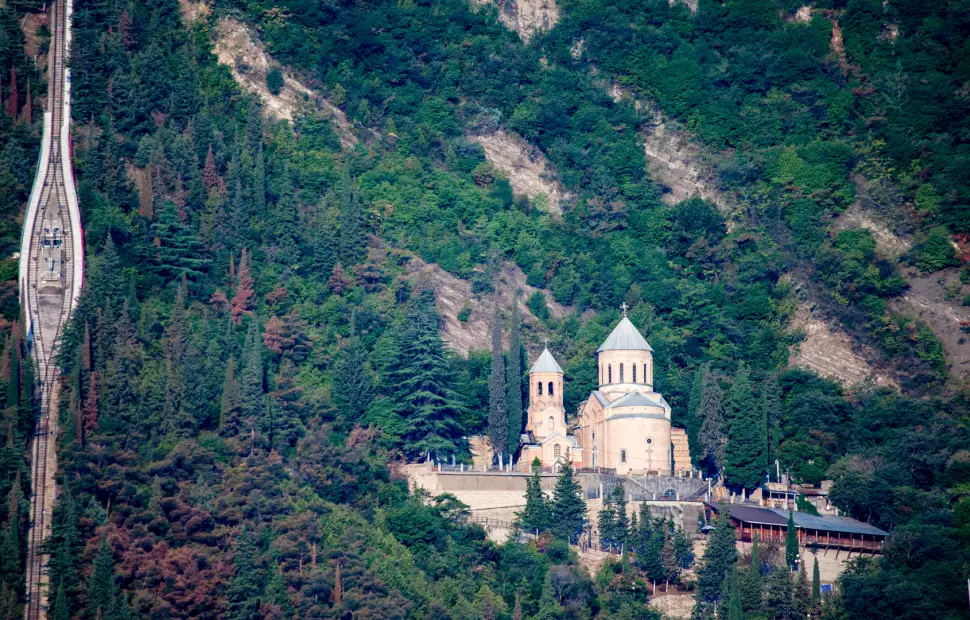
Above: Mtatsminda Pantheon, Tbilisi, Georgia
Because of the presence of Bolshevik activists, Konstantine Gamsakhurdia refused to be buried in the Pantheon.
DIGRESSION

Above: Georgian writer Konstantine Gamsakhurdia
Konstantine Gamsakhurdia (1893 – 1975) was a Georgian writer and public figure.
Educated and first published in Germany, he married Western European influences to purely Georgian thematic to produce his best works, such as The Right Hand of the Grand Master and David the Builder.
Hostile to the Soviet rule, he was, nevertheless, one of the few leading Georgian writers to have survived the Stalin-era repressions, despite exile to a White Sea (a southern inlet of the Barents Sea located on the northwest coast of Russia) island and several arrests.
His works are noted for their character portrayals of great psychological insight.
Another major feature of Gamsakhurdia’s writings is a new subtlety he infused into Georgian diction, imitating an archaic language to create a sense of classicism.
(Konstantine Gamsakhurdia’s son, Zviad, became a Soviet-era dissident who was subsequently elected the first President of Georgia in 1991, but died under suspicious circumstances in the Civil War in 1993.)
Konstantine spent most of the First World War years in Germany, France, and Switzerland, taking his doctorate at Berlin University in 1918.
As a Russian subject, he was briefly interned at Traunstein in Bavaria, where Thomas Mann sent him chocolate.
Gamsakhurdia published his first poems and short stories early in the 1910s, influenced by German Expressionism and by French Post-Symbolist literature.
While in Germany, he regularly wrote for the German press on Georgia and the Caucasus, and was involved in organizing a Georgian Liberation Committee.
After Georgia’s declaration of independence in 1918, he became an attaché at Georgia’s embassy in Berlin, responsible for the repatriation of Georgian First World War prisoners and placing Georgian students in German universities.
Gamsakhurdia met the 1921 Bolshevik takeover of Georgia with hostility.
He edited Tbilisi-based literary journals and, for a short time, led an ‘academic group‘ of writers which placed artistic values above political correctness.
Gamsakhurdia published his writings in defiance of growing ideological pressure, and went on to lead a peaceful protest rally on the anniversary of Georgia’s forcible Sovietization in 1922.
In 1925, Gamsakhurdia published his first and one of his most impressive novels, The Smile of Dionysus, which took him eight years to write.
It tells the tale of a young Georgian intellectual in Paris who is detached from his native society and remains a complete stranger in the city of his ideals.
This novel, like his earlier works, was partially ‘Decadent‘ and did not please the Soviet ideologists, who suspected Gamsakhurdia of fostering discontent.
After the suppression of the 1924 anti-Soviet uprising in Georgia, Gamsakhurdia was excluded from Tbilisi State University, where he taught German literature.
He was soon arrested and deported to the Solovetsky Islands in the White Sea, where he was to spend a few years.
On his release, Gamsakhurdia was forced to keep silent.
On the verge of suicide, the writer fought his depression by translating Dante.
Early in the 1930s, he obtained Lavrentiy Beria’s protection and was able to resume writing, with an attempt at a ‘socialist’ novel, Stealing the Moon (1936), a story of love and collectivization in Abkhazia.
Next came the psychological novella Khogais Mindia (1937), yet another appeal in classical Georgian literature to this Khevsur myth.
Beria was critical of these works, though.
Soon Gamsakhurdia was arrested for an affair with Lida Gasviani, a young charming Trotskyist director of the State Publishing House, but was interrogated and released by Beria, who told him ironically that sexual relations with enemies of the people were permitted.
Gamsakhurdia survived the Joseph Stalin – Lavrentiy Beria purges, which destroyed a large part of Georgian literary society, but resolutely refused to denounce others.
He had to pay tribute to the Stalinist dogma, conceiving a novel on Stalin’s childhood in 1939.
However, as the first published part of this work was not approved by the authorities, it was promptly discontinued and withdrawn from public libraries.
At the height of the Stalinist terror, Gamsakhurdia turned to the more favoured genre of historical and patriotic prose, embarking on his magnum opus, the novel The Right Hand of the Grand Master (1939), set in the early 11th century around the legend of the building of the Cathedral of the Living Pillar against a broad panorama of 11th-century Georgia.
It deals with the tragic fate of the devoted architect Konstantine Arsakidze, from whom King Giorgi I commissions a cathedral, but Arsakidze becomes the king’s rival in love for the beautiful Shorena, a daughter of the rebellious nobleman.
The clash of powerful human passions, between illicit love and duty, culminates in the mutilation and execution of Arsakidze at Giorgi’s behest.
The story conveys a subtle allegorical message.
The harassed artists of Stalin’s era can be recognised in Arsakidze.
Gamsakhurdia’s major post-World War II works are The Flowering of the Vine (1955), which deals with a Georgian village shortly before the war, and the monumental novel David the Builder (1962), a tetralogy about the venerated king David the Builder, who ruled Georgia from 1089 to 1125.
This work won for the author a prestigious Shota Rustaveli State Prize in 1965.
Gamsakhurdia also wrote a biographical novel about Goethe, and literary criticism of Georgian and foreign authors.
Publication of his memoirs, Flirting with Ghosts (1963), and of his testament (1959) was aborted at that time.
He died on 17 July 1975 and was interred at his mansion, which he called a ‘Colchian Tower‘.
He refused to be buried in the Mtatsminda Pantheon because he detested that Jesus and Judas were buried side by side there, referring to the proximity of the graves of the national writer Ilia Chavchavadze and his outspoken critic and political foe, the Bolshevik Filipp Makharadze, who is believed to have been involved in Chavchavadze’s assassination.
While Gamsakhurdia’s death was officially attributed to natural causes, Zviad penned an open letter to Yuri Andropov in 1975 in which he asserted that the KGB had poisoned his father.
End of Digression
In 2009, Tbilisi City Hall announced that the old Mtatsminda Pantheon had no more space and that there were ongoing consultations about a new one with the Patriarch of Georgia.
In October 2009, the Deputy Mayor of Tbilisi declared:
“A new place has to be selected, where a church can be erected and public funerals can be held.
It is important to build the new Pantheon at an especially good location, accessible for society and approved by society“.
However, since the official closure of the old site, there have been exceptions:
Mukhran Machavariani was buried there in 2010.
DIGRESSION

Above: Georgian poet/politician Mukran Machavariani
Mukhran Machavariani (1929 – 2010) was a Georgian poet, a member of the Supreme Council of the Republic of Georgia (Georgian Parliament) from 1990 until 1992, and a recipient of the Shota Rustaveli Prize of Georgia.
From 1988 until 1990 he was the Chairman of the Union of Georgian Writers.
He died during a performance at Rustaveli Theatre in Tbilisi.

Above: Writer’s House of Georgia, Tblisi, Georgia
Machavariani is an especially interesting figure for an exploration of Georgian literature because he stands at the intersection of poetry, national identity and the restoration of Georgian independence.
He was not simply a poet who entered politics.
He was a literary figure whose public life coincided with one of the most consequential periods in modern Georgian history.
And there’s a rather wonderful irony:
A man who devoted so much of his life to the Georgian language died while speaking at a theatre in Tbilisi, at an event honouring another Georgian poet.

Above: Georgia (Kartuli) in the Georgian language
He studied Georgian language and literature at Tbilisi State University, graduating in 1954.
His first poems had appeared in a university literary almanac, Pirveli Skhivi (First Ray), in 1952.

Above: Logo of Tbilisi State University
His first collection, Poems, appeared in 1955.
Two further collections followed in 1958:
- The Red Sun and the Green Grass
- Silence Without You
Machavariani received recognition at the 1959 World Festival of Youth and Students.
His work was subsequently translated into several languages, including English.
That early recognition is significant.
He was establishing himself as a distinctive Georgian literary voice while still a relatively young man.
One of the most accessible ways into Machavariani’s poetry is through his poem The Georgian Language.
Here is an English translation published in Georgia Today in September 2023:
“Is Georgian only a language!?
It is the Georgians’ belief!
It is God!
It is destiny!
It is as large as the sea!
There is something worth pausing over here.
He is not describing language as a practical means of communication.
He is describing language as the vessel of a people’s collective existence.
Language becomes faith, history, destiny and identity.
For a country whose language and cultural independence have repeatedly been challenged by larger political powers, this is not merely patriotic decoration.
It is an assertion of continuity.

He was a poet not afraid to criticize his own country.
This is where Machavariani becomes much more interesting than a conventional patriotic poet.
The Georgian Encyclopedia describes his writing as innovative in both subject matter and poetic form.
It says he helped revive connections with the avant-garde literary traditions of the 1920s, which had been artificially interrupted.
His poetry combined:
- Patriotic and historical themes.
- Philosophical reflection.
- Love, nature, spring and human goodness.
- Satire directed at social hypocrisy and national shortcomings.
The last point is important.
Machavariani’s patriotism was not simply the celebration of Georgia.
He could be fiercely critical of Georgian society itself.
The Encyclopedia quotes his sentiment:
“We shall blame no foreigner for our own shortcomings!”
That is a rather bracing declaration.
He believed that loving one’s country also meant being honest about its failings.

Above: Mukhran Machavariani
In 1983, Machavariani published a cycle of poems entitled 1832, referring to the failed Georgian conspiracy against Russian rule.
The conspiracy had been organised by Georgian nobles and intellectuals who hoped to restore the country’s independence.
It was discovered by the Russian authorities before it could be carried out.
According to the Georgian Encyclopedia, the poems provoked the anger of Soviet ideological authorities because they expressed not merely a desire for Georgian independence but an active call towards it.
Consider the timing:
1983 was still six years before the collapse of Communist rule in Eastern Europe and eight years before Georgia restored its independence.
Machavariani was revisiting a 19th century attempt at liberation to speak to the political aspirations of his own generation.
There is a direct line here to Baratashvili.
Both men were engaging with the unfinished business of Georgian independence, albeit from very different historical circumstances.

Above: 100 Poems, Mukhran Machavariani
Machavariani’s influence extended beyond his own poetry.
His editorial career was substantial.
He was involved not just in writing literature but in deciding what was published, discussed and made available to readers.
He also translated literature, including works by foreign poets, and contributed to linguistic scholarship.

Above: Extraordinary by its Ordinariness, Mukhran Machavariani
Here is perhaps the most consequential part of his biography.
Machavariani became Chairman of the Georgian Writers’ Union in 1988, at a time when national independence movements were gaining momentum throughout the Soviet Union.
From 1989 to 1991, he served in Georgia’s first Supreme Council.
He was elected as part of the Round Table – Free Georgia political grouping.
On 9 April 1991, he signed the Act of Restoration of State Independence of Georgia.
This was not a ceremonial association.
He was one of the people formally involved in restoring the independent Georgian state.
He subsequently served another term in the Georgian Parliament from 1999 to 2004.
Some Georgian poets expressed national identity through historical allegory because direct political expression was dangerous.
Machavariani lived long enough to move from literary resistance into the political process itself.

Above: Georgian Parliament, Tbilisi, Georgia
On 17 May 2010, Machavariani attended an event at Tbilisi’s Rustaveli Theatre celebrating the 85th anniversary of fellow poet Pridon Khalvashi.
He was delivering a speech when he suffered a sudden heart attack and died on stage.
He was 81.
The coincidence is almost theatrical in itself:
A poet dies while publicly honouring another poet, in the country’s most celebrated theatrical institution.
He was buried at the Mtatsminda Pantheon of Writers and Public Figures.

Above: Rustaveli Theatre, Tbilisi, Georgia
End of Digression
Chabua Amirejibi was buried there in 2013.
DIGRESSION

Mzechabuk “Chabua” Amirejibi, (often written as “Amiredjibi“) (1921 – 2013) was a Georgian novelist and Soviet-era dissident notable for his magnum opus, Data Tutashkhia, and his many years in Soviet prisons.
He was born in Tbilisi.
His family, once a princely house, was heavily repressed during Joseph Stalin’s Great Purge:
His father was shot in 1938 and his mother sent to a Gulag camp.

Above: Georgian-born Russian leader Joseph Stalin (1878 – 1953)
During World War II, he was recruited into the Red Army, but was soon sacked due to his family background.

Above: Soviet Red Army headgear insignia
Subsequently, he became involved in anti-Soviet activities, becoming a member of the underground political organization Tetri Giorgi (one of the names of St. George)(Patriotic Union).

Above: Tetri Giorgi Church near Alaverdi Monastery in Akhmeta, Georgia
In April 1944, Chabua Amirejibi was arrested on coup plot charges and sentenced to 25 years of imprisonment in Siberia.
After 15 years in prison, three prison escapes, and two death sentences, he was ultimately rehabilitated in 1959 and began his literary career in his late thirties with short stories including The Road (1962), My Ragger Uncle (1963), The Bull’s Confession (1964) and Giorgi Burduli (1965).
Amirejibi’s most famous novel and one of the best works in modern Georgian literature, Data Tutashkhia (1975), achieved sensational success for the magazine Tsiskari and fame for the writer himself.
Conceived during Amirejibi’s years in prison, it was only through the intervention of the contemporary Georgian Communist Party chief Eduard Shevardnadze that this substantial novel of over 700 pages passed the Soviet censors and was published.

Above: Georgian/Soviet politician Eduard Shevardnadze (1928 – 2014)
The novel is the story of Data Tutashkhia, a fictional Georgian outlaw of the Imperial Russian period, a very popular theme in Georgian literature.
The story is narrated by a Russian gendarme, Count Szeged, who frequently passes the story-telling on to other characters.
The work follows the life of Tutashkhia as he spends years eluding capture by the Tsarist police, combining thrilling escapades with Dostoevskian dealings with the fate of an individual and national soul.
The police are led by Data’s cousin, his detached and imperturbable double, Mushni Zarandia.
The book, and the feature film based on it, turned Tutaskhia into an iconic hero, widely popular in Georgia.

Above: Data Tutashkhia (1975), Chabua Amirejibi
However, the tragic years of civil war and the death of his eldest son Irakli in the War in Abkhazia in 1992 heavily affected the writer.

Above: Abkhaz militants crossing the Gumista River, 15 March 1993
Therefore, it came as a real surprise in 1995 when Amirejibi published his next major novel, Gora Mborgali (“Infuriating“), begun in 1978 and based on the author’s experiences in Soviet prisons.

His last work, George the Brilliant, a historical novel about the 14th century Georgian king preaching national pride, appeared in 2005.
Amirejibi briefly returned to politics in July 2009, when he joined the movement Daitsavi Sakartvelo (“Defend Georgia“), allied with the opposition to President Mikheil Saakashvili’s government.
On 16 November 2010, he was consecrated as a Georgian Orthodox monk under the name of David.
Due to his health condition, the ceremony was conducted at the writer’s own apartment.

Above: Chabua Amirejibi
End of Digression
In 2021, the remains of Giorgi Kvinitadze, a commanding general of Georgia’s First Republic, were reinterred on the Mtatsminda Pantheon, after being returned from France.
DIGRESSION

Above: Georgian military commander Giorgi Kvinitadze (1874 – 1970)
Giorgi Kvinitadze was a Georgian military commander who rose from an officer in the Imperial Russian army to commander-in-chief of the Democratic Republic of Georgia.

Above: Flag of Georgia (1918 – 1921)
After the Red Army invasion of Georgia, Kvinitadze went into exile to France, where he wrote his memoirs of the 1917–1921 events in Georgia.

Above: 11th Army of the Red Army enters Tbilisi, 25 February 1921
In 2013 he was posthumously awarded the title and Order of National Hero of Georgia.
Born into the family of a colonel of the Russian army in Dagestan, Kvinitadze entered the Tiflis Cadet Corps in 1884.

Above: Sulak Canyon on the river Sulak near Dubki village, Kazbekovsky district, Dagestan, Russia
He then continued his military education at St Constantine Infantry School, St Petersburg, which he graduated from in 1894, being commissioned as a podpuruchik (Lieutenant) in the 153rd Vladikavkaz Infantry Regiment.
He then served in Russian Poland.

Above: Coat of arms of Russian Congress Poland (1815 – 1915)
During the Russo-Japanese War (1904–1905) Kvinitadze was promoted to Captain.

Above: Images of the Russo-Japanese War
In 1910 he graduated from the General Staff Academy and was dispatched to the Caucasian Military District headquarters.

Above: General Staff Academy, St. Petersburg, Russia (1832 – 1918)
During World War I, in 1916, Kvinitadze was promoted to Colonel and appointed a chief of staff of the 4th Caucasian Rifle Division.

Above: Aftermath of the Russian siege of Przemyśl in Austria-Hungary, 1915
After the Russian Revolution of 1917, Kvinitadze, now Major General, served as a Deputy Minister of War for the Transcaucasus federal government before becoming the Commander in Chief of the army of a newly independent Georgia in 1918.
He resigned shortly thereafter due to his disagreement with the Menshevik leadership of the country.

Above: Flag of the Transcaucasian Democratic Federative Republic (22 April – 28 May 1918), a short-lived state in the Caucasus that included most of the territory of present-day Armenia, Azerbaijan and Georgia, as well as parts of Russia and Turkey.
Later that year, however, Kvinitadze returned to military service in the capacity of Chief of Staff during the war with Armenia.

Above: Armenian-Georgian War, 7–31 December 1918
In 1919, Kvinitadze commanded the Georgian troops that defeated Muslim revolutionaries in Akhaltsikhe province, and occupied, on 20 April 1919, the hitherto Turkish-held city of Artvin.

Above: Artvin, Türkiye
Kvinitadze helped establish a military school in Tiflis and served as its Commandant before being made Commander-in-Chief of the Georgian army again early in May 1920, when the Bolsheviks attempted a coup d’état.
He happened still to be on the spot when the Bolsheviks assaulted the military school as a preliminary to a coup.
Kvinitadze, with his cadets, put up a stout resistance and successfully defended the building.
Days later, Kvinitadze, at the head of the Georgian army, rolled back an attempt by the Soviet Russian troops to penetrate from Azerbaijan.

Above: Former Military School, Tbilisi, Georgia
During the Red Army invasion of Georgia of 1921, he was reappointed Commander-in-Chief.
After Georgia’s defeat in the war in March 1921, Kvinitadze left for France, where he first worked as a clerk for Pathé Records and then ran a small business producing matsoni (fermented milk yoghurt).

He died in Chatou suburb of Paris in 1970 and was buried at the Georgian cemetery of Leuville-sur-Orge.

Above: The grave of Mariam Makashvili and Giorgi Kvinitadze in Chatou, Georgian cemetery of Leuville-sur-Orge, France
Kvinitadze’s remains were reburied with full military honors to the Mtatsminda Pantheon in Tbilisi on 26 May 2021.
A street in Tbilisi, where Georgia’s Ministry of Defense is located, was named after Kvinitadze in 2006.

Above: Georgian Ministry of Defense, Tbilisi, Georgia
Kvinitadze’s Russian-language book My Memoirs from the Years of Independence of Georgia, 1917–1921 first appeared in Paris in 1985 and was published in a Georgian translation in 1998.
Writing most of the memoir in 1922, a year after Georgia’s sovietization, Kvinitadze provides new details and personal observations about the troubled years of 1917–1921.
In addition to being a military chronicle written by a participant of those events, Kvinitadze’s memoirs are a political commentary, directing harsh criticism at the Mensheviks, accusing them of undermining the state and alienating the Georgian people with their socialist and internationalist rhetoric, incompetence and failure to defend the country against the anticipated foreign intervention.
Kvinitadze’s memoirs are considered one of the best firsthand accounts of Georgia’s short-lived independence written abroad.
Above: Giorgi Kvinitadze
End of Digression
As of 2014, there are three Pantheons in Tbilisi under City Hall supervision, which are Mtatsminda Pantheon, Didube Pantheon, and Khojivank Pantheon (the last of which is Armenian).

Above: Khojivank Armenian Pantheon, Tbilisi, Georgia
The sculptural monuments themselves deserve attention.
They are not merely identifying markers.
They are interpretations of the people being remembered.
A question worth investigating:
Who gets remembered?

Above: Mtatsminda Pantheon, Tbilisi, Georgia
Baratashvili died in Ganja on 21 October 1845, aged just 27.
He had been appointed Deputy Governor there, far from the literary circles of Tbilisi.

Above: Ganja, Azerbaijan (1845)
His poetry had circulated in manuscript form, but he had not experienced the recognition that would eventually make him one of Georgia’s most celebrated writers.
In 1893, almost 48 years after his death, his remains were brought back to Georgia and interred at the Didube Pantheon.
The transfer became a national demonstration.
The Georgian Society for the Spreading of Literacy helped finance the transportation of his remains.
Its historical account includes an extraordinary photograph of the procession in April 1893.
In 1938, he was transferred again, this time to Mtatsminda.

Above: Baratashvili funeral cortege, 25 April 1893
There is another dimension that I would not overlook.
The Pantheon was conceived in 1915 but opened in 1929, during Soviet rule.
Its development and the selection of those commemorated took place within a changing political environment.
Historian Claire P. Kaiser examines this in her book Georgian and Soviet: Entitled Nationhood and the Specter of Stalin in the Caucasus (2023).
Her chapter on the Pantheon considers how it became a representation of modern Georgian nationhood, despite having been created and substantially populated during the Soviet period.
She also examines additions, omissions and the changing political significance of the site.

A national pantheon is never simply a collection of people who were famous.
It is also a record of the people subsequent generations have decided deserves to be remembered.

Above: Mtatsminda Pantheon, Tblisi, Georgia
(To be continued….)
Above: Mtatsminda Pantheon, Tbilisi, Georgia
