
“An anvil of soft lead breaks even hard stone.
Now want I tongue, heart and skill for utterance!
Grant me strength!
And if I have aid from thee I shall have understanding….
Tenderly indeed should we cherish his memory….
In truth none like him have ever been.
Hitherto the tale has told as a tale….“

Above: Scene from The Knight in the Panther’s Skin
Imagine arriving in Georgia as a foreigner and discovering that there is a book you really ought to have read.
Not merely a celebrated literary work, but something approaching a national institution.
Its author is revered.
His name adorns streets and public buildings.
His image appears on currency.
His writing is treated as an essential expression of national identity.

Above: Flag of Georgia
And then comes the awkward question:
What if you haven’t read it?
Or perhaps more awkwardly:
What if you have read it and don’t particularly enjoy it?
There is a human story here that doesn’t require us to pretend the poem is either a masterpiece beyond criticism or an inaccessible medieval relic.
The author is Shota Rustaveli.
The book is The Knight in the Panther’s Skin.
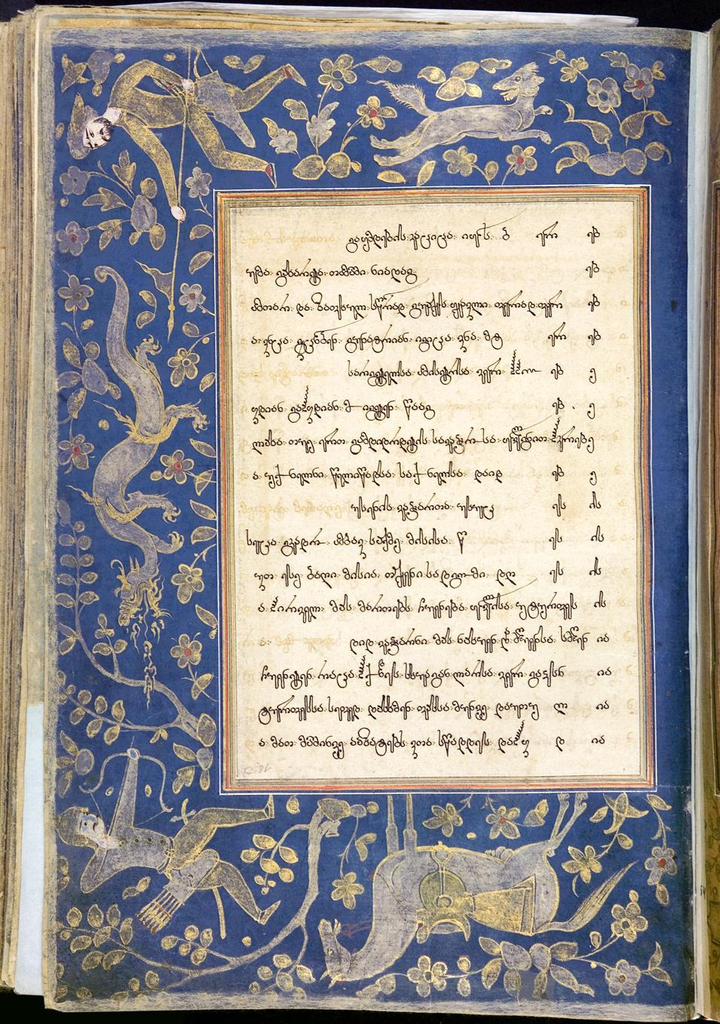
Above: Manuscript of The Knight in the Panther’s Skin
Rustaveli is generally regarded as the greatest poet of Georgia’s medieval Golden Age.
His epic, written in Georgian around the turn of the 13th century, has occupied a special place in the country’s literary and cultural life for centuries.
The poem was traditionally given to brides as part of their dowry, and generations of Georgians have learned passages by heart.
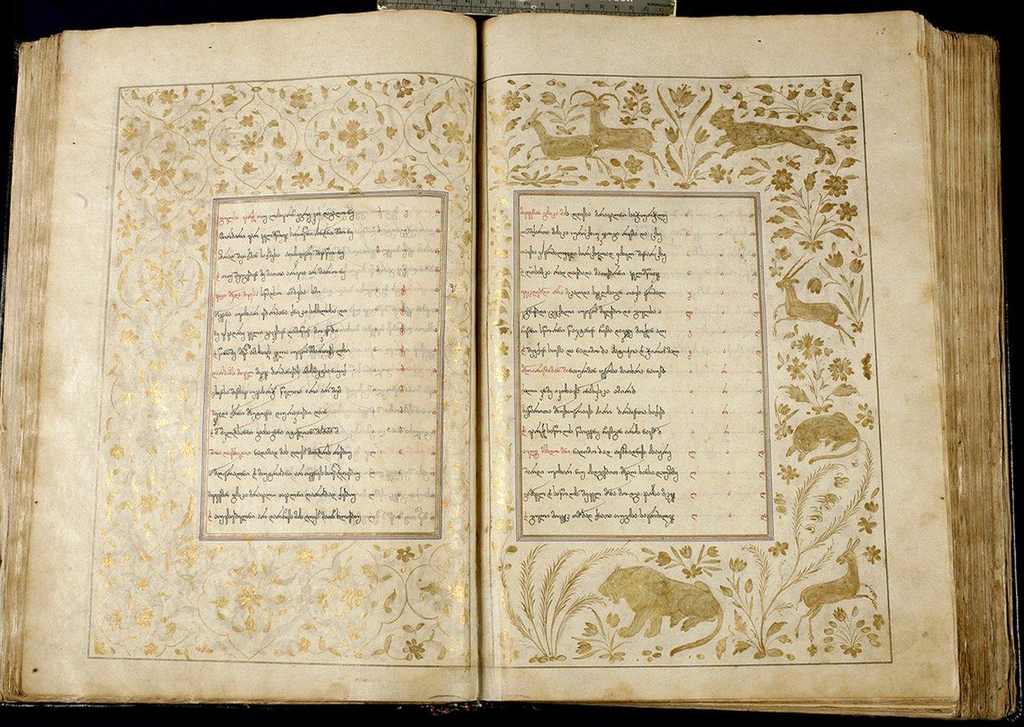
Above: The Knight in the Panther’s Skin
Its first printed edition appeared in 1712, under the patronage of King Vakhtang VI.
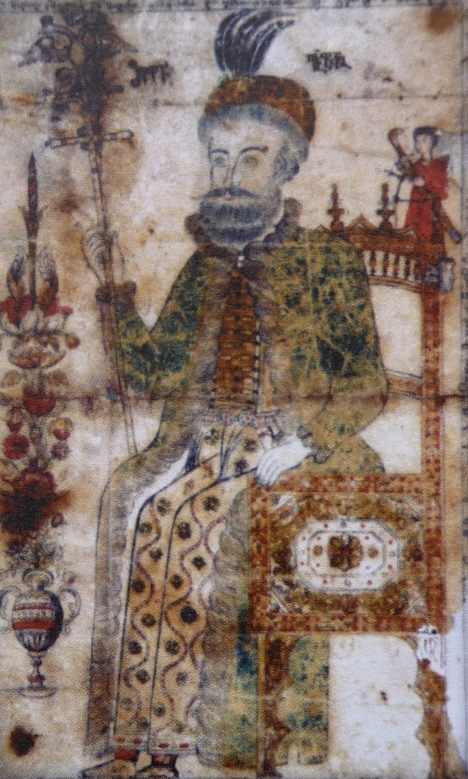
Above: Miniature depicting Vakhtang VI on his throne (1675 – 1737)
The English writer Fitzroy Maclean described it as:
“A fine allegorical poem of great breadth of vision, harmoniously fusing the currents of Neoplatonist philosophy and Eastern romance.“

Above: Scottish writer Fitzroy Maclean (1911 – 1996)
That is quite an introduction.
One might reasonably wonder whether the book could possibly live up to its reputation.

Above: Scenes from The Knight in the Panther’s Skin
Rustaveli’s presence in Georgia is difficult to miss.
Tbilisi’s principal thoroughfare is Rustaveli Avenue.

Above: Shota Rustaveli Avenue, Tbilisi, Georgia
There is a Rustaveli Theatre, a Rustaveli Metro Station and a Shota Rustaveli International Airport.
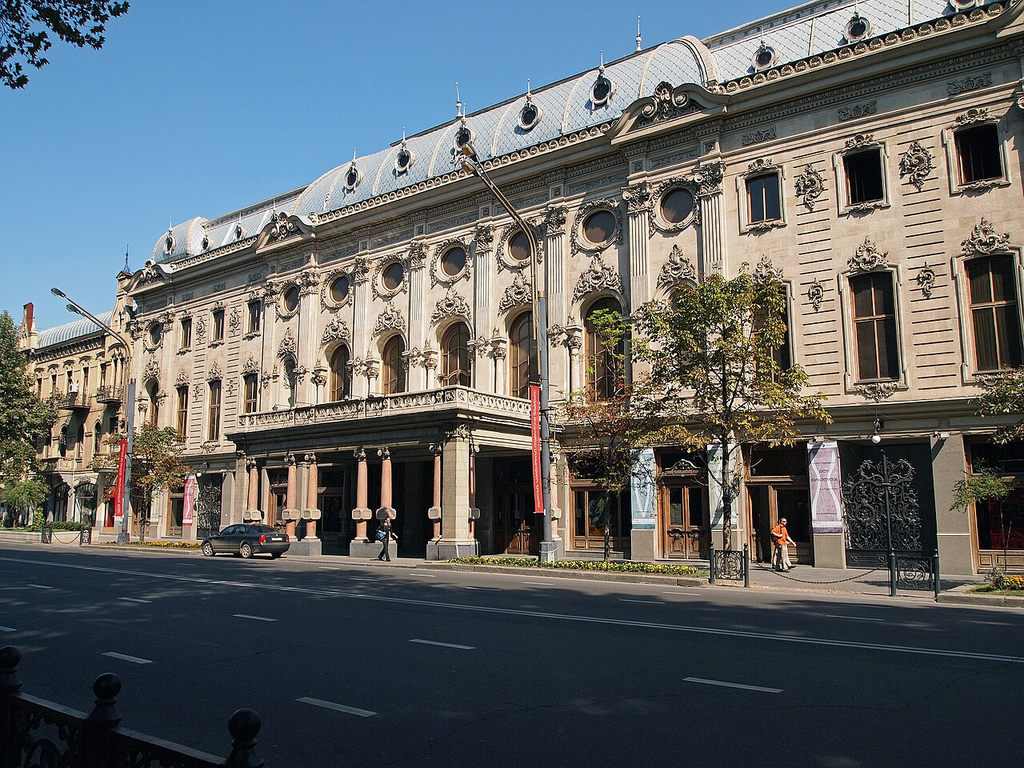
Above: Rustaveli National Theatre, Tbilisi, Georgia
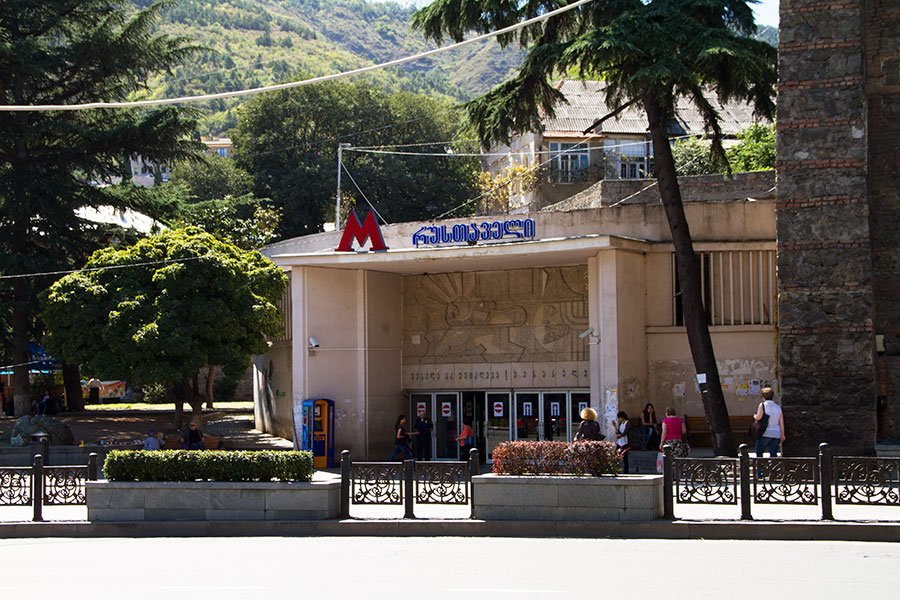
Above: Entrance vestibule to the Rustaveli Metro Station, Tbilisi, Georgia

Above: Shota Rustaveli Tbilisi International Airport, Tbilisi, Georgia
The country’s principal state prize for achievements in literature and the arts bears his name.
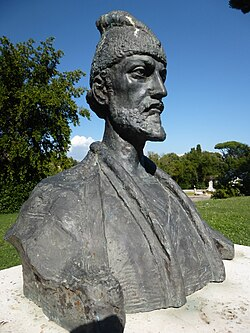
Above: Statue of Shota Rustaveli, Rome, Italy
His portrait appears on the 100-lari banknote.

Above: 100 Georgian lari banknote depicting Rustaveli
Streets bearing his name can be found in cities well beyond Georgia.

Above: Shota Rustaveli Street, Kyiv, Ukraine

Above: Shota Rustaveli Street, Tashkent, Uzbekistan

Above: Shota Rustaveli Park, Moscow, Russia

Above: Shota Rustaveli Street, Yerevan, Armenia
The Hungarian artist Mihály Zichy also became closely associated with the poem.
His 19th-century illustrations have helped generations of readers visualize its characters and adventures.

Above: Hungarian painter Mihály Zichy (1827 – 1906)
Rustaveli is not simply a poet whose work is studied.
He is part of the Georgian landscape.

Above: Shota Rustaveli Monument, Tbilisi, Georgia
Who was Shota Rustaveli?
Here, things become rather less certain.
Rustaveli’s biography is remarkably obscure.
He is traditionally associated with the court of Queen Tamar, who ruled Georgia from 1184 to 1213, during its period of greatest medieval power and cultural achievement.

Above: Georgian monarch Tamar the Great (1160 – 1213)
Rustaveli is often described as having served as the royal treasurer.
A portrait traditionally identified as Rustaveli survives in the Georgian Monastery of the Holy Cross in Jerusalem.

Above: Fresco of Rustaveli in the Monastery of the Cross in Jerusalem, Israel
Beyond such evidence, however, much of what we think we know comes from later tradition and legend.
One particularly romantic story suggests that Rustaveli fell in love with Queen Tamar, composed his epic in her honour, and, when his affection was not returned, took monastic vows and travelled to Jerusalem.
There he supposedly spent his final years and was buried.
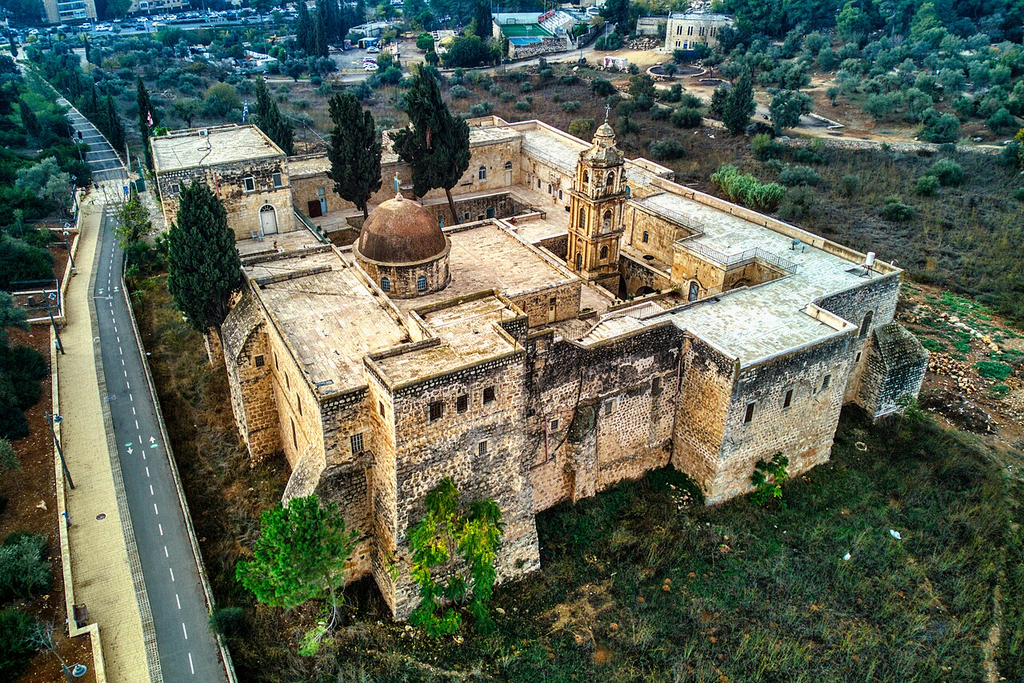
Above: Monastery of the Cross, Jerusalem, Israel
It is a wonderful story.
It is not, however, a reliably documented biography.

Above: Tamar the Great
The Jerusalem portrait itself has had a troubled history.
In 2004, it was vandalized, with the face and part of the accompanying Georgian inscription damaged.
The fresco and inscription were subsequently restored.
The portrait is an important part of Rustaveli’s historical association with the monastery, but it cannot establish all the details of the familiar romantic legend.
Perhaps the uncertainty is fitting.
We know considerably more about the world Rustaveli created than about the man who created it.
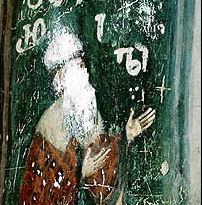
Above: Damaged fresco of Rustaveli
The Knight in the Panther’s Skin is a long poem, comprising more than 1,600 quatrains written in a distinctive sixteen-syllable metre.
Its setting is not Georgia.
Its principal characters are not Georgian.
They are not presented as Christians.
The story takes place in imaginary versions of Arabia and India.
This is not unusual in medieval literature, where distant and exotic settings provided opportunities for imaginative storytelling.
The poem’s prologue also acknowledges a Persian literary inheritance, describing the work as a Persian tale rendered into Georgian.
The precise nature of that inheritance remains a matter of scholarly discussion.
Persian literature clearly influenced Rustaveli’s style and literary conventions, although whether he adapted an existing story or created his own using Persian models is less certain.
There is something rather interesting about that.
A poem written in Georgian, which became one of the strongest expressions of Georgian cultural identity, draws heavily upon literary traditions beyond Georgia.
Perhaps that is one reason it has endured.
Cultural identity need not mean cultural isolation.
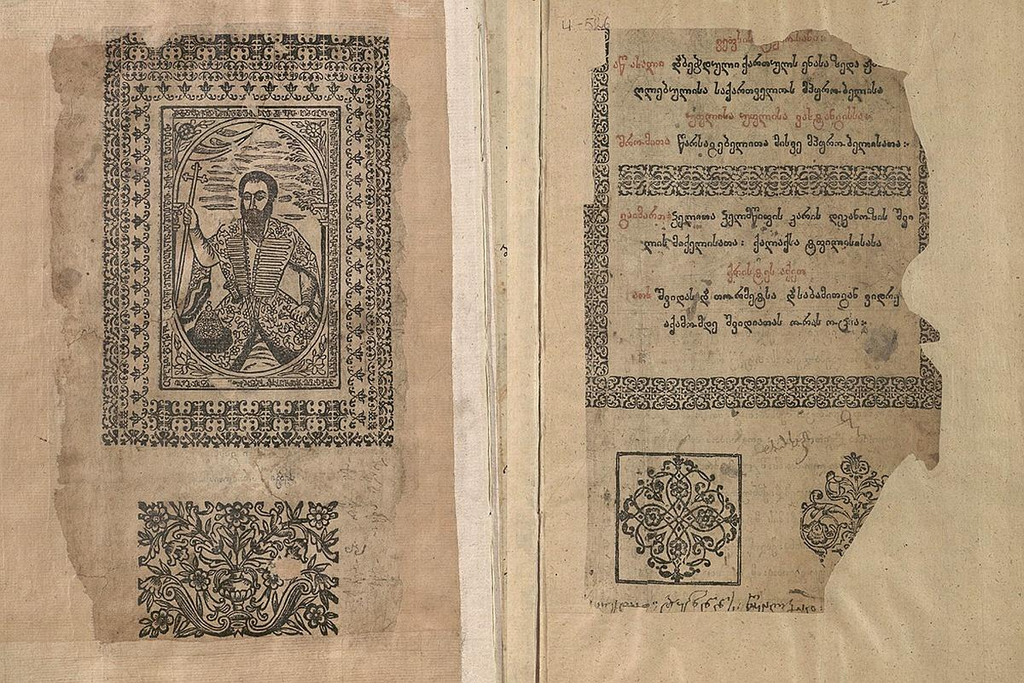
Above: The Knight in the Panther’s Skin
The plot is a romantic adventure involving two knights, two princesses, several kingdoms, a mysterious stranger, a kidnapping, a rescue mission and, eventually, a succession of happy marriages.

Above: Scene from The Knight in the Panther’s Skin
It is also, in many respects, a story about friendship.
The King of Arabia, Rostevan, has no sons.
He therefore appoints his only daughter, the beautiful and intelligent Tinatin, as his successor.
Tinatin is in love with Avtandil, one of the King’s leading knights.
During a hunting expedition, Rostevan and Avtandil encounter a mysterious knight dressed in the skin of a panther.
He is alone, weeping inconsolably.
When the King’s servants approach him, he kills them and disappears.
The King becomes obsessed with discovering the stranger’s identity.
Tinatin asks Avtandil to find him, promising to marry him if he succeeds.
After a lengthy search, Avtandil eventually discovers the knight living in a cave with a woman named Asmat.

Above: Conversation of Tariel with Avtandil (1966), Irakli Toidze
His name is Tariel, an Indian prince who has fallen desperately in love with Nestan-Darejan, the daughter of the King of India.
Tariel had hoped to marry Nestan, but her father had arranged her marriage to a prince from Khwarazm.
At Nestan’s request, Tariel killed the intended bridegroom.
Nestan was subsequently sent away and eventually disappeared.
Unable to find her, Tariel withdrew from the world, consumed by grief.

Above: Scene from The Knight in the Panther’s Skin
Moved by his story, Avtandil promises to help him find Nestan.
This is no small undertaking.
Avtandil already has a future with Tinatin and his departure means defying the wishes of his own King.
Nevertheless, he leaves.
His search takes him to the kingdom of Phridon and then to the city of Gulansharo, where he discovers that Nestan is being held captive by the mysterious Kaji.
Eventually, Avtandil, Tariel and Phridon join forces.
With an army of 300 men, they attack the fortress, rescue Nestan and restore the lovers to one another.

Above: Liberation of Nestan-Darejan (1966), Irakli Toidze
Avtandil marries Tinatin.
Tariel marries Nestan.
Phridon returns to his own kingdom.
Everybody lives happily ever after.
Well, almost everybody.
The villains have a less satisfactory conclusion.
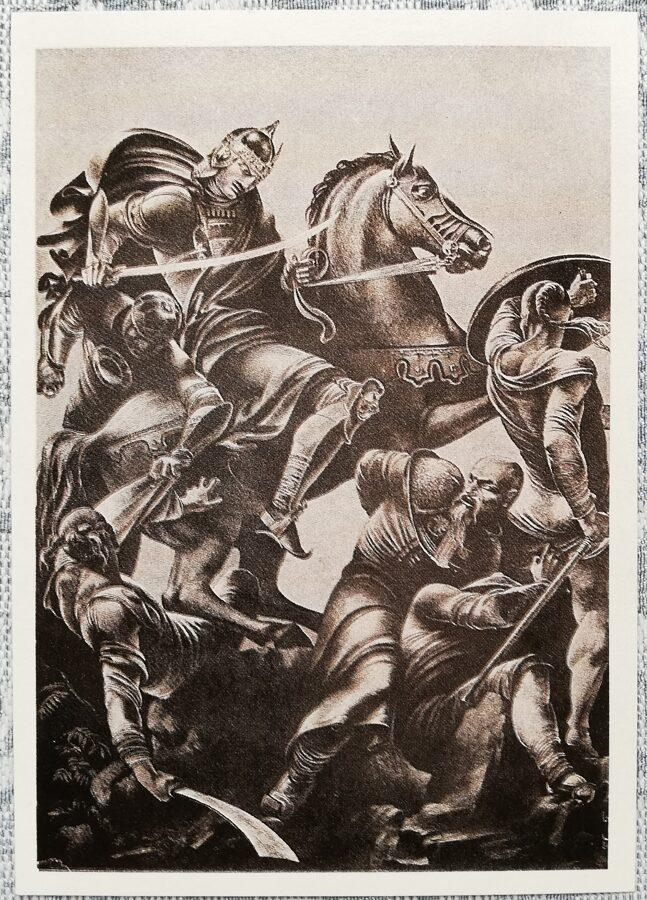
Above: Battle of Tariel with the Hatays (1978), Sergo Kobuladze
And there are an awful lot of tears along the way.
The knights are courageous warriors, but they also cry with extraordinary enthusiasm.
Their grief is frequently expressed in extravagant language, and the tears are not confined to the protagonists.
Entire populations seem capable of weeping at the departure of a friend.
It is rather refreshing to encounter medieval heroes who are not afraid to show their emotions.
Perhaps the poem is melodramatic.
Perhaps Rustaveli understood that courage and vulnerability are not mutually exclusive.
And perhaps we should not take every tear quite so seriously.

Above: The Knight in the Panther’s Skin
Why did Rustaveli write it?
The poem is not simply an adventure story.
Rustaveli uses the lives of his characters to explore love, friendship, loyalty, courage, responsibility and the proper conduct of human beings.
He begins by discussing poetry itself:
“Poetry is a branch of wisdom, a divine thing, that benefits those who hear it.“
For Rustaveli, poetry is not merely entertainment or an opportunity for a writer to demonstrate technical skill.
It should communicate something worthwhile.
It should combine artistic expression with emotional and intellectual substance.
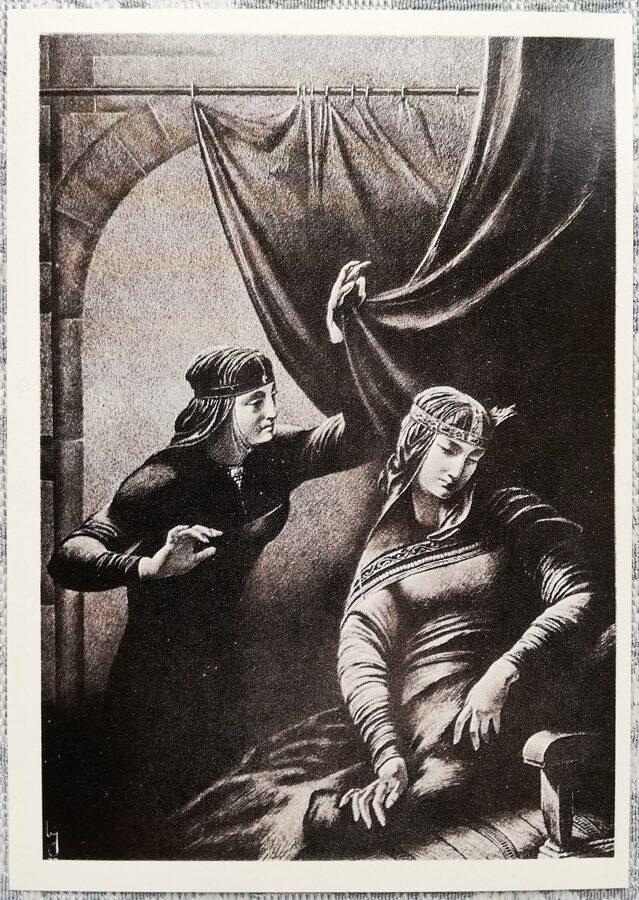
Above: Nestan-Darejan, hidden in the Fatman House (1978), Sergo Kobuladze
Rustaveli also considers the responsibilities of individuals.
A labourer should work.
A warrior should demonstrate courage.
A lover should remain faithful.
People should take their respective responsibilities seriously rather than disparaging others for fulfilling theirs.
There is a moral philosophy here:
We should recognize the value of different contributions to society.
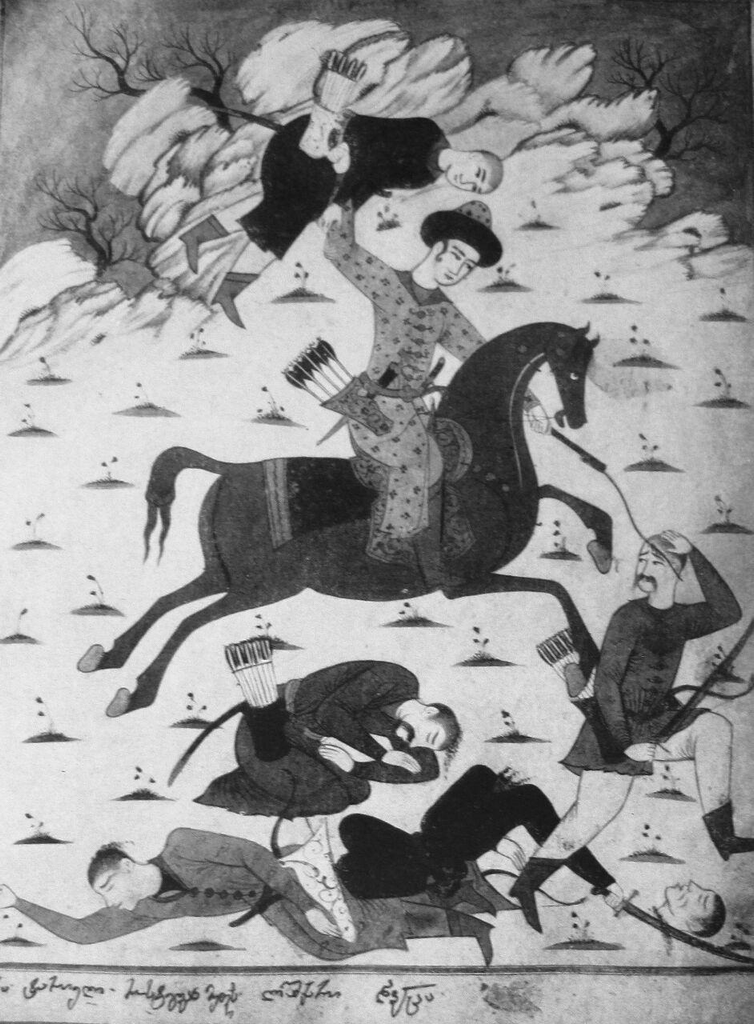
Above: Tariel killing Rostevan’s soldiers, 17th century Georgian miniature
Rustaveli also distinguishes genuine love from mere physical desire.
His understanding of love encompasses divine love, earthly passion and a higher form of human affection.
True love requires constancy, loyalty and endurance.
It is not simply an emotion that appears when circumstances are favourable and disappears when they become difficult.
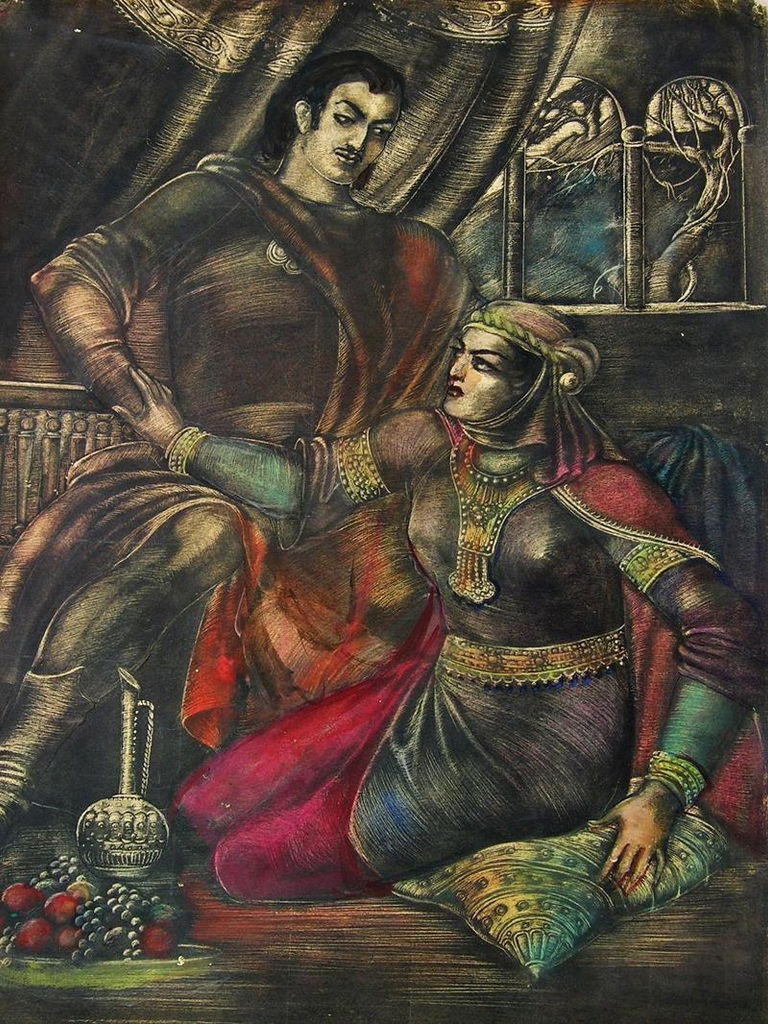
Above: Scene from The Knight in the Panther’s Skin
He also writes of friendship as something that demands action.
Avtandil does not merely sympathize with Tariel.
He places himself at risk to help him.
He is prepared to sacrifice his own comfort, security and immediate happiness to honour a promise made to a friend.
Rustaveli could have written a philosophical treatise about love, loyalty, courage and friendship.
Instead, he tells us a story.
He gives us Tariel, overwhelmed by grief and unable to rescue the woman he loves.
He gives us Avtandil, who risks his own happiness and position to help a friend.
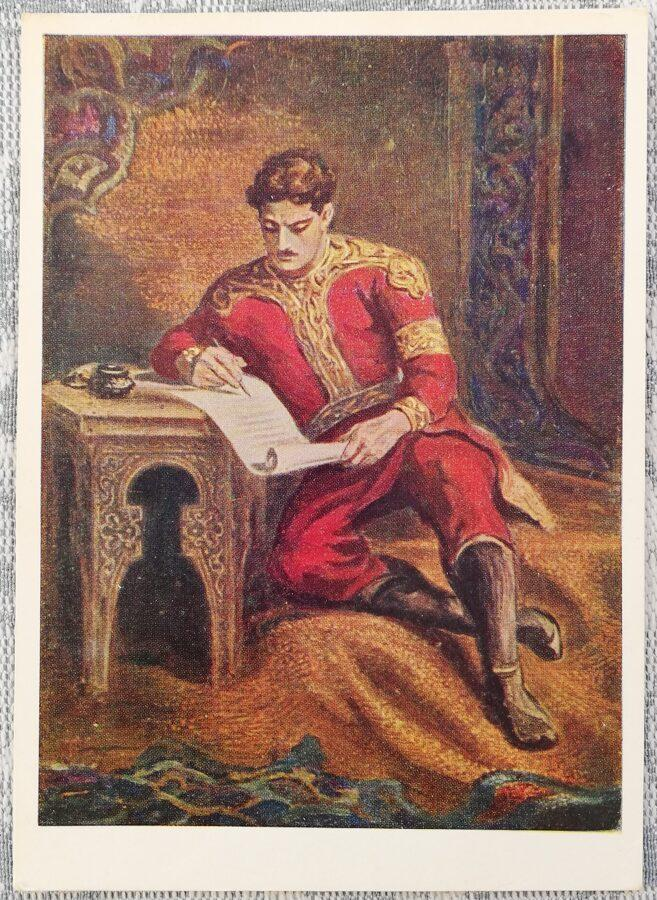
Above: Avtandil writes a testament (1966), Irakle Toidze
He gives us Tinatin and Nestan, women who exercise their right to choose their partners.
He gives us kings, warriors, merchants, servants and strangers.
In other words, he places his ideas into the lives of characters.
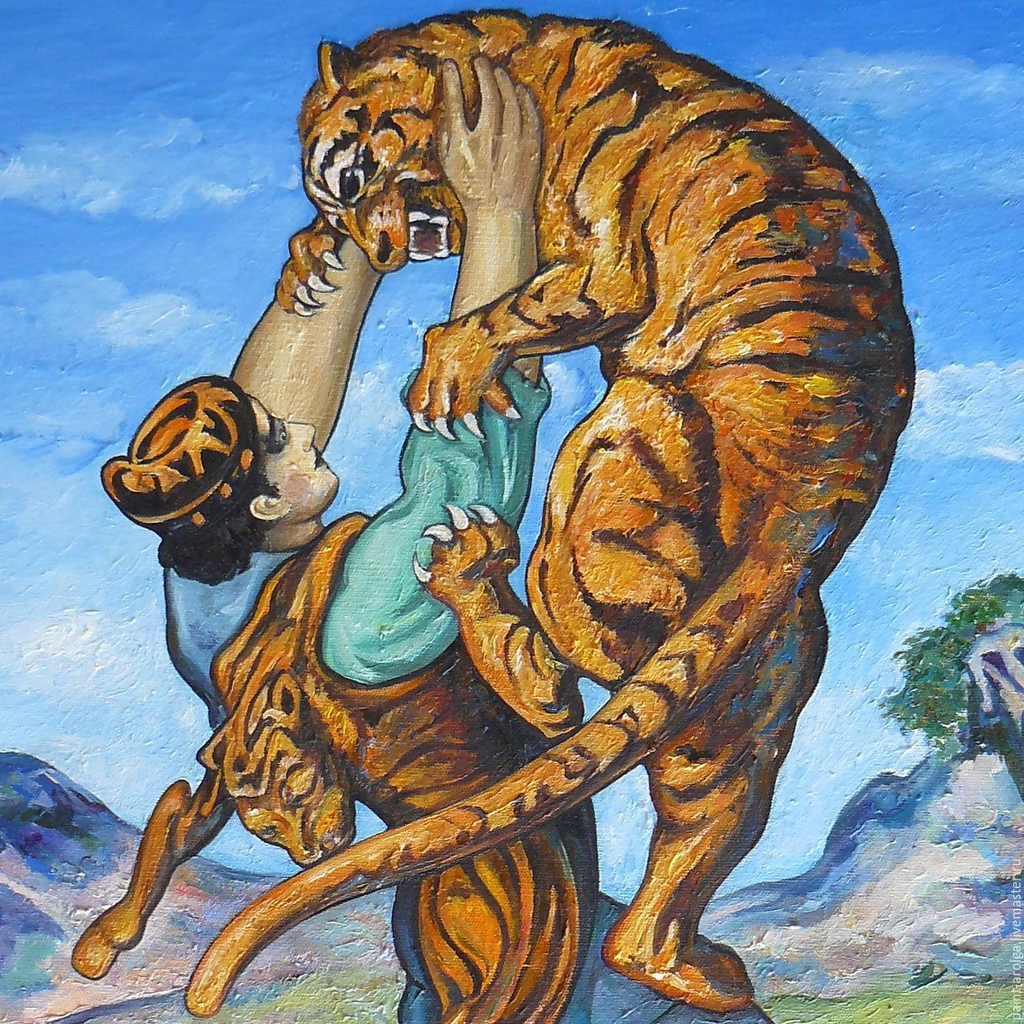
The relationship between Avtandil and Tariel is the central driving force of the poem.
Their friendship helps Tariel move beyond despair towards reasoned action and collaboration.
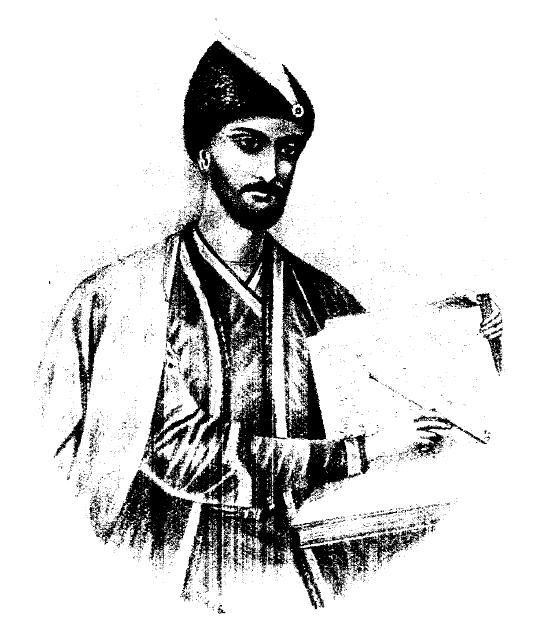
Above: Shota Rustaveli
The story also presents a world in which people from different kingdoms and religious backgrounds can recognise one another’s humanity.
The principal characters are Muslim, yet the poem was written in Christian Georgia.
Rustaveli’s moral universe is not confined by the religious identity of its characters.
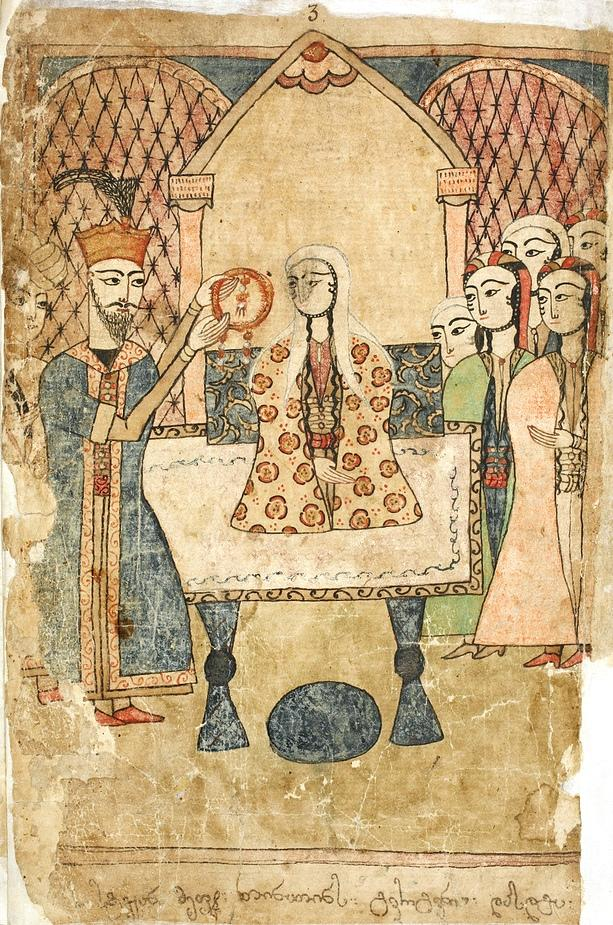
Above: Scene from The Knight in the Panther’s Skin
There are also striking ideas about women and authority.
Tinatin inherits her father’s kingdom, while Nestan resists a marriage arranged against her wishes.
These are notable features of a medieval romance, although the women do not always enjoy the same freedom of action as the male heroes.

Above: Scene from The Knight in the Panther’s Skin
The poem’s political philosophy is less radical.
Rustaveli favours strong and capable rulers, but expects them to govern with justice and prudence.
It is a complex mixture of ideals, conventions and contradictions.
That is perhaps what makes it interesting.

Above: Scene from The Knight in the Panther’s Skin
Why read it?
I have watched four YouTube videos, consulted Wikipedia and accumulated enough competing interpretations to make reading the original seem almost unnecessary!

A small confession:
Sometimes the research surrounding a book becomes a substitute for actually reading it.

Above: Logo of Wikipedia
I read Marjory Scott Wardrop’s English translation, published in 1912.
Wardrop devoted many years to the work, but died before completing it.
Her translation is in prose and the language can feel rather dated to a modern reader.

Above: English scholar/translator Marjory Wardrop (1869 – 1909)
There are, of course, limitations to reading poetry in translation.
The original Georgian metre, wordplay and linguistic intricacies cannot simply be transferred into English.

Nevertheless, I found myself asking a more fundamental question.
Why should I read this book?
Not because every Georgian is expected to admire it.
Not because it is eight centuries old.
Not because it has been declared a national masterpiece.
I wanted to discover whether there was something in Rustaveli’s writing that might still have meaning for someone living in the 21st century, in a country far removed from medieval Georgia.
The answer, I think, lies in the questions the poem raises about human relationships.
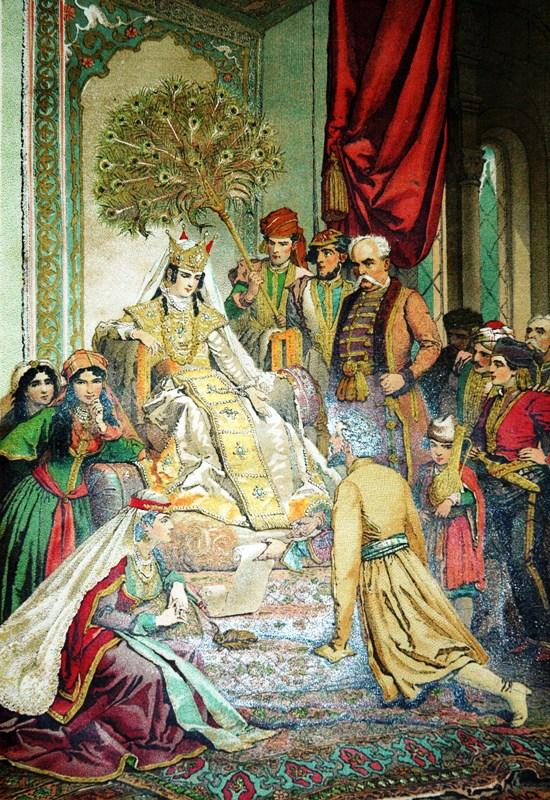
Above: Obeyance to Tamar
Is goodness worthwhile when it is not reciprocated?
I cannot deny that my own personal history clouds my judgement on this work.
I have not been particularly acquainted with the reciprocity that relationships with others are said to reward.
To love in the manner Rustaveli describes has merit, but is that merit rewarded?
I wonder.
It is one thing to admire a knight who risks everything for a friend, or a lover who remains faithful through years of separation.
It is quite another to practise those virtues in ordinary life, where people can be inconsistent, self-interested, disappointing or simply unable to return what we give.
Is an act of kindness, loyalty or love worthwhile in itself?
Does the person who gives receive affection, loyalty or consideration in return?
Does behaving this way make one’s life better?
Or can it leave one exposed to exploitation and disappointment?

Above: Image of Shota Rustaveli
Rustaveli’s world tends to bring virtue and happiness into alignment.
The faithful lovers are reunited.
The loyal friends triumph.
The kingdoms enjoy peace.
But life doesn’t always arrange such satisfying conclusions.
A person can love faithfully and not be loved in return.
A person can demonstrate extraordinary loyalty to someone who takes it for granted.
A person can behave honourably and still lose.
I wouldn’t pretend otherwise.

Above: Scene from The Knight in the Panther’s Skin
I would distinguish cynicism from skepticism.
Cynicism says that generosity is ultimately foolish, loyalty is usually exploited and love is an illusion.
Skepticism asks whether those things are actually true, and under what circumstances.
I would encourage the latter.

Above: An introduction to the erotic and romantic art of Mihály Zichy, the collector.com
You needn’t approach Rustaveli as someone seeking confirmation that his ideals work.
You can approach him as someone asking whether they work, what they cost and whether they need qualification.
Indeed, there is a potentially fascinating tension between the poem’s idealism and the experience of a modern reader who has discovered that reciprocity cannot be guaranteed.
Perhaps his philosophy becomes more interesting when we test it against modern experience rather than accept it wholesale.
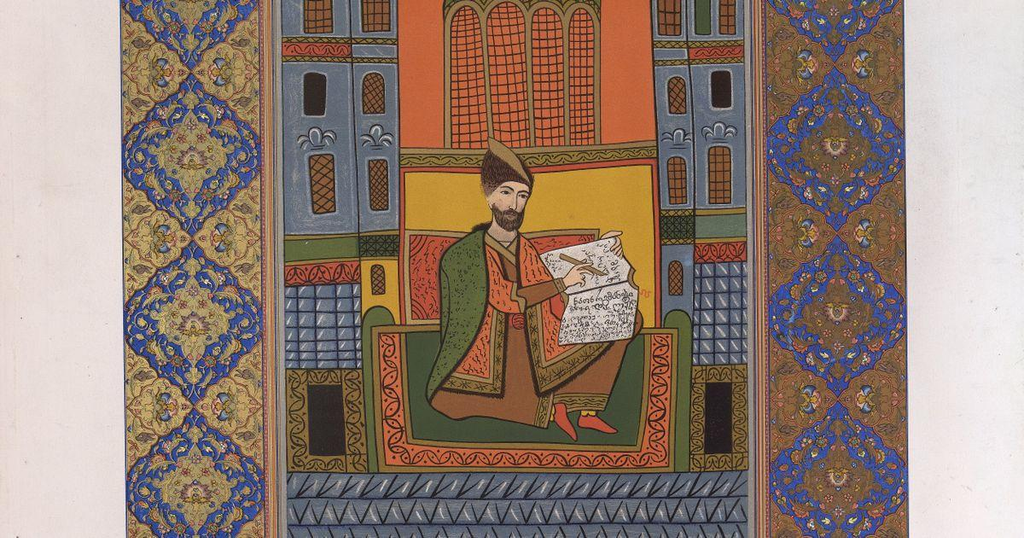
Above: Shota Rustaveli
Can we love without possessing or controlling another person?
How much should we sacrifice for a friend?
When does loyalty become an excuse for tolerating disrespect?
Is it sometimes more courageous to walk away?
Can we give freely without creating an obligation or expectation?
Can we preserve our dignity when others fail to respect us?
These questions don’t necessarily reject Rustaveli’s values.
They ask how those values might be practiced without abandoning our own well-being.
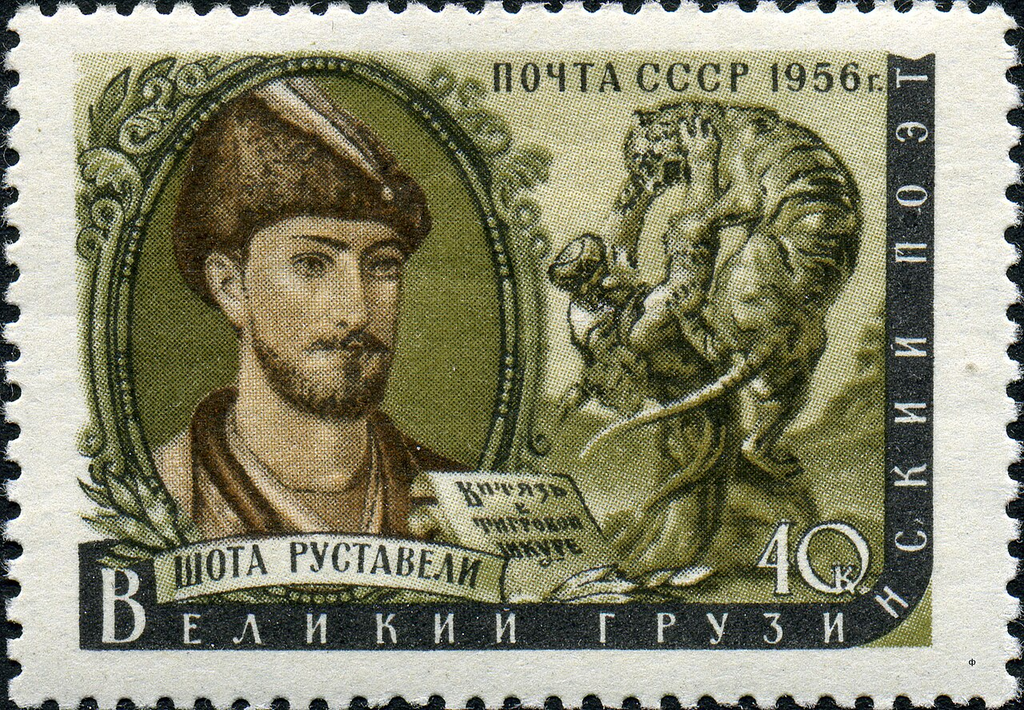
Above: Rustaveli stamp (1956), Russia
We can wish somebody well without inviting them back into our lives.
We can forgive without restoring trust.
We can remain capable of love without accepting a relationship that diminishes us.
That, to me, is a worthwhile modern application of the poem’s moral concerns.

Above: Rustaveli bust, Budapest, Hungary
What survives?
I would tentatively reduce the poem’s philosophy to four propositions.
Love requires commitment.
It is not simply an emotion but a willingness to endure difficulty for another person.
Friendship requires action.
Loyalty means being prepared to help when doing so is inconvenient or personally costly.
Courage requires responsibility.
Strength is not merely the ability to defeat an enemy. It is the willingness to act honourably.
Human worth is not confined by cultural or religious identity.
The poem’s moral universe includes people from different kingdoms and religious backgrounds. Its characters are not required to share the same origins to recognise their obligations to one another.
You don’t have to be Georgian to appreciate a story about friendship.
You don’t have to be Christian to appreciate its moral questions.
You don’t have to be a medieval knight to understand the difficulty of doing the right thing when it conflicts with your own interests.
The historical setting is specific.
The human questions are not.
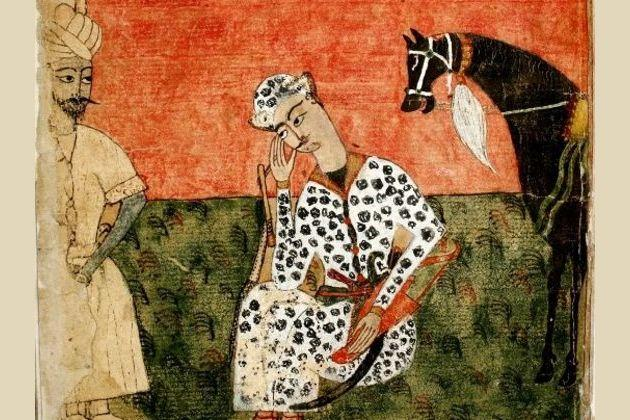
Above: Scene from The Knight in the Panther’s Skin
Does a book deserve to be read because it is considered great?
Or does it become great because generations of readers have found something worth returning to?

Perhaps Rustaveli’s real subject is not love, friendship or heroism individually, but the responsibilities we acquire through our relationships with other people.
That would bring almost everything together without requiring us to write an encyclopaedia of medieval Georgian literature.
Eight centuries ago, a Georgian poet created a world in which loyalty, generosity, courage and love were qualities worthy of admiration.
His characters endure extraordinary hardships for one another, apparently confident that such devotion has meaning.
But does it?

Above: Memorial monument for Shota Rustaveli near the Monastery of the Holy Cross in Jerusalem
Is love still virtuous when it is unreturned?
Is loyalty admirable when it is exploited?
And can generosity survive without reciprocity?

Above: Shota Rustaveli
I don’t think we should dismiss Rustaveli because his world offers happier endings than our own.
Nor should we accept his ideals simply because generations have admired them.
Perhaps the modern reader’s task is to discover which of those ideals remain worth pursuing, and how to pursue them without losing sight of our own dignity.

Above: Shota Rustaveli
I arrived in Georgia knowing nothing about Shota Rustaveli.
I leave this particular road with more questions than answers.
That may be a reasonable outcome for a journey through literature.
And perhaps that is why the book deserves to be read.

Above: Bus station, Batumi, Adjara, Georgia
